
Last updated on June 3rd, 2026 at 02:55 pm
Lab relocations for laboratory management are among the most complex operational challenges a facility can face. Unlike a standard office move, relocating a lab means handling sensitive instruments, irreplaceable samples, hazardous chemicals, and strict regulatory requirements – all at once.
Here is what successful lab relocation management involves:
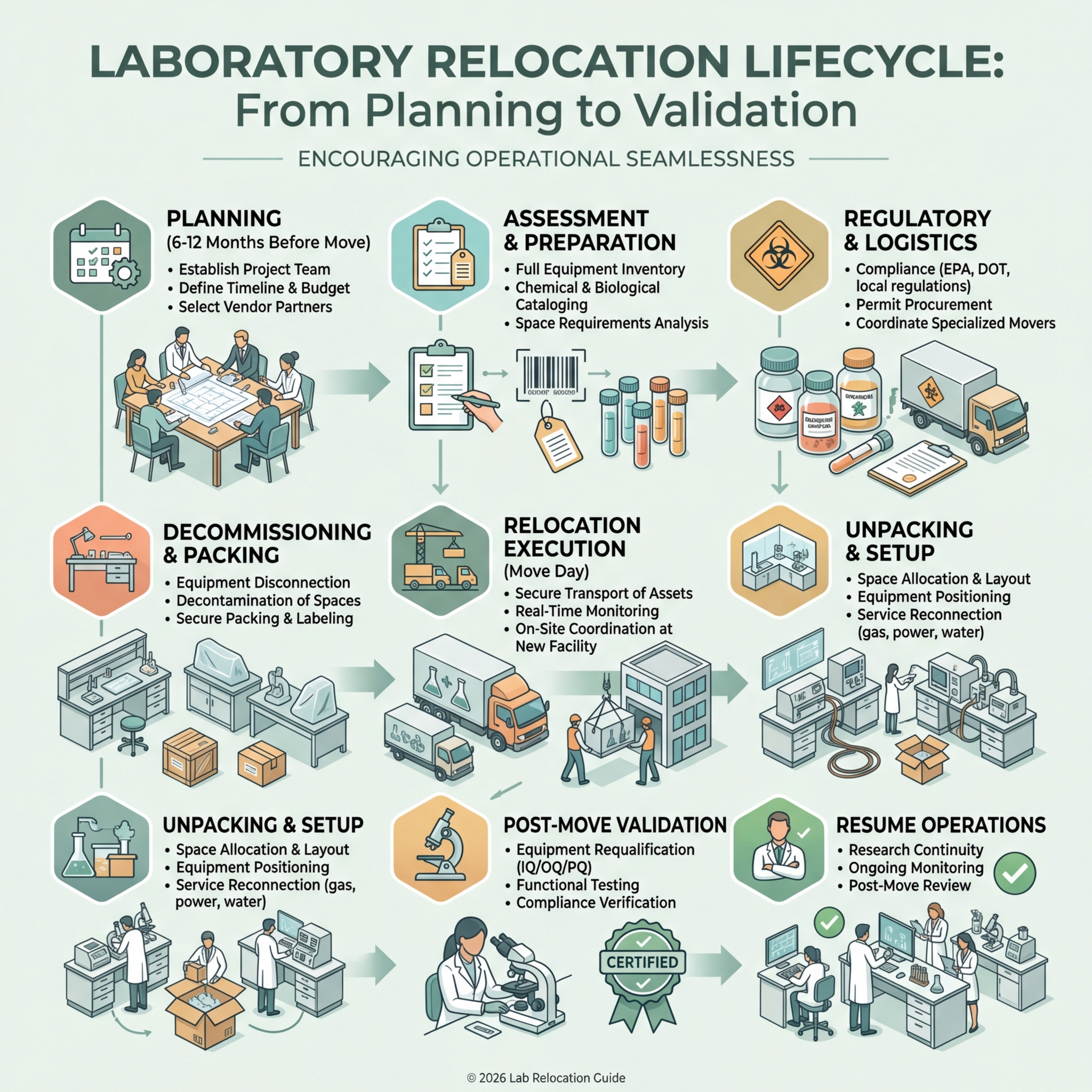
- Start planning 6-12 months in advance – most moves require four to six months of planning before a single piece of equipment is touched
- Conduct a full inventory assessment – catalog every piece of equipment, reagent, and sample
- Assemble a cross-functional team – include lab leadership, safety officers, IT, and facilities managers
- Manage hazardous materials and waste – comply with EPA, DOT, and relevant transport regulations
- Coordinate specialized movers – standard movers cannot safely handle lab-grade instruments
- Validate and requalify equipment post-move – confirm compliance and functionality before resuming operations
The stakes are high. Lab relocation can be complicated and costly, especially when research materials, regulated substances, and delicate instrumentation are involved.
Rapidly evolving sectors like biotech, pharmaceutical, and life sciences are constantly outgrowing their facilities – or rightsizing to cut costs. A poorly managed move can disrupt research timelines, trigger compliance violations, and destroy years of work. A well-managed one can support continuity, reduce risk, and help teams return to work faster.
This guide walks through every phase of the process – from early planning to post-move validation – so your team can relocate with confidence and minimal disruption. For readers seeking a neutral overview of laboratory operations and safety controls, the Occupational Safety and Health Administration’s laboratory safety guidance provides useful background on compliance expectations that often affect move planning.
Strategic Planning For Lab Relocations For Laboratory Management
A successful laboratory move is never an accident; it is the result of meticulous, long-term strategy. When organizations in New England — from the biotech hubs of Boston and Worcester to the research corridors in Manchester, New Hampshire, and Portland, Maine — decide to move, they aren’t just shifting boxes. They are relocating years of intellectual property and delicate physical assets.
The primary reasons organizations choose to relocate are often strategic. They may be pursuing growth goals that require larger footprints, or they may be seeking specialized facilities that better align with their current research mission. In some cases, a move is driven by the need to consolidate multiple disjointed lab structures into a centralized campus to foster better collaboration and innovation.
The Planning Window And Timeline
How far in advance should lab relocation planning begin? Expert consensus suggests that for complex facilities, a 6- to 12-month timeline is standard. A typical laboratory relocation can take four to six months of planning before a single piece of equipment is even moved. This lead time is necessary to conduct on-site surveys, secure specialized vendors, and navigate the maze of regulatory permits required in states like Massachusetts and Rhode Island.
For local moves within a city, such as moving between facilities in Bangor or Lewiston, Maine, a shorter window of 4 to 6 weeks might suffice for the physical move itself, but the behind-the-scenes preparation remains extensive. During this period, identifying “move captains” is essential. These individuals serve as the bridge between lab staff and the relocation team, ensuring that every department’s unique needs are heard and addressed.
Risk Assessment And Stakeholder Communication
Before any packing begins, a thorough risk assessment must be performed. This involves identifying high-value assets, irreplaceable samples, and potential points of failure — such as the length of a freezer cord or the specific power requirements of a mass spectrometer.
Effective communication is the glue that holds a relocation project together. Regular meetings involving internal teams, vendors, and facilities managers prevent “change order” surprises and keep the project on budget. For those in the early stages, reviewing the 5 Important Factors to Consider Before Moving Your Lab can help identify potential pitfalls before they become expensive problems.
Essential Steps in Lab Relocations for Laboratory Management
Creating a comprehensive lab relocation plan requires a phased approach. It starts with a deep dive into what the lab actually contains.
Inventory Assessment and Documentation Teams should conduct a thorough inventory assessment of all equipment, samples, and materials. This is more than just a list; it involves populating a Master Equipment List (MEL) and a Master Instrument List (MIL). Each item should be tagged with its destination in the new facility, often using color-coded labels to match equipment to specific lab zones.
Asset Appraisal and Surplus Liquidation Relocation is the perfect time for an “equipment audit.” Organizations should decide whether to retain, resell, or retire assets. Strategic liquidation of surplus equipment can recover capital and simplify the layout of the new space. In many cases, laboratories combine their move with equipment upgrades, utilizing refurbished systems to hit the ground running in the new location.
Managing Timelines and Personnel During Lab Relocations for Laboratory Management
One of the greatest challenges in lab relocations for laboratory management is balancing the move with ongoing research. Operational downtime is the enemy of productivity.
To minimize this, many labs opt for phased moves. This strategy allows some departments to remain operational while others transition, ensuring that critical research doesn’t grind to a halt. Staggering workstation relocations and ensuring IT infrastructure is live at the new site before the move begins are best practices for a quick return to productivity.
Personnel stress is another factor that shouldn’t be overlooked. Moving is inherently disruptive. Maintaining morale requires clear communication about roles and a realistic understanding of the timeline. Providing staff with a clear roadmap, such as the one found in Lab Relocation 5 Things You Need to Know, can reduce anxiety and keep the team focused on the scientific mission.
Technical Logistics and Specialized Equipment Handling
Moving a laboratory is not a “white glove” furniture move; it is a technical operation. Specialized movers are required to handle sensitive instrumentation that may be susceptible to shock, tilt, or temperature fluctuations.
Specialized Considerations for Sensitive Equipment
Instruments like HPLCs, GCs, and electron microscopes require more than just bubble wrap. They often need custom crating tailored to their exact dimensions. Furthermore, many of these instruments require decommissioning by certified technicians or Original Equipment Manufacturer (OEM) engineers to preserve warranties and ensure they can be successfully recommissioned at the new site.
Cold Chain Logistics and Sample Integrity
Perhaps the most nerve-wracking part of any lab move is transporting temperature-controlled samples. Whether it is reagents kept at +4°C or biological specimens stored in cryogenic conditions at -196°C, the cold chain must remain unbroken.
Best practices include:
- Using real-time temperature monitoring with Wi-Fi-enabled devices.
- Having redundancy in place, such as backup freezers and extra dry ice.
- Utilizing specialized trucks with on-board power for Ultra-Low Temperature (ULT) freezers.
Losing a decade of research due to a failed compressor or a short power cord is a nightmare scenario that proper planning can prevent.
Protecting Research Integrity and Data
The physical move is only half the battle; the data must follow safely. This involves more than just moving servers. It requires a robust plan for IT infrastructure and data safeguarding.
Chain Of Custody For labs involved in clinical trials or forensic research, maintaining a documented chain of custody is non-negotiable. Every sample and data drive must be tracked from the moment it leaves the old bench until it is secured in the new facility. This level of documentation is critical for regulatory audits and for maintaining the integrity of the research itself.
Regulatory Compliance and Hazardous Material Management
Navigating the regulatory landscape is perhaps the most daunting aspect of lab relocations for laboratory management. In New England, labs must adhere to a complex web of local, state, and federal regulations.
Navigating Permits and Transport Rules
Relocating hazardous materials requires strict adherence to Department of Transportation (DOT) and Environmental Protection Agency (EPA) standards. You cannot simply put chemicals in the back of a personal vehicle and drive from Boston to Springfield.
Specific permits are often required for the transportation of:
- Flammable liquids and solids.
- Oxidizers and organic peroxides.
- Toxic and infectious substances.
- Radioactive materials.
Ensuring compliance means working with partners who understand the nuances of Planning Laboratory Move, Safe Chemical Transportation, and can identify What Hazardous Materials Should Be Transported Lab Pack.
Lab Decommissioning and Chemical Disposal
Before a lab can be fully “closed,” it must be decommissioned. This is a formal process that ensures the old facility is safe for its next occupant and that the departing organization is free from future environmental liability.
Chemical Lab Packs: One of the most efficient ways to manage chemicals that aren’t moving to the new site is to use a Chemical Lab Pack. This process involves a professional team coming to your site, identifying various chemicals, and safely consolidating them into DOT-approved containers for disposal. This is especially useful for handling “legacy” chemicals or problematic items, such as peroxidized ethers and corroded cylinders, that may have been tucked away in a cabinet for years.
Understanding What Needs to Know: Lab Decommissioning is vital for any lab manager to ensure that no stone is left unturned — and no liability is left behind.
Post-Move Validation and Operational Readiness
Once the equipment has arrived at the new facility in Manchester, NH, or Burlington, VT, the work is far from over. The final phase of lab relocations for laboratory management is ensuring that everything works exactly as it did before the move.
Requalification and Testing
In regulated environments, such as those following Good Manufacturing Practices (GMP) or Good Laboratory Practices (GLP), equipment must undergo formal validation. This usually involves:
- Installation Qualification (IQ): Verifying the equipment is installed correctly.
- Operational Qualification (OQ): Ensuring the equipment operates within specified limits.
- Performance Qualification (PQ): Confirming the equipment performs consistently under actual research conditions.
This process ensures that the move hasn’t introduced “calibration drift” or other technical issues that could skew research results.
Safety Walk-Throughs and Final Inspections
Before the lab is fully “live,” a safety walk-through is essential. This check ensures that fume hoods are drawing correctly, emergency showers and eyewash stations are functional, and that all hazardous materials are stored according to their compatibility.
Addressing any “punch list” items — such as minor electrical tweaks or plumbing adjustments — immediately prevents them from becoming long-term frustrations.
Frequently Asked Questions About Lab Relocation
How Far In Advance Should We Start Planning?
For most laboratories, planning should begin 6 to 12 months before the “go live” date. This allows sufficient time for inventory assessment, vendor selection, and obtaining the necessary regulatory permits. Even for local moves within New England, a minimum of 4 to 6 months is recommended to ensure a smooth transition.
How Do We Minimize Operational Downtime?
The most effective way to minimize downtime is through a phased move approach. By moving departments in stages and ensuring that IT and utilities are fully functional at the new site before equipment arrives, you can maintain research continuity. Additionally, scheduling calibrations and requalifications immediately upon arrival helps get instruments back online quickly.
What Are The Biggest Risks During A Lab Move?
The primary risks include damage to sensitive equipment, loss of sample integrity due to cold chain failure, and regulatory non-compliance. These can be mitigated by hiring specialized lab movers, using real-time temperature monitoring for specimens, and partnering with hazardous waste experts who understand DOT and EPA regulations.
Partner with Maine Labpack for a Seamless Lab Relocation
Relocating a laboratory is a monumental task, but it doesn’t have to be a disastrous one. By starting early, building a cross-functional team, and focusing on the technical details of equipment and hazardous material management, organizations can transition to their new homes with minimal stress.
Whether you are expanding into a larger space in Boston or consolidating research facilities in Portland, Maine Labpack is here to help. As a New England-based hazardous waste management company, they specialize in professional, on-time, and sustainable chemical disposal. They act as a one-stop shop, coming directly to your site to handle the complexities of chemical consolidation and disposal so you can focus on your science.
To learn more about safe chemical management during your move, check out The Lab Pack Lowdown: Everything You Need to Know About Chemical Consolidation or the Pocket Guide Lab Pack Disposal Safety Requirements.
Ready to ensure your move is as safe and compliant as possible? Explore our hazardous waste disposal solutions today!