

Understanding What a Chemical Lab Pack Is and Why It Matters
If you work in a laboratory, hospital, school, manufacturing facility, or any business that uses chemicals, you probably have expired reagents, off-spec materials, or damaged containers sitting in storage. You can’t pour them down the drain or toss them in regular trash—that’s illegal under EPA and RCRA regulations.
Lab packing solves this problem. It allows you to combine many different small chemical containers into one properly packaged drum for safe removal. The process involves identifying each chemical, segregating by compatibility, and packing with absorbent materials to prevent leaks during transport.
According to OSHA, there are approximately 35,000 labs in the United States generating these small-volume hazardous wastes. Without proper disposal methods like lab packing, facilities risk serious fines—like the $150,000 penalty MIT faced in 1998 when 56 of their 114 laboratories violated RCRA, Clean Water Act, and Clean Air Act regulations.
This guide walks you through everything you need to know about chemical lab packs—from understanding what qualifies as lab pack waste to the step-by-step packing process, regulatory requirements, and why professional services often make the most sense for busy facilities.
What Is a Chemical Lab Pack, and Why Is It Necessary?
At its core, understanding what a chemical lab pack is involves looking at the logistics of waste management. In a typical laboratory or industrial setting, you don’t just have one giant vat of waste; you have hundreds of small jars, bottles, and vials. Shipping these individually would be a logistical nightmare and prohibitively expensive.
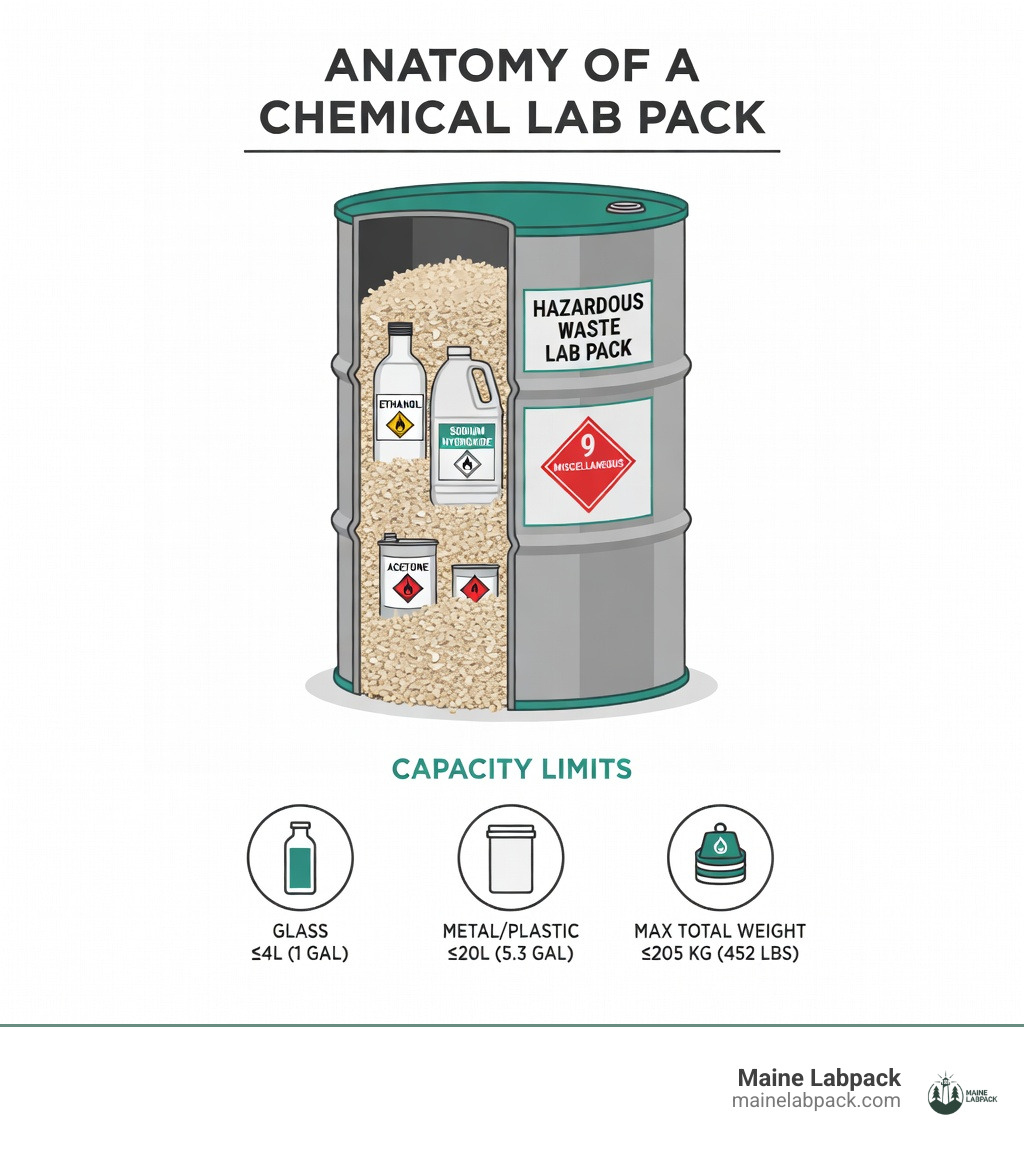
A lab pack acts as a “container for containers.” It is an outer package—most often a 55-gallon drum made of steel, plastic, or fiber—that holds smaller, intact containers of chemicals. To ensure these small containers don’t break or react during transit, they are surrounded by an absorbent, chemically inert material such as vermiculite. This material serves two purposes: it cushions bottles against road bumps and acts as a secondary containment system in case a bottle leaks.
This process is necessary because mixing different chemical wastes into one large tank (a process called “bulking”) can be extremely dangerous if the chemicals are incompatible. Lab packing keeps the chemicals in their original containers, providing a much higher level of safety for the people handling the waste and the environment. It is the gold standard for Lab Packs for Chemical Shipments because it balances efficiency with extreme caution.
For businesses in New England, from Portland, Maine, to Boston, Massachusetts, and beyond, utilizing chemical lab pack services is the most reliable way to ensure that “spring cleaning” in the storage closet doesn’t turn into a regulatory headache.
Understanding Chemical Lab Packs For Different Industries
While the term “lab” is in the name, you don’t need to be wearing a white coat and holding a beaker to need these services. Many different industries generate small-volume hazardous waste:
- Academic Labs: Schools and universities are some of the most common users. Science departments accumulate reagents, acids, and solvents used for demonstrations. Under 40 CFR Part 262, Subpart K, academic labs must dispose of unused chemicals within 6 months of the start date of accumulation.
- Hospitals and Medical Facilities: From pathology labs to maintenance closets, hospitals generate various wastes, including disinfectants, pharmaceuticals, and cleaning agents.
- Dry Cleaners: These businesses often use perchloroethylene (PERC) as a solvent. The EPA has written extensively about waste reduction for dry cleaners because PERC dry cleaners generate hazardous waste like still residue and spent filter cartridges that must be handled with care.
- Automotive Shops: Think of all the aerosols, spent coolants, and oily rags. These are small-volume items that often require consolidation.
- Manufacturing: Quality assurance labs in manufacturing plants often maintain small quantities of various chemicals used to test product purity or strength.
Common Materials Found In Lab Packs
When you are figuring out what a chemical lab pack is and what can go inside one, the range of possible materials is broad. In general, hazardous materials in small containers (often less than 10 gallons) may be suitable for lab packing. Common categories include:
- Acids and Bases: Corrosive materials like hydrochloric acid or sodium hydroxide.
- Flammable Solvents: Common lab chemicals like acetone, ethanol, or benzene.
- Oxidizers: Chemicals that can provide oxygen to a fire, making it burn more intensely.
- Reactive Materials: Substances that might react violently with water or air.
- Toxic Reagents: Various chemical compounds used in research that are harmful if touched or inhaled.
Properly identifying these materials is the first and most critical step. You can find more info about hazardous waste determination to help you understand if your surplus inventory qualifies as hazardous waste under RCRA guidelines.
The Step-By-Step Lab Packing Process
The process of lab packing is a meticulous one that requires a background in chemistry and a deep understanding of federal regulations. It isn’t just about putting bottles in a box; it’s about preventing a chemical disaster.
Step 1: Inventory and Identification A qualified professional (often a chemist) must go through your storage area and identify every single container. This includes “unknowns”—those dusty bottles with faded labels that everyone is afraid to touch. Professionals use field testing to identify these mystery substances so they can be safely categorized.
Step 2: Segregation This is where the magic (and safety) happens. Chemicals are grouped by their hazard class and compatibility. You cannot pack an acid in the same drum as a base, nor can you pack a flammable liquid with an oxidizer. If a container were to leak, you want the resulting mixture to be as boring as possible.
Step 3: Packing Once segregated, the small containers are placed into the outer drum. A layer of absorbent material (like vermiculite) is placed at the bottom, then the containers are added, and more absorbent is poured in to fill all the voids. The drum must be “full” to prevent the inner containers from shifting during transport.
Step 4: Labeling and Paperwork Every drum must be labeled according to DOT and EPA standards. This includes the proper shipping name, hazard class, and identification numbers. Understanding the anatomy of a hazardous waste label is vital for compliance, as missing information can lead to rejected shipments or heavy fines.
Packaging Requirements and Chemical Lab Pack Capacity Limits
To qualify for the regulatory exceptions that make lab packing so useful, you must adhere to strict capacity and weight limits. These limits ensure that the inner containers are small enough to be safely managed if a leak occurs.
| Container Type | Inner Packaging Limit | Outer Packaging Limit |
|---|---|---|
| Glass Containers | 4 Liters (1 Gallon) | 205 kg (452 lbs) Gross Weight |
| Metal Containers | 20 Liters (5.3 Gallons) | 205 kg (452 lbs) Gross Weight |
| Plastic Containers | 20 Liters (5.3 Gallons) | 205 kg (452 lbs) Gross Weight |
| Outer Drum | N/A | Typically 55 Gallons (up to 110) |
These limits are set by the DOT to ensure the integrity of the “combination packaging.” For a deeper dive into these specifics, you can review more info about lab pack disposal safety requirements.
Regulatory compliance and safety standards
Navigating hazardous waste is like walking through a minefield of acronyms. Several federal agencies oversee the lifecycle of a lab pack:
- EPA (Environmental Protection Agency): Under the Resource Conservation and Recovery Act (RCRA), the EPA regulates the generation, transportation, treatment, storage, and disposal of hazardous waste. This is often called “cradle-to-grave” responsibility.
- DOT (Department of Transportation): The DOT governs how these materials move on public roads. They set the standards for the drums, the labels, and the training required for drivers. You must comply with all U.S. Department of Transportation (DOT) hazmat shipping regulations to avoid legal trouble.
- OSHA (Occupational Safety and Health Administration): OSHA focuses on the safety of the workers performing the lab packing and those working in the vicinity.
- LDR (Land Disposal Restrictions): These are U.S. Environmental Protection Agency (EPA) lab pack treatment standards that dictate how the waste must be treated (e.g., incineration or stabilization) before it can be disposed of.
Prohibited Items and Chemical Lab Pack Limitations
Not everything can be thrown into a lab pack. There are specific materials that are considered too dangerous for standard consolidation and require specialized handling:
- Poison-by-Inhalation (PIH): Materials that are highly toxic if breathed in, even in small amounts.
- Temperature-Controlled Materials: Chemicals that must stay at a specific temperature to remain stable (e.g., certain organic peroxides).
- Radioactive Materials: These require entirely different regulatory paths and specialized shielding.
- Explosives: Standard lab packing is not designed to contain a detonation.
- Mercury Waste: Specifically, certain types of mercury-containing equipment or bulk mercury often have different disposal requirements.
It is important to be aware of the exceptions to hazardous waste transportation rules to ensure you aren’t accidentally shipping a prohibited item.
Benefits of Professional Chemical Consolidation
While it might be tempting to try and manage your own waste to save a few dollars, the risks often outweigh the rewards. Professional services provide several key benefits:
- Environmental Protection: Professionals ensure that chemicals never reach the groundwater or the atmosphere. Improper disposal, like pouring acids down a sink, kills the beneficial bacteria in wastewater treatment plants and can lead to criminal charges.
- Fine Avoidance: As seen with the MIT example, the government doesn’t take kindly to RCRA violations. A professional service ensures every “i” is dotted and every “t” is crossed on your manifests.
- Safety: Chemical reactions are no joke. In New England labs, aging picric acid has been known to become shock-sensitive and explosive. Professionals know how to handle these high-hazard items safely.
- Cost-Effectiveness: Lab packing allows you to ship many different waste streams together, which is significantly cheaper than shipping each one as its own separate hazmat load.
Understanding CERCLA and Superfund regulations also highlights the importance of choosing a reputable partner. Under these laws, you could be held liable for the cleanup of a disposal site decades later if your waste was found there and handled improperly. You should look for more info about choosing a lab pack service company to ensure they have the proper insurance, licenses, and expertise to protect your business.
Frequently Asked Questions about Lab Packing
What are the weight limits for a completed lab pack?
The maximum gross weight for a completed lab pack is 205 kg (452 lbs). This includes the weight of the outer drum, the inner containers, the chemicals themselves, and the absorbent packing material. Keeping the weight below this limit is a requirement for using the DOT lab pack exceptions.
How long can lab packs remain on-site before disposal?
This depends on your facility’s “generator status” under RCRA. Small Quantity Generators (SQGs) can generally store waste for up to 180 days (or 270 days if the disposal site is more than 200 miles away). Large Quantity Generators (LQGs) are typically limited to 90 days. Academic labs have specific rules under Subpart K that require removal within six months of the accumulation start date.
Why is chemical compatibility and segregation so critical?
Segregation is the primary safety mechanism of a lab pack. If a drum were involved in a traffic accident and the inner glass bottles broke, you want the resulting mixture to stay stable. If you mixed a strong acid with a cyanide solution, you would create lethal hydrogen cyanide gas. By segregating chemicals by hazard class, you eliminate the risk of fires, explosions, or toxic gas releases inside the drum.
Get Expert Help With Chemical Lab Packing Today
Managing hazardous waste doesn’t have to be a source of stress for your facility. By understanding what a chemical lab pack is, you can take the first step toward a cleaner, safer, and more compliant workplace. Whether you are a small high school in Bangor, Maine, or a large manufacturing plant in Worcester, Massachusetts, proper chemical consolidation is the key to responsible environmental stewardship.
Maine Labpack is your local partner in this process. Serving the entire New England region—from the coast of Rhode Island to the northern reaches of Aroostook County—they provide a one-stop shop for professional, on-time, and sustainable disposal. Their team of experts handles the identification, segregation, and packing on-site, ensuring that your waste is managed correctly from the moment they arrive until it reaches its final disposal destination.
Don’t let unused chemicals become a liability. Contact us for chemical lab pack disposal today and let the experts handle the complexity of compliance for you.