

Hazardous disposal is the regulated process of safely managing and discarding materials that pose risks to human health or the environment. Understanding proper disposal protects your facility from fines, prevents environmental contamination, and keeps your community safe.
Quick Guide to Proper Hazardous Disposal:
- Identify your waste – Determine if materials are listed or characteristic hazardous waste
- Know your generator status – Small, Large, or Very Small Quantity Generator
- Choose the right method – Incineration, recycling, or secure landfill based on waste type
- Follow regulations – Comply with EPA, OSHA, and DOT requirements
- Document everything – Maintain manifests from generation through final disposal
- Use licensed facilities – Work only with permitted treatment, storage, and disposal facilities
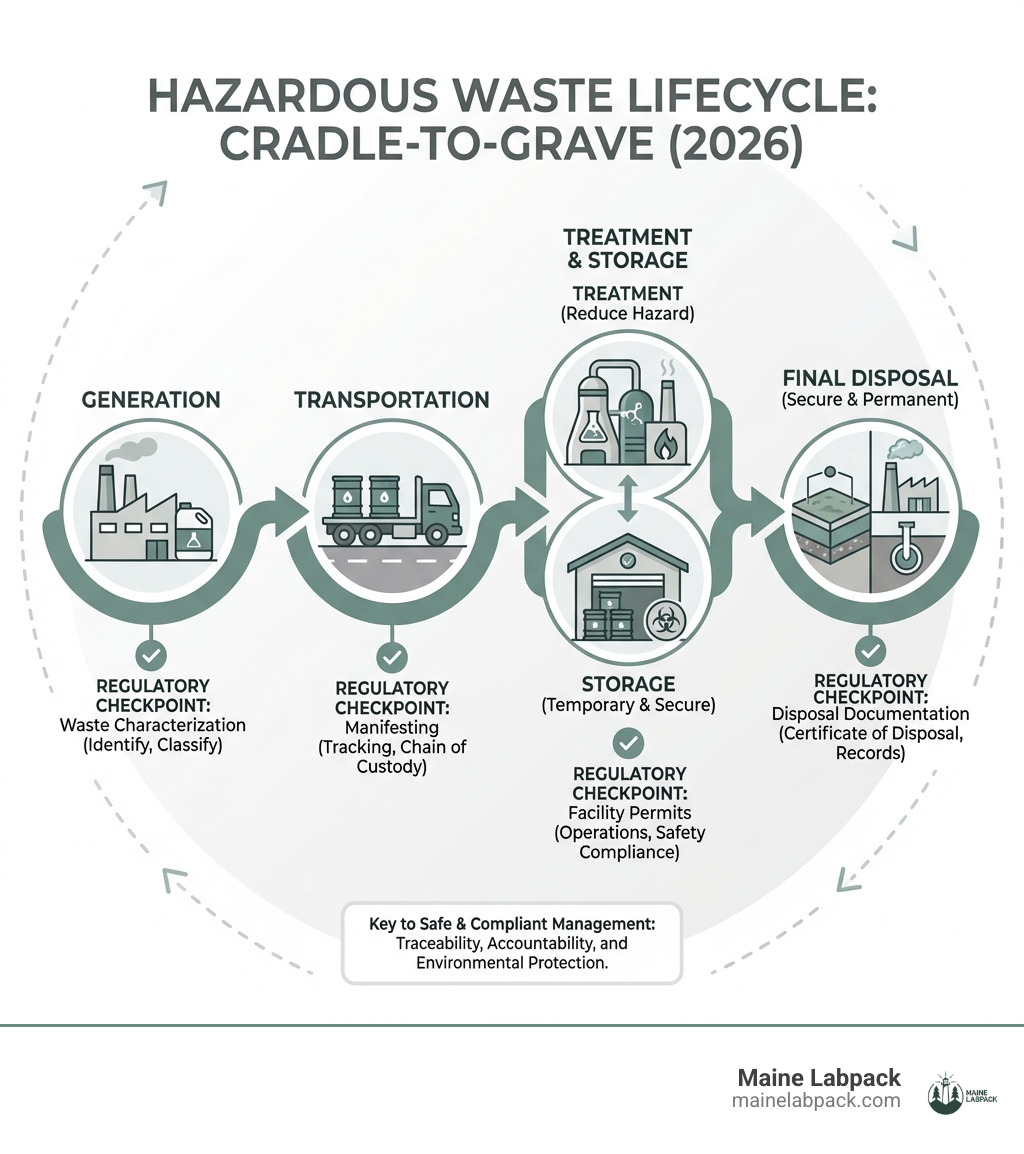
Hazardous waste that is improperly managed poses a serious threat to human health and the environment. The Resource Conservation and Recovery Act (RCRA), passed in 1976, established the framework we use today – a “cradle-to-grave” system that tracks waste from the moment it’s created until its final disposal.
For facilities dealing with accumulated hazardous chemicals, the stakes are high. A single compliance violation can result in significant fines and operational shutdowns. Meanwhile, improper disposal can contaminate soil and groundwater for decades, affecting entire communities.
The good news? Proper hazardous disposal doesn’t have to be overwhelming. Whether you’re managing laboratory chemicals, industrial solvents, or universal waste like fluorescent bulbs, clear regulations and proven disposal methods exist to guide you.
This guide walks you through everything you need to know: what makes waste hazardous, how to dispose of it legally, which regulations apply to your facility, and how to choose the right disposal method for your specific needs.
Defining Hazardous Waste and Associated Risks
Understanding what constitutes hazardous waste is the critical first step in proper hazardous disposal. Simply put, hazardous waste is any waste with properties that make it dangerous or capable of harming human health or the environment. It originates from diverse sources, from industrial manufacturing processes to common household items like batteries, and can appear in various forms, including liquids, solids, gases, and sludges.
The U.S. Environmental Protection Agency (EPA) provides a comprehensive framework for identifying hazardous waste, categorizing it primarily into “listed wastes” and “characteristic wastes.” For a more in-depth look, refer to the EPA’s Hazardous Waste Overview.
Listed Waste
These are wastes specifically identified by the EPA as hazardous. They generally fall into four categories:
- F-list: Wastes from common manufacturing and industrial processes (e.g., spent solvents).
- K-list: Wastes from specific industries (e.g., wastewater treatment sludge from electroplating).
- P-list and U-list: Discarded commercial chemical products, including certain unused pure chemicals and formulations.
Characteristic Waste
A waste is considered hazardous if it exhibits one or more of four characteristics, regardless of whether it’s on a specific list:
- Ignitability: Wastes that can easily catch fire, such as many paints, solvents, and certain cleaning products.
- Corrosivity: Wastes that can corrode metal containers, like strong acids or bases found in some drain cleaners or battery acid.
- Reactivity: Wastes that are unstable under normal conditions, react violently with water, or create toxic fumes or explosions. Examples include certain chemicals or explosives.
- Toxicity: Wastes that are harmful or fatal when ingested or absorbed, or that leach toxic constituents into groundwater. This characteristic is often determined by the Toxicity Characteristic Leaching Procedure (TCLP) test.
For a deeper dive into these classifications, you can explore the Basics of hazardous waste determination and understand How toxic waste is defined by various agencies.
Human Health and Environmental Risks
The risks associated with improper hazardous disposal are severe and far-reaching. When hazardous waste is not managed correctly, it can lead to:
- Human health risks: Direct exposure through skin contact, inhalation, or ingestion can cause acute poisoning, chronic illnesses, birth defects, and various cancers. Contaminated water or food sources also pose significant threats.
- Soil contamination: Hazardous chemicals can seep into the soil, rendering land unusable for agriculture or construction and harming local ecosystems. This contamination can persist for decades, requiring extensive and costly remediation.
- Groundwater protection: Perhaps one of the most critical concerns, improper disposal can lead to hazardous substances leaching into groundwater. Since groundwater is a primary source of drinking water for many communities, this contamination can have devastating impacts on public health and natural water systems, often requiring complex and expensive treatment processes.
The EPA emphasizes that hazardous waste that is improperly managed poses a serious threat to human health and the environment, underscoring the “cradle-to-grave” approach mandated by RCRA to ensure safe handling from generation to final disposition.
Primary Methods for Hazardous Disposal
Once a waste is identified as hazardous, selecting the correct hazardous disposal method is paramount to protecting human health and the environment. The primary methods generally involve treatment, recycling, or secure long-term storage, each custom to the specific characteristics of the waste.
High-Temperature Incineration
High-temperature incineration is a leading method for destroying hazardous and industrial waste, particularly organic compounds. This process uses extreme heat to break down hazardous constituents into simpler, less harmful substances, often achieving destruction efficiencies of up to 99.9999% for many hazardous compounds.
Key incineration technologies include:
- Rotary kiln incineration: Versatile for solids, sludges, and liquids, rotating kilns ensure thorough mixing and combustion.
- Liquid injection: Specifically designed for liquid hazardous wastes, these systems atomize and burn liquids efficiently.
- Direct incineration: Used for wastes with sufficient BTU value to sustain combustion without auxiliary fuel.
- Fluidized bed incineration: Wastes are burned in a bed of inert particles suspended by air, offering excellent heat transfer and pollution control.
Incineration is often combined with advanced air pollution control systems to capture and neutralize emissions, helping permitted facilities meet stringent environmental standards like MACT (Maximum Achievable Control Technology).
Chemical Lab Pack Services
For laboratories, schools, and other facilities generating diverse, smaller quantities of hazardous chemicals, chemical lab pack services offer a specialized solution. This involves categorizing, segregating, and packaging compatible hazardous chemicals into drums for safe transport and subsequent treatment or disposal. This method is crucial for ensuring that reactive or incompatible chemicals are not mixed, preventing dangerous reactions during storage and transportation.
Landfill Sequestration
While incineration is preferred for many wastes, some treated hazardous wastes or specific non-combustible hazardous materials are disposed of in highly engineered hazardous waste landfills. These are not typical municipal landfills but rather secure facilities designed with multiple liners, leachate collection systems, and groundwater monitoring to prevent contamination. This method, often referred to as landfill sequestration, helps ensure long-term isolation of the waste from the environment.
Universal Waste Recycling
Certain common hazardous items are designated as “universal waste” to encourage recycling and ease regulatory burdens. These include batteries, lamps (fluorescent bulbs, HIDs), mercury-containing equipment, and certain pesticides. Universal waste recycling programs streamline collection and transportation, diverting these materials from general landfills where they could release toxins. For example, understanding How to dispose of fluorescent light bulbs is a key aspect of universal waste management.
Drum Waste Management
Many industrial and commercial facilities generate hazardous waste in drums. Effective drum waste management involves proper identification, labeling, storage, and transportation of these containers, ensuring regulatory compliance and safe disposal.
Incineration vs. Recycling Destruction Efficiencies
| Method | Primary Goal | Typical Destruction Efficiency (Hazardous Constituents) | Environmental Benefit | Best Suited For |
|---|---|---|---|---|
| Incineration | Complete destruction of organic hazards | Up to 99.9999% | Eliminates toxicity, reduces volume | Organic liquids, solids, sludges, medical waste |
| Recycling | Material recovery and reuse | Variable (depends on material and process) | Resource conservation, waste reduction | Universal wastes (batteries, lamps), certain solvents |
Navigating Regulations and Agency Roles
The landscape of hazardous disposal is heavily regulated to safeguard human health and the environment. Navigating these regulations requires understanding the roles of various government agencies and the framework they enforce.
RCRA Framework and Cradle-to-Grave Management
At the heart of hazardous waste management in the U.S. is the Resource Conservation and Recovery Act (RCRA), established in 1976. RCRA created a “cradle-to-grave” system, ensuring that hazardous waste is managed safely from its creation, during transportation, through treatment and storage, and until its ultimate disposal. This comprehensive approach mandates strict controls at every stage.
Key Regulatory Agencies and Their Roles
- Environmental Protection Agency (EPA): The EPA defines what constitutes hazardous waste, sets federal standards for its management, and oversees the entire “cradle-to-grave” system. They develop regulations for hazardous waste generators, transporters, and treatment, storage, and disposal facilities (TSDFs). The EPA also spearheads initiatives to address emerging hazardous waste challenges.
- Occupational Safety and Health Administration (OSHA): OSHA focuses on worker safety. Their standards protect employees involved in hazardous waste operations, including handling, storage, and emergency response. This ensures that those on the front lines of hazardous disposal are equipped with the necessary training and safety protocols.
- Department of Transportation (DOT): The DOT regulates the safe transportation of hazardous materials, including hazardous waste, across public roads, railways, and waterways. Transporters must comply with stringent packaging, labeling, placarding, and documentation requirements outlined in the Federal Hazardous Materials Regulations.
- State Environmental Agencies: While federal regulations provide a baseline, state environmental agencies, such as Maine’s Department of Environmental Protection (DEP), New Hampshire’s Department of Environmental Services (DES), Massachusetts’ Department of Environmental Protection (MassDEP), Vermont’s Agency of Natural Resources (DEC), and Rhode Island’s Department of Environmental Management (DEM), play a crucial role. They implement and enforce federal rules, often developing their own, sometimes more stringent, state-specific regulations. These agencies oversee hazardous waste programs, issue permits, and provide guidance to generators within their jurisdictions. For example, a state agency like the New York State Department of Environmental Conservation (NYSDEC) might have a Bureau of Hazardous Waste and Radiation Management to handle specific aspects of waste oversight and provide contact information for entities like Small Quantity Generators (SQGs).
Generator Status and Compliance
Under RCRA, the degree of regulation a facility faces largely depends on its “generator status,” which is determined by the amount of hazardous waste it produces each month. Understanding How generator status impacts collection is vital for compliance:
- Very Small Quantity Generators (VSQGs): Generate 100 kg (220 lbs) or less of hazardous waste per month. They have fewer regulations but must still dispose of waste properly.
- Small Quantity Generators (SQGs): Generate between 100 kg (220 lbs) and 1,000 kg (2,200 lbs) of hazardous waste per month. They have more detailed requirements for accumulation, manifesting, and record-keeping.
- Large Quantity Generators (LQGs): Generate over 1,000 kg (2,200 lbs) of hazardous waste per month, or more than 1 kg (2.2 lbs) of acute hazardous waste. They face the most stringent regulations, including detailed emergency planning and personnel training.
Maintaining Hazmat compliance is an ongoing commitment that involves proper waste determination, record-keeping, personnel training, and adherence to all federal and state regulations.
Safe Disposal for Households and Businesses
Safe hazardous disposal is a shared responsibility, extending from individual households to large industrial facilities. While the principles remain the same – identify, segregate, and dispose of properly – the methods and regulations often differ.
HHW vs. Industrial Hazardous Waste
A key distinction lies between household hazardous waste (HHW) and industrial hazardous waste.
- Household Hazardous Waste (HHW): This refers to municipal solid waste generated by a private residence that exhibits hazardous characteristics (ignitability, corrosivity, reactivity, toxicity) or is a listed hazardous waste. Examples include paints, automotive fluids, pesticides, and certain cleaning supplies. The goal for HHW is to provide convenient, safe, and often cost-free options for residents, as throwing these items in regular trash is not environmentally sound. To learn more about managing these items, see What to do with household hazardous waste.
- Industrial Hazardous Waste: This is generated by commercial, industrial, and institutional entities. It often involves larger volumes and a wider variety of complex chemicals, requiring specialized disposal services. Businesses, regardless of size, are responsible for the “cradle-to-grave” management of their waste.
Small Quantity Generators and Lab Decommissioning
Even small businesses can generate hazardous waste, falling into the Small Quantity Generator (SQG) category. These businesses have specific responsibilities and often benefit significantly from professional hazardous waste management services. For example, 6 reasons small businesses need professional management highlight how experts can ensure compliance and safety.
For facilities undergoing closure or relocation, lab decommissioning presents a unique set of challenges. This process involves the safe removal, packaging, and disposal of all chemicals and hazardous materials, adhering to strict regulatory protocols. Understanding What you need to know about lab decommissioning is crucial to avoid environmental liabilities and ensure a smooth transition.
Some state programs, like those seen in various counties, might impose weight limits for businesses or other entities participating in collection events, such as a 220 lbs limit per participant, to manage capacity and ensure proper processing.
Best Practices for Safe Hazardous Disposal
Effective hazardous disposal extends beyond just finding a drop-off point; it involves meticulous handling, storage, and transportation practices.
- Proper Labeling: Accurate and clear labeling is non-negotiable. Every container of hazardous waste must be properly labeled with its contents, hazard warnings, and accumulation start date. This ensures that handlers are aware of the risks and that the waste is managed according to its specific properties. Understanding the Anatomy of a hazardous waste label is crucial for compliance.
- Secondary Containment: Hazardous waste should be stored in appropriate containers and, where necessary, within secondary containment structures (e.g., trays, berms) to prevent spills or leaks from reaching the environment. This is a fundamental aspect of safe storage, as detailed in guidelines like Maine hazardous waste storage requirements.
- Spill Response and Emergency Preparedness: Facilities generating hazardous waste must have a robust spill response plan and trained personnel. This includes having appropriate personal protective equipment (PPE) and spill kits readily available. Developing and adhering to a Standard Operating Procedure (SOP) is vital for safety, as outlined in guides like Writing an effective SOP.
Future Trends in Waste Management
The field of hazardous disposal is constantly evolving, driven by scientific advancements, new regulatory challenges, and a growing emphasis on sustainability. Several key trends are shaping the future of hazardous waste management.
- PFAS Initiatives: Per- and polyfluoroalkyl substances (PFAS), often called “forever chemicals,” are a significant emerging concern. The EPA is actively developing initiatives under RCRA to address the management and disposal of PFAS-containing wastes, recognizing their persistence and widespread environmental presence. This will lead to new regulations and disposal methods specifically custom for these challenging compounds.
- Lithium-ion Batteries: The proliferation of electronic devices has led to a surge in discarded lithium-ion batteries. These batteries pose fire hazards and contain valuable, sometimes toxic, materials. Future trends include improved recycling programs and safer disposal methods to prevent fires and recover critical minerals.
- Sustainable Waste Management: There’s a clear shift towards more sustainable practices, moving beyond mere disposal to waste minimization, reuse, and recycling. The concept of a “circular economy,” where resources are kept in use for as long as possible, is gaining traction. This involves innovative technologies and processes to extract value from waste streams. Indeed, 2025: A pivotal year for sustainable waste management highlights the increasing focus on these environmentally conscious approaches.
- Electronic Manifests: To improve efficiency, accuracy, and transparency in hazardous waste tracking, the EPA has implemented an electronic manifest system. This digital record-keeping replaces paper manifests, streamlining the “cradle-to-grave” process and reducing administrative burdens. This is part of broader efforts outlined in documents like the EPA Unified Agenda of Regulatory Actions, which details future regulatory initiatives.
These trends underscore a collective commitment to making hazardous disposal safer, more efficient, and more environmentally responsible.
Frequently Asked Questions about Hazardous Disposal
What is the difference between hazardous and universal waste?
Hazardous waste is a broad category defined by its potential to harm human health or the environment, exhibiting characteristics like ignitability, corrosivity, reactivity, or toxicity, or appearing on specific EPA lists. Universal waste is a subset of hazardous waste that is commonly generated by many different types of facilities and households. It includes items like batteries, fluorescent lamps, mercury-containing equipment (e.g., thermostats), and certain pesticides. These wastes are subject to less stringent regulations than other hazardous wastes to encourage their proper collection and recycling, thus diverting them from municipal landfills.
Can I throw old paint in the regular trash?
Generally, no. Wet paint, especially oil-based paint, should never be thrown in the regular trash because it is ignitable and can contaminate landfills. Latex or water-based paints, if completely dried out, might be acceptable in some municipal trash systems, but it’s always best to check local regulations. The preferred and safest method is to use paint stewardship programs like PaintCare, which accept both oil-based and wet latex paints for recycling or proper disposal. Always contact your local household hazardous waste program or a PaintCare drop-off site for guidance.
What are the penalties for improper hazardous waste disposal?
The penalties for improper hazardous disposal can be severe, ranging from substantial financial fines to criminal charges. Under RCRA, violations can lead to civil penalties of tens of thousands of dollars per day per violation. Businesses and individuals may also face legal action, mandatory environmental cleanup costs (which can be exorbitant), and significant reputational damage. The goal of these penalties is to deter illegal dumping and ensure compliance with regulations designed to protect public health and the environment.
Dispose Smarter and Protect Your Community with Maine Labpack
Effective hazardous disposal is more than just a regulatory requirement; it’s a commitment to protecting our communities and the planet. From understanding what makes a waste hazardous to navigating complex federal and state regulations, the process demands diligence and expertise. Whether you’re a homeowner with old paint or an industrial facility managing complex chemical waste, choosing the right disposal method and partnering with qualified professionals is essential.
For businesses and institutions across New England, Maine Labpack stands ready as a trusted partner in professional, on-time, and sustainable chemical and hazardous materials disposal. Specializing as a one-stop shop that comes to your site, Maine Labpack provides expert guidance and services to ensure your hazardous waste is managed safely, legally, and responsibly, keeping your community safe and clean. For comprehensive solutions, explore Hazardous Waste Disposal services.