

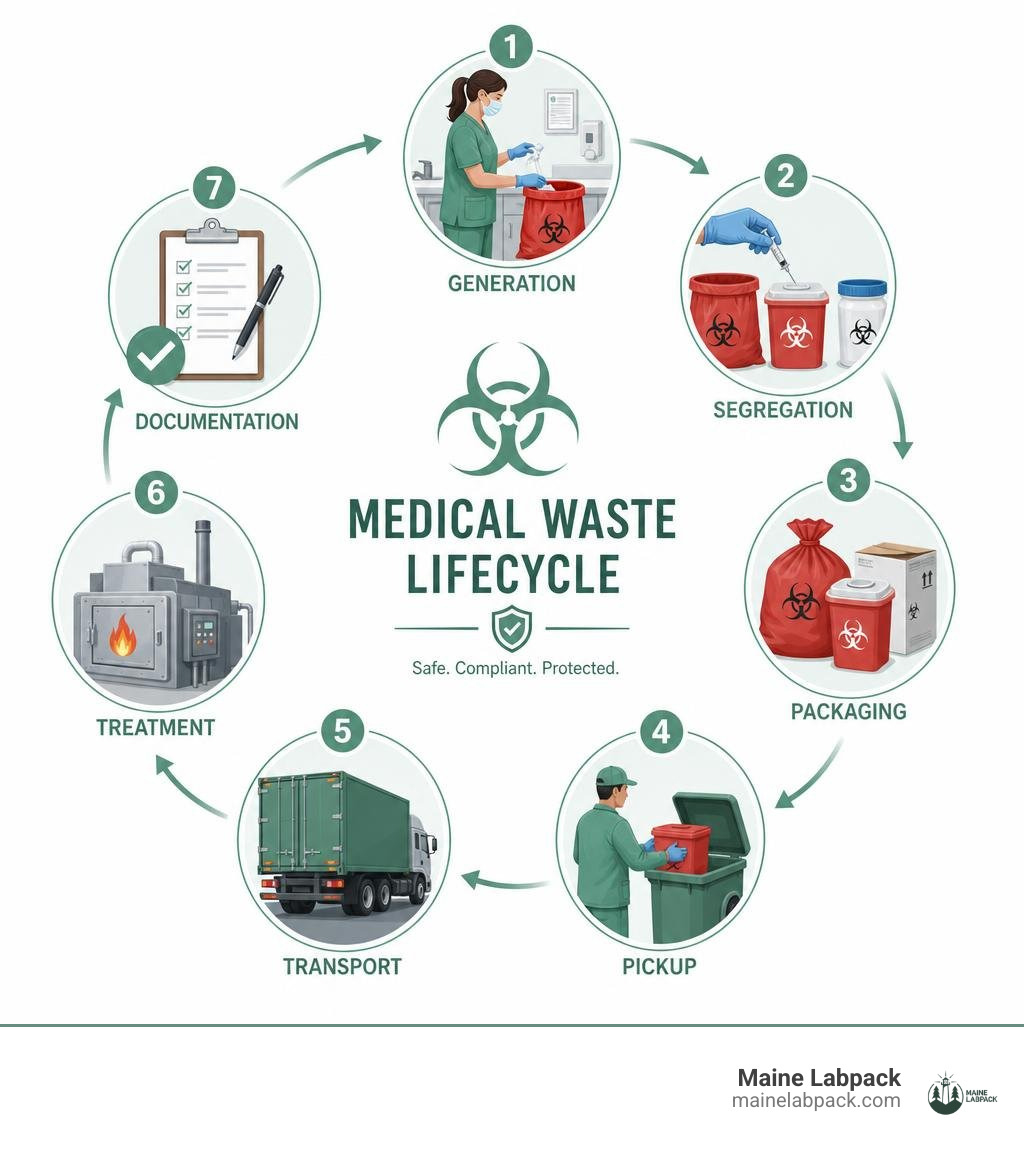
Biohazardous waste disposal companies help healthcare facilities safely collect, transport, treat, and document regulated medical waste — keeping staff, patients, and the public protected while meeting strict legal requirements.
Here’s a quick look at what these companies typically handle:
- Regulated medical waste (red bag) — blood-soaked items, infectious PPE, bandages
- Sharps waste — needles, scalpels, lancets in puncture-resistant containers
- Pharmaceutical waste — expired or unused medications requiring compliant destruction
- Pathological waste — human tissues and surgical specimens, usually incinerated
- Chemotherapy (trace) waste — IV bags, tubing, PPE contaminated with chemo agents
- Hazardous and universal waste — batteries, chemicals, and other regulated materials
The U.S. waste management industry has grown to $88.4 billion in annual revenue — and regulated medical waste is one of its fastest-moving segments. Volume has increased significantly due to population growth and the lasting impact of recent public health emergencies.
For facilities managing accumulated biohazardous materials, the stakes are high. OSHA, EPA, DOT, and state health agencies all impose overlapping rules. A missed pickup, a mislabeled container, or a gap in documentation can mean fines, failed inspections, or worse — harm to the people inside your building.
Choosing the wrong vendor can be just as costly as choosing no vendor at all.
This guide walks you through everything you need to know to evaluate your options confidently.
Understanding the Waste Streams Managed by Biohazardous Waste Disposal Companies
Managing waste in a healthcare facility is a bit like sorting laundry, except the stakes are infinitely higher and a mistake can result in a federal audit rather than a pink undershirt. To keep your facility safe and compliant, you must first understand the different categories of waste generated on-site.
Different materials require entirely different handling protocols, treatment methods, and disposal containers. A clear breakdown of the six core types of regulated medical waste can help staff segregate these streams at the source, preventing costly and dangerous mixing of incompatible materials.
Regulated Medical Waste and Red Bag Protocols
Regulated medical waste (RMW), commonly referred to as red-bag waste, consists of materials that are saturated with blood or other potentially infectious materials (OPIM). This includes items like blood-soaked gauze, saturated bandages, contaminated personal protective equipment (PPE), and plastic tubing used in fluid administration.
Because medical waste and biohazardous waste are often discussed together, it is important to understand how the categories differ in daily operations. Biohazardous waste specifically refers to biological agents that pose a threat to living organisms, while medical waste is a broader category generated during healthcare activities.
To manage these streams properly, facilities often partner with professional medical waste disposal services to establish routine collection and treatment processes. Proper red bag protocols require placing a sturdy, leak-proof red bag liner inside a designated rigid container. When the bag is approximately three-quarters full, it must be securely tied and sealed to prevent any leakage during transport.
Pathological and Chemotherapy Waste Requirements
Pathological waste and trace chemotherapy waste represent highly sensitive waste streams that demand specialized handling. Pathological waste includes human tissues, organs, and body parts removed during surgery or autopsy. Because of its nature, this waste must be segregated from standard red-bag waste and packaged specifically for incineration, with safe pathological waste disposal practices in place to prevent biological degradation and odor during storage.
Similarly, trace chemotherapy waste—which includes depleted IV bags, tubing, and PPE worn during the administration of chemotherapeutic agents—cannot be autoclaved. It must be sent to a licensed incineration facility. Managing pathological waste disposal and chemotherapy streams separately ensures that your facility remains compliant with environmental laws while protecting waste management workers from chemical exposure.
Sharps Management and Disposal Best Practices
Sharps are defined as any objects capable of puncturing or cutting human skin. In a healthcare environment, this includes contaminated needles, syringes, scalpel blades, lancets, and broken glass. Because needlestick injuries present a direct pathway for bloodborne pathogens, proper sharps waste management is a top priority for facility safety officers.
Strong sharps disposal best practices include placing all sharps immediately into rigid, puncture-resistant, leak-proof containers. These containers must be located as close as possible to the point of use. Never attempt to force items into an overfilled sharps container; they should be closed and replaced when they reach the fill line indicated on the box.
Navigating Compliance and Regulatory Standards
Operating a healthcare facility in New England means complying with a complex web of federal, state, and local regulations. Organizations like OSHA, the EPA, the DOT, and state-specific environmental protection agencies all have a say in how biohazardous waste is handled. Failing to meet these standards can result in severe financial penalties and damage to your facility’s reputation.
A thorough understanding of regulated waste compliance is essential for any administrator looking to maintain an inspection-ready facility.
In New England, state-specific rules vary significantly. For instance, the Maine Department of Environmental Protection enforces strict guidelines regarding how long biomedical waste can be stored on-site before treatment or disposal. Reviewing Maine biohazardous waste guidelines helps facilities in cities like Portland, Bangor, and Lewiston align their internal policies with state regulations.
Additionally, understanding the nuance of different waste classes through a practical guide to regulated medical waste classes ensures that nothing is misclassified. Partnering with a compliant service provider can help simplify this complex regulatory landscape.
OSHA and HIPAA Training for Healthcare Staff
Regulatory compliance is only as strong as the training your staff receives. OSHA requires annual bloodborne pathogens training for all employees who may reasonably anticipate contact with blood or other infectious materials. Facilities can review the federal bloodborne pathogens requirements for rules related to exposure control plans, training, PPE, sharps handling, and incident response.
At the same time, HIPAA compliance must be maintained when disposing of medical records or labeled pharmaceutical waste that contains protected health information (PHI). Many biohazardous waste disposal companies offer integrated compliance portals that provide online training modules for both OSHA and HIPAA, allowing administrators to track employee progress and maintain training certificates in one central location.
Chain of Custody and Certificates of Destruction
When biohazardous waste leaves your facility, your legal liability does not end. Under the “cradle-to-grave” principle established by environmental laws, a waste generator is responsible for their waste until it is fully treated and disposed of. This is why chain-of-custody documentation is so critical.
Every shipment of regulated medical waste must be accompanied by a shipping manifest that tracks the waste from your doorstep to the treatment facility. Once the waste has been autoclaved or incinerated, the disposal company issues a Certificate of Destruction. These documents must be retained in your compliance files to prove to inspectors that your waste was handled legally and safely.
Evaluating Service Models and Pricing Structures
Every medical facility has different needs based on its size, patient volume, and the specific types of waste it generates. A large hospital in Boston or Worcester requires a vastly different service model than a small physical therapy clinic in Concord, New Hampshire, or a dental office in Burlington, Vermont. Finding the right fit requires balancing operational efficiency with cost-effectiveness.
To help guide your decision, review the key factors that influence the cost of medical waste disposal in Maine and how regional requirements may affect your overall investment.
| Service Model | Best Suited For | Key Advantages | Potential Drawbacks |
|---|---|---|---|
| Scheduled Pickups | Hospitals, urgent care centers, busy clinics | Highly predictable, hands-off management, consistent compliance | Can be inefficient if waste volume fluctuates |
| On-Call Services | Small practices, dental offices, specialty clinics | Pay only when needed, highly flexible | Requires active monitoring of waste levels by staff |
| Bulk Waste Consolidation | Laboratories, research facilities, multi-site networks | Highly cost-effective for large volumes, streamlined transport | Requires significant storage space on-site |
Scheduled Pickups Versus On-Call Services
For high-volume waste generators, scheduled pickups are the gold standard. Having a set schedule—whether weekly, bi-weekly, or monthly—ensures that waste never accumulates past legal storage limits. This model provides peace of mind, as staff members do not need to remember to call for a pickup.
For smaller facilities, on-call services offer a more flexible approach. If your clinic only generates a single box of regulated waste every few months, paying for a weekly pickup makes little sense. On-call services allow you to request a pickup only when your storage containers are nearing capacity, though you must remain diligent about state-specific storage time limits.
Contract Pitfalls and Hidden Fees to Avoid
When shopping for a waste disposal partner, transparent pricing is key. Some national providers attract customers with low introductory rates, only to add unexpected charges later. Common hidden fees to watch out for include:
- Fuel surcharges that fluctuate wildly month-to-month
- Environmental compliance fees that are tacked onto every invoice
- Container fees charged separately from the pickup service
- Auto-renewal clauses that lock you into long-term contracts without your active consent
Always look for providers that offer flat-rate pricing or transparent, per-container rates with clear, easy-to-understand contract terms.
Selecting the Right Provider for Your Facility
Choosing a biohazardous waste disposal partner is a decision that impacts your facility’s safety, compliance, and budget. While it can be tempting to simply select the cheapest option or the largest national brand, taking a more strategic approach will yield better long-term results.
How to Evaluate Biohazardous Waste Disposal Companies
When comparing potential partners, start by looking at their geographic coverage and infrastructure. It is critical to choose a provider that understands the unique regulatory environments of the New England states. For example, if your facility is located in Maine, you should look for partners familiar with Maine biohazardous waste guidelines and state-specific requirements.
Local options offer regional expertise that large national brokers sometimes struggle to match. Working with a provider that has a strong local network ensures you find reliable, compliant, and timely service tailored to your specific area.
Ask potential providers the following questions:
- Do you own your treatment facilities, or do you act as a broker and subcontract the work?
- What is your history of regulatory compliance? Have you had any recent OSHA or DOT violations?
- How do you handle emergency pickup requests or sudden surges in waste volume?
- Do you provide real-time online tracking and digital certificates of destruction?
Sustainability Initiatives Offered by Biohazardous Waste Disposal Companies
Environmental responsibility is becoming increasingly important to healthcare providers and their patients. Many disposal companies now offer innovative programs designed to minimize the ecological footprint of medical waste.
These initiatives include the use of reusable sharps containers, which can be washed, sanitized, and reused hundreds of times, diverting thousands of pounds of single-use plastic from landfills. Other green initiatives include waste-to-energy programs, where sterilized medical waste is incinerated in specialized facilities that capture the heat to generate electricity, offsetting carbon emissions in the process.
Frequently Asked Questions About Medical Waste Management
How should biohazardous waste be packaged for transport?
Proper packaging is the responsibility of the waste generator and is critical for the safety of transport workers. All red-bag waste must be placed inside a compliant red bag liner that is housed within a rigid, puncture-resistant container.
The bag must be tied securely (using a single-knot or gooseneck method) when it is three-quarters full. Following clear medical waste storage guidelines will help your facility meet pre-transport storage and packaging laws.
What is the difference between a broker and a direct service provider?
A broker acts as a middleman, taking your order and subcontracting the actual pickup, transport, and treatment to third-party companies. This can sometimes lead to communication breakdowns, hidden markups, and a fragmented chain of custody.
A direct service provider owns the trucks, employs the drivers, and operates the treatment facilities. This vertical integration offers superior cost control, clearer accountability, and a more secure chain of custody.
How do disposal companies support facilities during public health emergencies?
During disease outbreaks or public health crises, waste disposal needs can skyrocket overnight. Experienced disposal companies support facilities by providing rapid-response emergency pickups, supplying extra container inventory, and offering guidance on managing highly infectious waste streams in accordance with CDC and DOT guidelines.
Ready for Safer, Simpler Biohazardous Waste Disposal?
Navigating the complexities of medical waste management does not have to be a source of stress for your healthcare facility. By understanding your waste streams, staying on top of regulatory compliance, and choosing a transparent, reliable partner, you can ensure a safe environment for your staff and patients alike.
For facilities across New England—including Maine, New Hampshire, Massachusetts, Vermont, and Rhode Island—Maine Labpack offers a professional, on-time, and highly sustainable solution. As a true one-stop shop, they bring local expertise and direct accountability straight to your site, managing everything from routine medical waste to complex chemical disposal.
Schedule your compliant healthcare waste disposal today and experience the peace of mind that comes with a trusted, regional environmental partner.