
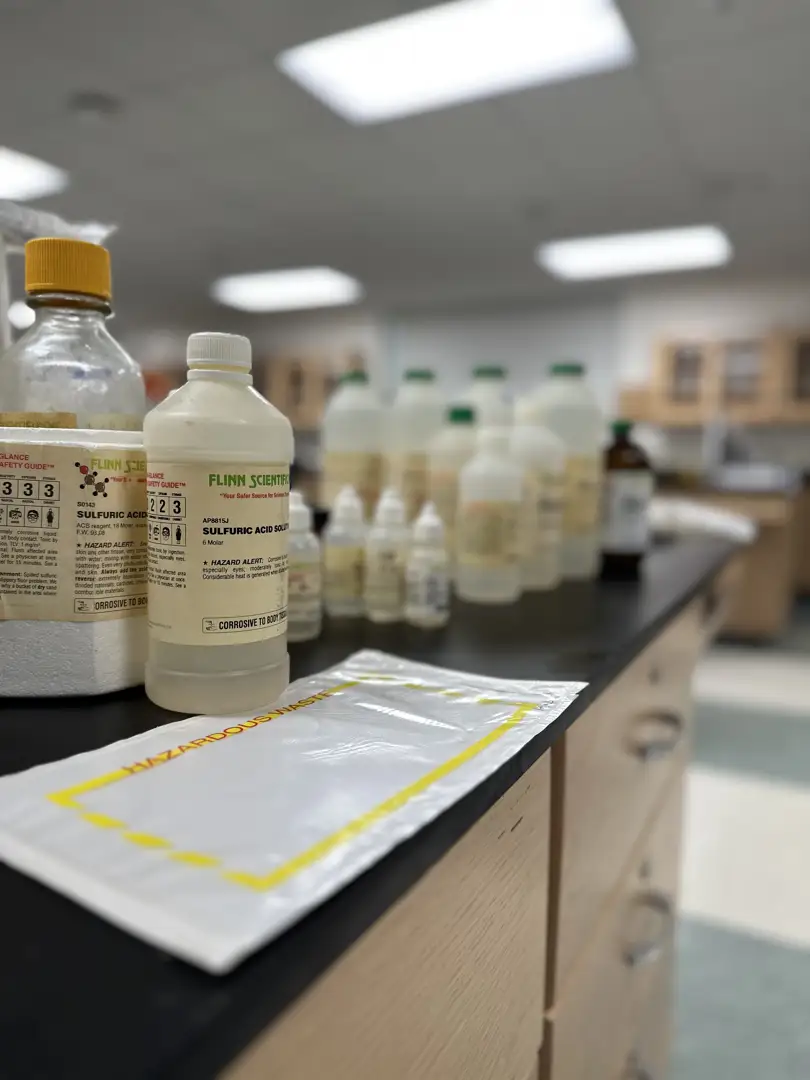
School chemical waste disposal is the process of safely identifying, storing, and removing hazardous chemicals from educational settings in compliance with EPA, OSHA, and state regulations.
Here’s a quick overview of what schools need to do:
- Identify hazardous chemicals across all areas — labs, art rooms, maintenance, and custodial storage
- Classify your generator status under EPA’s RCRA (most schools qualify as conditionally exempt small quantity generators)
- Label and store chemicals properly — segregated by compatibility, in ventilated, secure cabinets
- Dispose of chemicals on schedule — within five years, or within six months of expiration
- Work with a licensed hazardous waste vendor for lab packing and compliant removal
- Keep records — waste manifests, training logs, and disposal receipts
Walk into the chemical storeroom of almost any school, and you’re likely to find something that shouldn’t be there. Maybe it’s a bottle with a faded label. Maybe it’s a chemical a retired teacher left behind decades ago. In one well-documented case, a mock OSHA inspection at a high school uncovered a large bottle of picric acid with crystals forming around the cap — a situation serious enough to require the state bomb squad.
That’s not a worst-case hypothetical. It’s a real pattern that plays out in schools across the country.
Schools use chemicals every day — in science labs, art studios, maintenance closets, and even the nurse’s office. But most don’t have a clear system for tracking what they have, how long they’ve had it, or how to get rid of it safely. The result is slow accumulation of materials that are expired, degraded, incompatible, or outright dangerous.
The stakes are real. Students are more vulnerable to chemical exposure than adults. Improper storage can trigger fires, toxic reactions, or regulatory violations. And under EPA’s RCRA regulations, schools hold cradle-to-grave responsibility for their chemical waste — meaning liability doesn’t end when a vendor drives away.
This guide walks you through exactly how to manage school chemical waste the right way.
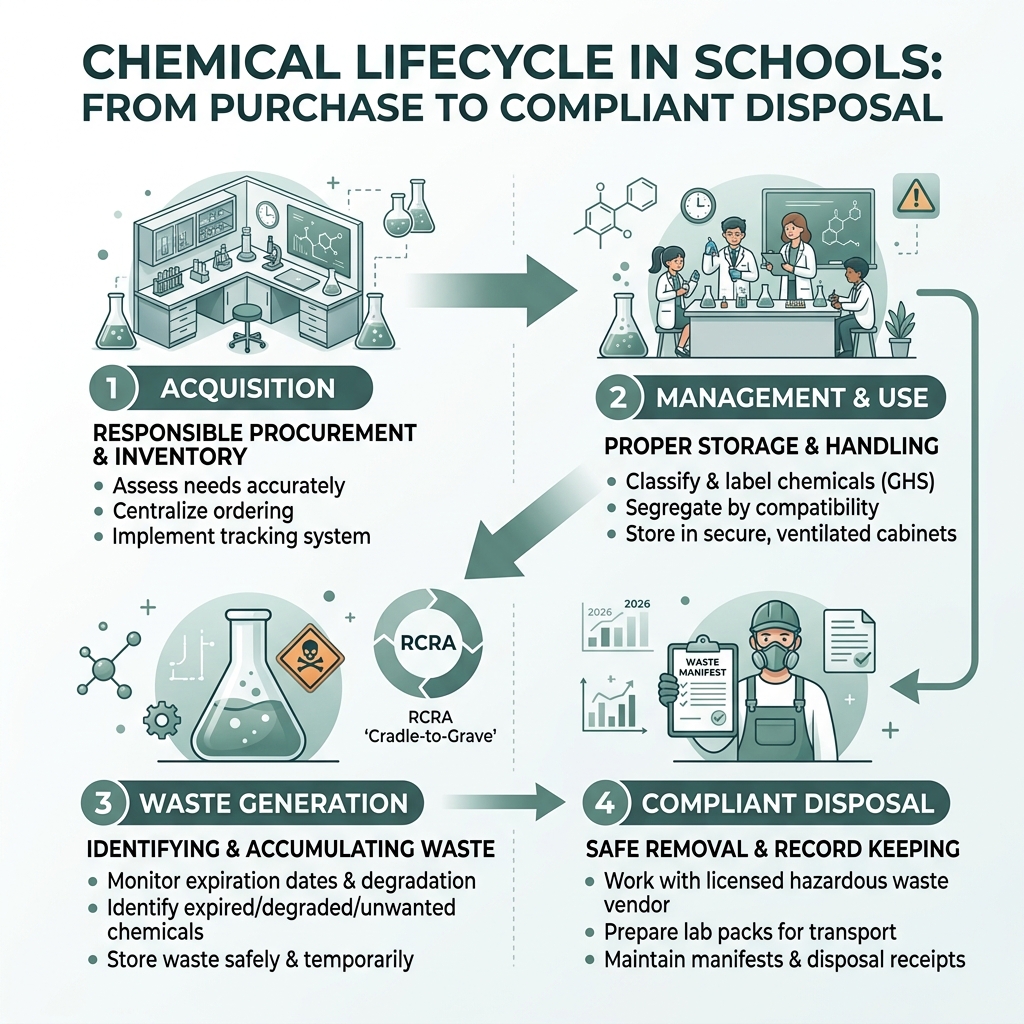
Identifying Hazardous Materials And Regulatory Requirements
Before a school can dispose of anything, it must first understand what it is holding. Hazardous waste isn’t just a glowing green liquid in a beaker; it is any unwanted substance that is toxic, ignitable, reactive, or corrosive. In a school, this spans from chemistry reagents like silver nitrate to maintenance supplies like oil-based paints, pesticides, and even fluorescent light bulbs.
The primary federal law governing this is the Resource Conservation and Recovery Act (RCRA), managed by the EPA. RCRA creates a “cradle-to-grave” system, meaning the school is responsible for the waste from the moment it is generated until it is finally destroyed or treated at a licensed facility.
Understanding Generator Status
The EPA classifies schools into three categories based on how much waste they produce each month. Most K-12 schools fall into the least regulated category, but it only takes a small amount of “acutely hazardous” waste to move a school into a higher, more strictly regulated bracket.
- Very Small Quantity Generator (VSQG): Also known as “conditionally exempt,” these schools generate less than 100 kg (about 220 lbs) of hazardous waste per month and no more than 1 kg of acutely hazardous waste.
- Small Quantity Generator (SQG): Schools generating between 100 kg and 1,000 kg of hazardous waste per month.
- Large Quantity Generator (LQG): Schools generating more than 1,000 kg of waste or more than 1 kg of acutely hazardous waste per month.
A key detail for science teachers: if you have more than 2.2 pounds (roughly one quart of liquid) of “P-listed” acutely toxic waste—such as sodium cyanide or arsenic trioxide—your school automatically triggers the most stringent LQG requirements. Performing a proper hazardous waste determination is the first step in staying compliant.
State And Local Oversight
In New England, state agencies like the Vermont DEC or the Maine DEP often have specific requirements that go beyond federal rules. For instance, Hazardous Waste Management for Schools in Vermont requires schools to obtain an EPA ID number and explicitly bans hazardous waste from the regular trash. OSHA also plays a role through the Laboratory Standard, which requires schools to have a Chemical Hygiene Plan (CHP) and a designated Chemical Hygiene Officer (CHO).
Best Practices For School Chemical Waste Disposal And Storage
Effective school chemical waste disposal begins long before the waste truck arrives. It starts with how chemicals are housed. Proper storage prevents “orphaned” chemicals—those mystery bottles that lost their labels ten years ago—and reduces the risk of accidental reactions.
The Chemical Hygiene Plan (CHP)
Every school using hazardous chemicals must have a written CHP. This isn’t just a binder that sits on a shelf; it is a living document that outlines exactly how chemicals are purchased, used, stored, and eventually discarded. Writing an effective Chemical Hygiene Plan ensures that every staff member knows their role in maintaining a safe environment.
Smart Storage Strategies
One of the most common mistakes in schools is organizing chemicals alphabetically. While it makes things easy to find, it can lead to disaster—like placing an oxidizer right next to a flammable solvent.
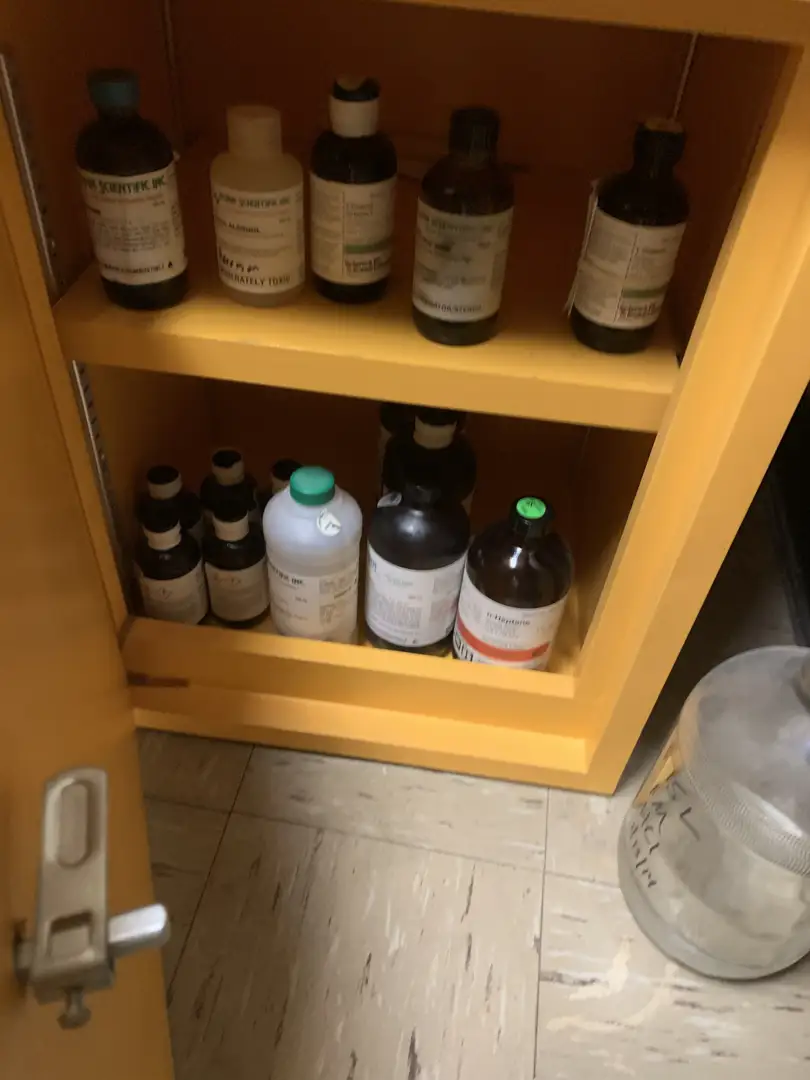
- Use the Flinn Method: Organize chemicals by compatible families (e.g., inorganic acids separate from organic acids).
- Ventilation and Security: Store volatile chemicals in ventilated cabinets and keep all storage areas locked and inaccessible to students.
- Secondary Containment: Use plastic trays to catch leaks, especially for corrosives. This is a core part of Maine hazardous waste storage requirements.
- GHS Labeling: Ensure every container has a Globally Harmonized System (GHS) label featuring the correct pictograms, signal words, and hazard statements.
Establishing A Compliant School Chemical Waste Disposal Workflow
How do you know when it’s time to say goodbye to a chemical? Industry experts, including Fisher Scientific, recommend a “5-year rule.” Do not keep hazardous chemicals longer than five years, regardless of the expiration date. Chemical stability degrades over time, and containers can become brittle or pressurized.
To keep your lab running smoothly, you should develop a hazardous materials SOP. This workflow should include:
- The Annual Cull: Every summer, review the inventory. If it hasn’t been used in two years and isn’t planned for next year, dispose of it.
- Labeling Waste: As soon as a substance becomes waste, it must be labeled. An anatomy of a hazardous waste label check ensures you include the words “Hazardous Waste,” the specific chemical names (no abbreviations!), and the date you started filling the container.
- Drain Vs. Trash: Most chemicals should never go down the drain or in the trash. Only very small amounts of neutralized acids or bases (pH between 5.5 and 10.5) are typically allowed in the sewer, and only with local authority approval.
Safe Storage And Labeling Protocols
The storage area is the heart of school safety. A cluttered, poorly labeled storeroom is an accident waiting to happen. To avoid common hazardous waste handling mistakes, schools should treat their storage area as a “Satellite Accumulation Area” (SAA).
Labeling for Compliance
Labels are your first line of defense. A compliant label tells a first responder exactly what they are dealing with in an emergency. Hazardous waste labels must be legible and permanently attached. If a label starts to peel or fade, replace it immediately.
Segregation and Shelf Life
Certain chemicals, like ethers, can form explosive peroxides over time. Others, like picric acid, become shock-sensitive when they dry out.
- Track Opening Dates: Always write the date a bottle was received and the date it was first opened on the label.
- Monitor for Degradation: Look for signs of trouble: crystals around caps, discoloration, bulging bottles, or “fuzz” growing on solids. These are immediate signals for disposal.
- Incompatible Pairs: Never store acids near bases, or flammables near oxidizers. Even in the waste area, keep these groups separated in secondary containment.
Minimizing Waste Through Green Chemistry And Inventory Control
The most cost-effective way to handle school chemical waste disposal is to generate less waste in the first place. This requires a shift from “buying in bulk to save money” (which usually backfires when disposal costs three times the purchase price) to a “just-in-time” mindset.
The Power Of The Annual Inventory
A school cannot manage what it doesn’t measure. A complete annual chemical inventory allows the Chemical Hygiene Officer to see exactly what is on hand. Use a digital tracking system or a simple spreadsheet to record quantities, storage locations, and SDS links.
Green Chemistry And Microscale Labs
Green chemistry involves substituting hazardous reagents with safer alternatives. For example, using household vinegar and baking soda for certain reactions instead of concentrated hydrochloric acid and sodium hydroxide.
- Microscale Techniques: Perform experiments using drops instead of beakers full of liquid. It teaches the same principles but reduces waste by 90% or more.
- Centralized Purchasing: Prevent three different teachers from ordering the same bottle of copper sulfate. One central “store” for the department reduces duplicates.
- Donation Policy: Never accept chemical donations from local businesses or retiring doctors. These are often “gifts” of high-cost disposal problems.
For schools in New England, following helpful tips for handling hazardous waste can turn a chaotic storeroom into a model of efficiency.
Professional Solutions For Lab Packing And Removal
When it comes time to move the waste off-site, schools rely on a process called “lab packing.” Because schools have hundreds of different chemicals in small bottles, they cannot just be poured into a large drum. Instead, a professional chemist visits the school, categorizes the small bottles, and packs them into larger drums with absorbent material.
The Lab Pack Process
Understanding the lab pack lowdown is essential for school administrators. A lab pack service ensures that hazardous materials are transported safely and in accordance with Department of Transportation (DOT) regulations.
- Inventory Review: The vendor reviews your list to ensure they have the right supplies.
- On-Site Packing: Chemists sort the chemicals by “compatibility groups” to ensure they won’t react inside the drum.
- Documentation: The vendor provides a shipping manifest, which is the legal proof that the waste was handled correctly.
Selecting A Vendor For School Chemical Waste Disposal
Not all waste haulers are created equal. When choosing a lab pack service company, schools should look for more than just the lowest price.
- Compliance Verification: Ensure the vendor is licensed and has a clean record with the EPA.
- Itemized Quotes: Ask for a quote based on your specific inventory to avoid “surprise” fees on the day of the cleanout.
- Cradle-To-Grave Support: Your school is liable for that waste forever. Working with a reputable chemical lab pack provider who uses high-quality TSDFs (Treatment, Storage, and Disposal Facilities) is the best way to mitigate risk.
- Manifests: You must keep copies of your shipping manifests for at least three years. A good vendor will help you manage this paperwork.
Frequently Asked Questions About School Lab Safety
How should schools handle mercury and unknown chemicals?
Mercury is a major liability; even a small spill from a broken thermometer can cost tens of thousands of dollars to clean up. Schools should replace all mercury thermometers and manometers with alcohol-filled or digital alternatives immediately. As for unknown chemicals, never guess what they are. Professional waste companies can perform “hazcatting” (hazardous characterization) to identify the material so it can be safely disposed of.
Can schools treat hazardous waste on-site?
Schools may sometimes neutralize simple acids and bases under the “elementary neutralization exclusion” when it is part of normal lab work. But once a material is managed as waste, on-site treatment can trigger RCRA permit requirements. Before doing neutralization, precipitation, or other treatment steps, review your state rules carefully.
How often should schools schedule waste cleanouts?
Schools should plan a full chemical waste review and cleanout at least once a year, often near the end of the school year. That annual check helps remove aging, expired, and unwanted chemicals before they build up. Many schools also benefit from smaller midyear reviews, especially if chemical use is high. The right schedule should align with waste accumulation limits, storage capacity, shelf-life concerns, and the school’s generator category.
Take the Next Step Toward Safer School Chemical Disposal
Managing school chemical waste disposal isn’t just about following the law; it’s about protecting the students and staff who walk the halls every day. From the initial inventory to the final lab pack, every step in the process contributes to a culture of safety and environmental responsibility.
Maine Labpack serves as a dedicated partner for educational institutions throughout New England—from Portland and Bangor to Manchester, Concord, Boston, and Burlington. As a one-stop shop for hazardous waste management, they provide the technical expertise and sustainable disposal solutions schools need to stay compliant and safe.
Whether you are dealing with a decades-old chemical stockpile or just need a routine end-of-year cleanout, professional support ensures the job is done right.
Schedule a compliant school chemical waste cleanout with Maine Labpack!