

Last updated on March 4th, 2026 at 08:39 pm
Why Proper Hazardous Waste Labeling Matters
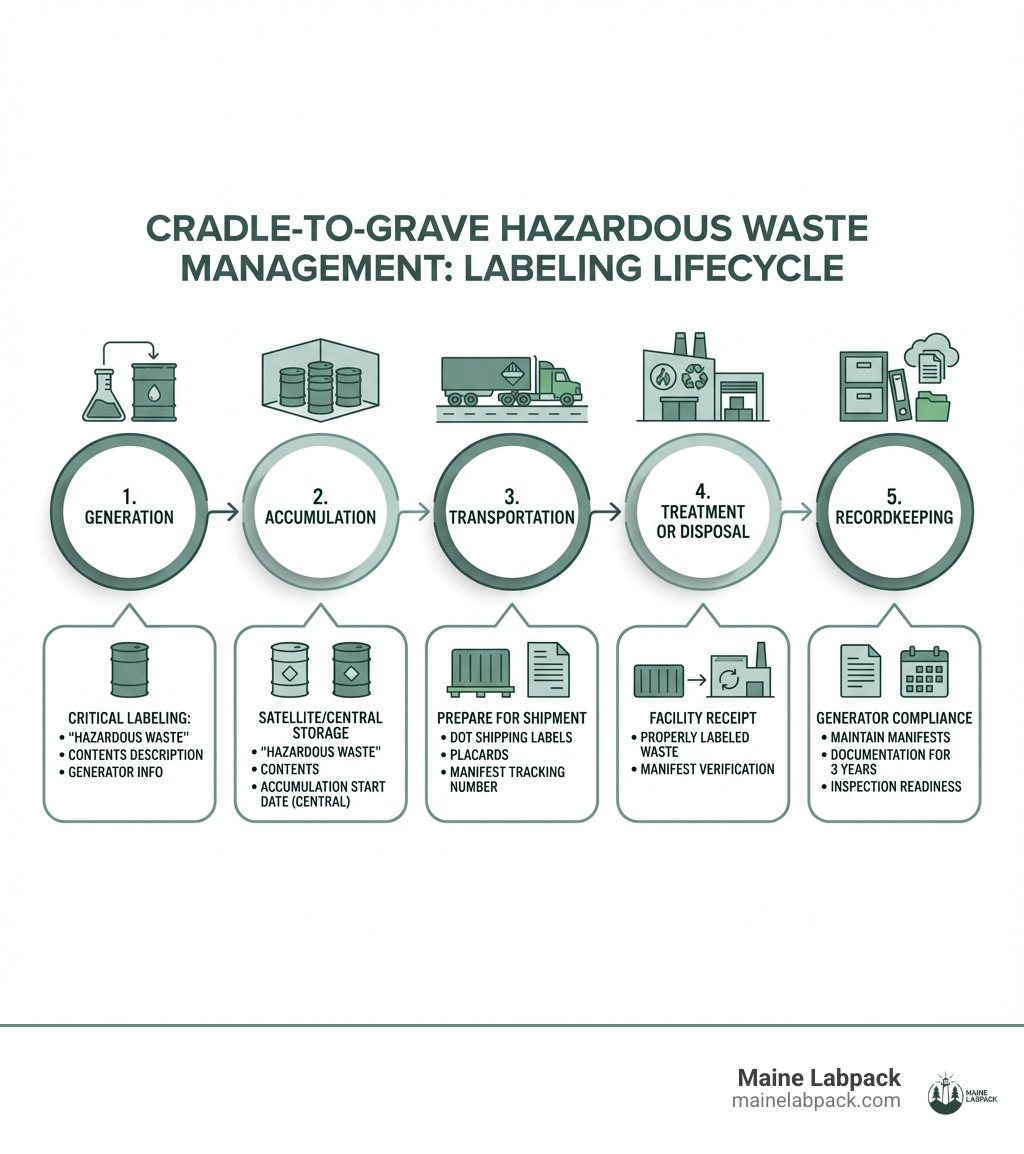
Hazardous waste labeling is the first line of defense in protecting your employees, your facility, and the environment from dangerous materials. If you’re managing hazardous waste, you need to know exactly what must be on every container, when to apply labels, and which regulatory bodies have jurisdiction over your operations.
Essential Hazardous Waste Label Requirements:
- “HAZARDOUS WASTE” – These exact words must appear on every container
- Generator Information – Your facility name, address, and EPA ID number
- Accumulation Start Date – When waste was first placed in the container (or when moved to Central Accumulation Area)
- Contents Description – Complete list of chemical constituents (no abbreviations or formulas)
- Hazard Indication – The primary dangers (e.g., Ignitable, Corrosive, Reactive, Toxic)
- Manifest Tracking Number – Required before transport off-site
Missing or inadequate labeling can trigger serious consequences. You’re looking at potential EPA fines, rejected shipments from disposal facilities, increased disposal costs, and most critically, safety risks like chemical exposures, fires, or accidental mixing of incompatible wastes.
The complexity comes from overlapping regulations. The EPA’s RCRA governs waste accumulation and disposal. OSHA’s HazCom rules apply to products in use. And the DOT has separate requirements once waste leaves your facility for transport.
Understanding the basics of hazardous waste determination is your starting point. Once you know a material is hazardous waste, proper labeling becomes mandatory—immediately.
The good news? While the regulations are detailed, compliance is straightforward when you understand what’s required at each stage of the waste lifecycle.
The Regulatory Maze: Who Makes the Rules?
Navigating hazardous waste can feel like traversing a labyrinth. Several key regulatory bodies establish the rules for hazardous waste labeling, each with a specific focus. These federal regulations apply across New England, including Maine, New Hampshire, Massachusetts, Vermont, and Rhode Island. States can sometimes implement regulations that are more stringent than federal requirements. Understanding these overlapping jurisdictions is crucial for compliance and safety.
The primary regulatory bodies governing hazardous waste labeling are:
- Environmental Protection Agency (EPA): The federal agency responsible for protecting human health and the environment. Through RCRA, the EPA sets the overarching framework for hazardous waste management.
- Resource Conservation and Recovery Act (RCRA): The federal law implemented by the EPA that governs the generation, transportation, treatment, storage, and disposal of hazardous waste. RCRA establishes the “cradle-to-grave” responsibility for hazardous waste.
- Occupational Safety and Health Administration (OSHA): This agency focuses on workplace safety and health. Its Hazard Communication Standard (HazCom) governs the labeling of hazardous chemicals in use within a facility.
- Department of Transportation (DOT): The DOT regulates the safe transportation of hazardous materials, including hazardous waste, when it’s moved off-site.
Ignoring these rules can lead to significant issues, including 5 common RCRA compliance violations that can result in hefty fines. For a broader understanding of the legal landscape, explore Hazardous Waste Regulations.
EPA and RCRA: The Foundation of Waste Management
The Resource Conservation and Recovery Act (RCRA) is the cornerstone of hazardous waste management in the United States. Enacted in 1976, RCRA gives the EPA the authority to control hazardous waste from its generation to its final disposal, a concept often referred to as “cradle-to-grave” responsibility. This means that generators of hazardous waste are responsible for it throughout its entire lifecycle.
A critical aspect of RCRA compliance is understanding your generator status, which dictates many of your specific requirements, including hazardous waste labeling. Generator status is determined by the amount of hazardous waste a facility generates per calendar month:
- Very Small Quantity Generators (VSQGs): Generate 100 kg (220 lbs) or less of non-acute hazardous waste per month, and 1 kg (2.2 lbs) or less of acute hazardous waste per month. VSQGs have the fewest federal regulations, but some state-level requirements may apply.
- Small Quantity Generators (SQGs): Generate more than 100 kg but less than 1,000 kg (2,200 lbs) of non-acute hazardous waste per month, and 1 kg or less of acute hazardous waste per month. SQGs have more stringent requirements than VSQGs, including accumulation time limits and personnel training.
- Large Quantity Generators (LQGs): Generate 1,000 kg (2,200 lbs) or more of non-acute hazardous waste per month, or more than 1 kg of acute hazardous waste per month. LQGs face the most comprehensive regulations, including strict accumulation limits, detailed training, and biennial reporting.
The amount of waste generated each month directly impacts the regulations that apply to your facility. For example, if a generator produces 75 kg of non-acute hazardous waste each month, they would be subject to VSQG regulations, provided they accumulate no more than 1,000 kg on site at any one time. However, if they exceed the 1,000 kg accumulation limit, even if their monthly generation is low, they might be subject to SQG standards.
All these regulations are detailed in Title 40 of the Code of Federal Regulations, specifically Part 262 for hazardous waste generators. Understanding how generator status impacts hazardous waste collection is key to maintaining compliance.
OSHA vs. RCRA: Product vs. Waste Labeling
It’s easy to get confused between OSHA’s and EPA’s labeling requirements because both deal with hazardous materials. However, their focus is distinct:
- OSHA’s Hazard Communication (HazCom) Standard (29 CFR § 1910.1200): This standard, aligned with the Globally Harmonized System (GHS), applies to hazardous chemicals in use within a workplace. Its purpose is to ensure employees are informed about the hazards of the chemicals they handle daily.
- EPA’s RCRA Program: This program applies once a chemical is no longer a product and becomes a hazardous waste. The labeling requirements shift from communicating product hazards to identifying the waste for proper management, transportation, and disposal.

Here’s a quick comparison of the key differences:
| Feature | OSHA HazCom Label Requirements (for chemicals in use) | EPA RCRA Label Requirements (for hazardous waste) |
|---|---|---|
| Purpose | Inform workers of chemical hazards, safe handling, and emergency procedures. | Identify hazardous waste for safe accumulation, transport, and disposal; ensure “cradle-to-grave” tracking. |
| Key Information | Product identifier, signal word (e.g., Danger, Warning), hazard statements, pictograms, precautionary statements, supplier information. | The words “HAZARDOUS WASTE”, Generator’s Name & Address, Accumulation Start Date, Manifest Tracking Number (for transport), Contents Description, Indication of Hazards (e.g., Ignitable, Corrosive, Reactive, Toxic). |
| Timing | Applied by manufacturer/importer; maintained on containers as long as chemical is in use. | Applied immediately when waste is first placed in a container. |
| Governing Law | Occupational Safety and Health Act (OSH Act), OSHA’s Hazard Communications Program (HazCom) | Resource Conservation and Recovery Act (RCRA), 40 CFR Part 262 |
| Appearance | Standardized GHS pictograms, often black on white diamonds with red borders. | Often a yellow label with black text; no specific pictogram requirement but hazard statements are crucial. |
| Primary Goal | Prevent exposure and injury during chemical use. | Prevent improper disposal and environmental contamination. |
Once a chemical becomes hazardous waste, the OSHA HazCom label is no longer sufficient; the EPA RCRA labeling requirements take precedence.
DOT: Labeling for Transport
When hazardous waste leaves your facility for off-site treatment, storage, or disposal, the Department of Transportation (DOT) steps in. The DOT regulates the safe transit of hazardous materials, including waste, across roads, railways, air, and water. This means additional labeling requirements come into play, primarily outlined in 49 CFR Part 172.
The DOT’s regulations focus on communicating hazards to transporters and emergency responders during transit. Key elements include:
- Proper Shipping Name: A standardized name for the hazardous material (e.g., “Waste Flammable Liquid, N.O.S.”).
- UN Identification Number: A four-digit number assigned to hazardous substances and articles (e.g., UN1993).
- Hazard Class and Division: Classifies the type of hazard (e.g., Class 3 for Flammable Liquids).
- DOT Labels: Diamond-shaped labels (at least 100 mm on all sides) affixed to individual packages, indicating the hazard class.
- Placards: Larger, diamond-shaped signs (at least 250 mm on all sides) displayed on the exterior of transport vehicles, tanks, or large containers, signifying the primary hazard(s) of the cargo.
Before transporting or offering hazardous waste for transportation off-site, a generator must label each package in accordance with the applicable DOT regulations on hazardous materials under 49 CFR part 172. This means your hazardous waste labeling must satisfy both EPA RCRA requirements for accumulation and DOT requirements for transport.
Understanding the difference between dangerous goods & hazardous materials is crucial here, as DOT uses the term “hazardous materials” to encompass both. For more details on these visual cues, refer to dangerous goods labels & markings.
Anatomy of a Compliant Hazardous Waste Label
A proper hazardous waste label is more than just a sticker; it’s a critical communication tool that ensures safety, compliance, and efficient waste management. According to EPA/RCRA regulations, these labels must be legible, durable, and prominently displayed on every hazardous waste container. They need to withstand the conditions of storage and handling without fading or detaching. Handmade labels are generally discouraged due to their potential for illegibility or damage.
For a visual breakdown, check out the anatomy of a hazardous waste label.
Core EPA & RCRA Hazardous Waste Labeling Requirements
Here’s a breakdown of the specific information that must be included on your hazardous waste label to comply with EPA RCRA regulations:
- The words “HAZARDOUS WASTE”: These exact words must be clearly and prominently displayed on the label. This immediately identifies the container’s contents as regulated waste.
- Generator Information: This includes the full name and address of the generator (your facility) and your facility’s EPA Identification Number. This ensures accountability and traceability.
- Manifest Tracking Number: Once the waste is prepared for off-site transportation, the unique manifest tracking number must be added to the label. This number links the waste to its corresponding manifest, enabling cradle-to-grave tracking.
- Accumulation Start Date: This is the date when hazardous waste was first placed into the container, or, in the case of a Satellite Accumulation Area (SAA), the date when the container reached its volume limit (55 gallons for non-acute, 1 quart/1 kg for acute hazardous waste) and was moved to a Central Accumulation Area (CAA). This date is crucial for tracking accumulation time limits (e.g., 90 days for LQGs, 180 days for SQGs).
- “Federal Law Prohibits Improper Disposal” Text: Labels for non-bulk containers (typically 119 gallons or less) must include the statement: “HAZARDOUS WASTE–Federal Law Prohibits Improper Disposal. If found, contact the nearest police or public safety authority or the U.S. Environmental Protection Agency.” This text, along with the generator’s information and EPA ID, is a critical component for proper tracking and emergency response.
These core elements ensure that anyone encountering the waste, from facility personnel to emergency responders, can quickly identify it and understand its regulatory status.
Describing the Contents: What’s Inside?
Beyond the administrative details, the hazardous waste label must also accurately describe the actual contents of the container. This is vital for safety, proper handling, and appropriate disposal.
- Chemical Constituents: The label must list the complete chemical constituents of the waste. This means no chemical formulas or abbreviations should be used. For example, instead of “MeOH,” write “Methanol.”
- Percentages: While perfect accuracy isn’t always feasible, providing approximate percentages of the constituents is important. A concentration accuracy of ±5% is generally acceptable. For instance, “Halogenated Waste: Dichloromethane 60%, Chloroform 30%, Water 10%.”
- Listing Trace Amounts: If constituents are present in very small quantities, typically less than 1%, they can be listed as “trace.” However, it’s a best practice to list all known hazardous constituents, even in trace amounts, to provide a comprehensive picture of the waste.
- Indication of Hazards: The label must clearly indicate the primary hazards of the contents. This helps personnel understand the immediate risks. Common hazard characteristics include:
- Ignitable: Can catch fire easily (e.g., solvents, paints).
- Corrosive: Can corrode metal or burn skin (e.g., strong acids or bases).
- Reactive: Unstable, can explode or produce toxic fumes when mixed with water or other materials.
- Toxic: Harmful or fatal when ingested, inhaled, or absorbed through the skin.
This detailed description ensures that waste handlers and disposal facilities know exactly what they are dealing with, preventing accidental mixing of incompatible wastes and ensuring the waste is treated or disposed of safely. Understanding the distinction between toxic vs. hazardous waste: what’s the difference? can also help in accurately characterizing your waste.
Practical Application: Labeling in Your Facility
Effective hazardous waste labeling isn’t just about sticking on a label; it’s about implementing a robust system within your facility. This involves clear procedures, well-defined roles and responsibilities, and ongoing employee training to ensure everyone understands their part in maintaining compliance and safety.
All chemical waste, regardless of where it is stored or how it is managed, must be properly labeled as soon as waste is added to a container. This “point of generation” labeling is a cornerstone of RCRA compliance.
Proper training programs are essential to communicate hazardous waste labeling requirements effectively to employees. This training should cover:
- Regulatory mandates: What information is required on labels and why.
- Waste determination: How to identify hazardous waste.
- Labeling procedures: When, where, and how to apply labels, including filling out content descriptions and accumulation start dates.
- Hazard recognition: Understanding the meaning of ignitable, corrosive, reactive, and toxic.
- Emergency procedures: What to do in case of a spill or leak involving labeled waste.
Establishing a clear chain of command for hazardous waste labeling and management is a best practice. This might include designating a hazardous waste coordinator, ensuring departmental supervisors are responsible for labeling in their areas, and providing specific training for personnel who prepare waste for shipment. For comprehensive guidance on managing chemicals safely, consider writing an effective chemical hygiene plan. Neglecting these steps can lead to 6 common hazardous waste handling mistakes and how to avoid them.
Best Practices for Hazardous Waste Labeling
Adopting best practices for hazardous waste labeling goes a long way in ensuring safety and compliance:
- Label Immediately at Point of Generation: As soon as the first drop of hazardous waste is added to a container, it must be labeled with the words “Hazardous Waste” and an indication of its hazards. This prevents confusion and ensures proper handling from the outset.
- Satellite Accumulation Areas (SAAs): These are areas at or near the point of waste generation, under the control of the operator. In an SAA, you can accumulate up to 55 gallons of non-acute hazardous waste or 1 quart/1 kg of acute hazardous waste. Containers in SAAs must be labeled with “Hazardous Waste” and an indication of the hazards. Once the volume limit is reached, the container must be dated, and the waste moved to a Central Accumulation Area (CAA) within three consecutive calendar days.
- Central Accumulation Areas (CAAs): These are designated areas where hazardous waste is accumulated for longer periods (e.g., 90 or 180 days, depending on generator status). Containers in CAAs must also be labeled with “Hazardous Waste,” an indication of hazards, and a clearly marked accumulation start date.
- Secondary Containers: If you transfer a hazardous chemical from its original labeled container to a secondary container (e.g., a smaller beaker, spray bottle), that secondary container must also be labeled with the chemical’s identity and appropriate hazard warnings, as per OSHA’s HazCom standard. Once that chemical becomes waste, the RCRA labeling rules apply.
- Weekly Inspections: For SQGs and LQGs, weekly inspections of containers in central accumulation areas are required to check for leaks, deterioration, and proper labeling. While not federally mandated for VSQGs or SAAs, it’s a best practice to regularly inspect all hazardous waste containers.
- Durability and Legibility: Labels must be durable enough to withstand the conditions of storage and handling (e.g., moisture, temperature fluctuations, chemical splashes) and remain legible. Avoid handwritten labels that can easily smudge or fade; use printed labels where possible.
- Audits: Regularly auditing your hazardous waste labeling system and practices is crucial for identifying and correcting deficiencies. This ensures ongoing compliance and reinforces best practices among employees. The importance of scheduling regular hazardous waste audits cannot be overstated.
For specific requirements regarding waste storage, including container conditions and accumulation limits in New England, refer to Maine hazardous waste storage requirements.
Special Considerations for Hazardous Waste Labeling
While the core requirements for hazardous waste labeling are consistent, certain waste types or situations demand specific nuances:
- Universal Waste: This category includes common hazardous wastes that are generated by a wide variety of establishments and are subject to streamlined collection standards. Universal wastes include batteries, lamps (light bulbs), mercury-containing equipment (e.g., thermostats), and aerosol cans. While less stringent than full RCRA hazardous waste, universal wastes still require specific labeling:
- Batteries: Must be labeled with “Universal Waste—Battery(ies),” “Waste Battery(ies),” or “Used Battery(ies).”
- Lamps: Must be labeled with “Universal Waste—Lamp(s),” “Waste Lamp(s),” or “Used Lamp(s).”
- Mercury-Containing Equipment: Must be labeled with “Universal Waste—Mercury Containing Equipment,” “Waste Mercury-Containing Equipment,” or “Used Mercury-Containing Equipment.”
- Aerosol Cans: Must be labeled with “Universal Waste—Aerosol Can(s),” “Waste Aerosol Can(s),” or “Used Aerosol Can(s).”
These labels help differentiate them from other hazardous wastes and facilitate universal waste recycling.
- Empty Containers: An empty container that will be used for hazardous waste doesn’t need a “Hazardous Waste” label until waste is actually added. However, it’s a good practice to clearly identify containers intended for hazardous waste to prevent accidental misuse. Once waste is added, the full hazardous waste labeling requirements apply immediately.
- Lab Packs: A “lab pack” is a common method for disposing of small containers of various hazardous chemicals, often from laboratories. While individual containers within a lab pack must be properly identified, the outer packaging of the lab pack itself will have a consolidated hazardous waste label that meets DOT requirements for transport. Chemical lab packs require expert knowledge for proper preparation and labeling.
- Unknown Chemicals: If you encounter an unknown chemical that could be hazardous, it must be treated and labeled as hazardous waste pending analysis. The label should indicate “Hazardous Waste Pending Analysis” and include any known or suspected hazards (e.g., “Ignitable,” “Corrosive”). This proactive approach ensures safety until the waste can be properly characterized. For more on this, see unknown chemicals: identification & prevention.
- Trace Amounts: As mentioned earlier, constituents present in less than 1% concentration can be listed as “trace” on the label. The key is to still list all known hazardous components to provide a comprehensive and accurate description of the waste.
Consequences of Improper Labeling
The repercussions of improper or missing hazardous waste labeling can be severe, impacting safety, compliance, and your bottom line:
- Fines and Penalties: Regulatory bodies like the EPA and state environmental agencies (e.g., Maine DEP, New Hampshire DES, Massachusetts DEP) impose significant fines for non-compliance. These penalties can range from thousands to tens of thousands of dollars per violation per day. Missing or incorrect labels are among the most common citations during inspections.
- Safety Risks: Inadequate labeling poses immediate and serious safety hazards to employees, emergency responders, and the public. Without clear information about the contents and hazards of a container, workers might unknowingly mix incompatible chemicals, leading to fires, explosions, or the release of toxic fumes. Accidental exposure to unlabeled hazardous waste can cause severe health effects.
- Environmental Contamination: Improperly labeled waste is more likely to be mishandled or disposed of incorrectly, increasing the risk of spills or releases that can contaminate soil, water, and air. This can lead to costly and lengthy environmental cleanups.
- Increased Disposal Costs: Waste disposal facilities rely on accurate hazardous waste labeling to properly categorize and process incoming materials. If labels are missing, illegible, or incorrect, the facility may refuse the shipment, or require expensive re-characterization and re-labeling, significantly increasing your disposal costs.
- Rejected Shipments: Transporters and Treatment, Storage, and Disposal Facilities (TSDFs) are legally obligated to reject improperly labeled hazardous waste. This can cause logistical nightmares, delays, and additional costs as you scramble to re-label and reschedule shipment.
- Reputational Damage: Beyond legal and financial penalties, a history of non-compliance can severely damage your organization’s reputation, affecting public trust and business relationships.
Avoiding these consequences starts with a commitment to proper hazardous waste labeling. It’s a fundamental step in surviving a DEP audit and maintaining a safe, compliant operation.
Frequently Asked Questions about Hazardous Waste Labeling
When exactly does a container need to be labeled?
A container must be labeled with the words “Hazardous Waste” and an indication of its hazards as soon as the first drop of waste is placed inside, as specified under RCRA regulations like 40 CFR § 262.15. This is known as labeling at the “point of generation.” The accumulation start date is marked when the container is full (in an SAA) or when it’s moved to a Central Accumulation Area.
Can I use systems like HMIS or NFPA diamonds on my waste labels?
While third-party systems like the Hazardous Materials Identification System (HMIS) or National Fire Protection Association (NFPA) diamonds are excellent for communicating hazards to employees and first responders, they are supplemental. They do not replace the mandatory labeling information required by the EPA under RCRA. You can use them in addition to the required RCRA label elements, especially as a way to indicate the hazards of the contents. For instance, the EPA accepts OSHA Hazard Communication Standard labels, NFPA Code 704, or GHS hazard communication systems as ways to indicate hazards on a RCRA label.
How do I get official hazardous waste labels?
You can obtain compliant labels from your hazardous waste management partner, purchase them from a safety supply company, or use an online waste management system (e.g., Chematix, SciShield) to generate and print them. The key is ensuring they contain all federally and state-mandated information. Many hazardous waste management companies, like Maine Labpack, provide compliant labels as part of their service to ensure your containers are always correctly marked.
Stay Compliant with Expert Guidance
Proper hazardous waste labeling is a non-negotiable aspect of safety and regulatory compliance. The rules are complex, multi-layered, and the stakes are high. From understanding the nuances between OSHA, EPA, and DOT requirements to accurately describing chemical constituents and managing accumulation start dates, every detail matters. Partnering with an expert ensures your facility avoids costly fines, prevents safety incidents, and contributes to a healthier environment.
Maine Labpack specializes in professional, on-time, and sustainable chemical and hazardous materials disposal, acting as a one-stop shop that comes to your site across New England. For comprehensive management of your waste streams, from labeling to final disposal, trust the experts. Learn more about our Hazardous Waste Disposal services and how we can help you achieve hazardous waste compliance.