

Why Hazmat Compliance Matters for Your Facility
Hazmat compliance is the process of following federal regulations for classifying, packaging, labeling, documenting, and transporting hazardous materials to protect public safety and the environment. Facilities that generate, store, or ship hazardous materials must comply with regulations enforced by the Department of Transportation (DOT), Environmental Protection Agency (EPA), and Occupational Safety and Health Administration (OSHA).
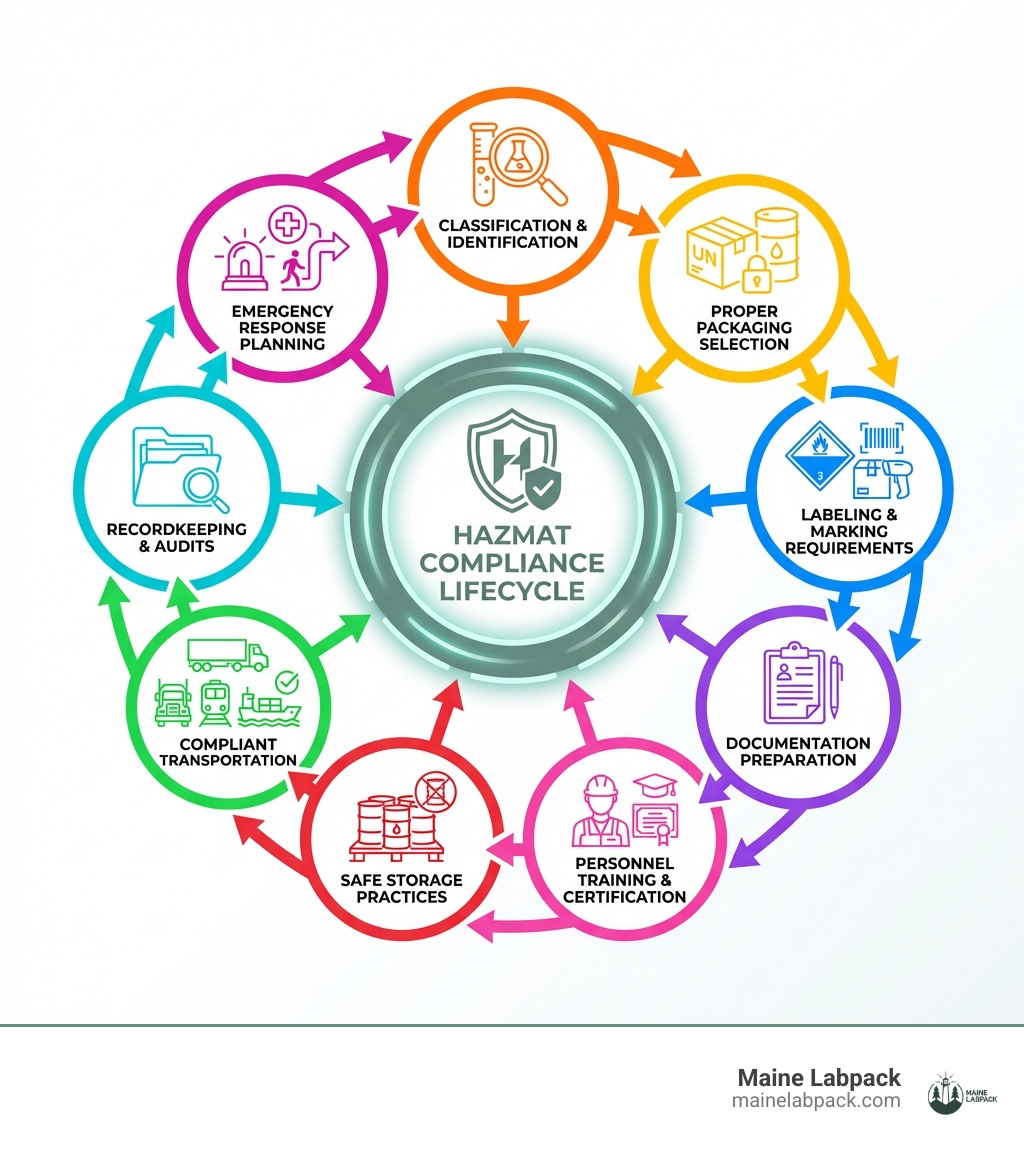
Key aspects of hazmat compliance include:
- Classification – Determining hazard class and packing group using the Hazardous Materials Table
- Packaging – Using performance-oriented, UN-rated containers that meet testing standards
- Labeling and Marking – Applying proper hazard labels, UN numbers, and shipping information
- Documentation – Preparing shipping papers, manifests, and emergency response information
- Training – Ensuring employees complete required training every three years
- Storage – Following secondary containment and segregation requirements
Every day, millions of tons of hazardous materials move through the United States. When facilities fail to comply with regulations, they face serious consequences: civil penalties up to $79,976 per violation, shipment delays, and potential harm to workers and communities.
Following the Lac-Megantic tragedy in 2013, where a rail disaster involving hazardous materials devastated a community, regulatory oversight intensified. Today’s compliance requirements reflect hard-learned lessons about the critical importance of proper hazmat handling.
For facilities in New England, navigating these complex regulations can feel overwhelming. But understanding the core requirements protects your operations, your employees, and your community. This guide breaks down everything you need to know about staying compliant with hazmat regulations in the United States.
The Regulatory Framework for Hazmat Compliance
Navigating hazmat compliance requires an understanding of which government agencies are watching and what rules they are enforcing. In the United States, several heavy hitters overlap to ensure that chemicals and dangerous goods don’t cause chaos during storage or transit.
The primary authority for hazardous materials in motion is the United States Department of Transportation. Under the DOT, the Pipeline and Hazardous Materials Safety Administration (PHMSA) writes the rules that govern how materials are moved by highway, rail, air, and water. These rules are known as the Hazardous Materials Regulations (HMR).
However, hazmat compliance isn’t just about the road. The EPA manages hazardous waste through the Resource Conservation and Recovery Act (RCRA), ensuring that “cradle-to-grave” management prevents environmental contamination. Meanwhile, OSHA steps in to protect the people handling these materials on-site, requiring specific communication and safety standards. Understanding How Toxic Waste is Defined by DOT, RCRA, OSHA is the first step in ensuring a facility doesn’t fall through the cracks of these overlapping jurisdictions.
PHMSA and the Hazardous Materials Regulations (HMR)
If you are looking for the “bible” of hazmat compliance, you will find it in Title 49 of the Code of Federal Regulations, specifically Parts 100-185. This is where the PHMSA outlines the safety standards for everything from lithium batteries to industrial acids.
The Electronic Code of Federal Regulations (e-CFR: Title 49 CFR Parts 100-185) provides daily updates to these rules. Staying current is vital because PHMSA frequently issues new rulemakings and safety advisories. For example, a facility might be perfectly compliant one day and out of step the next due to a change in how a specific chemical must be packaged.
Achieving Hazmat Compliance means more than just reading the book; it requires applying these standards to every single shipment that leaves a loading dock. This includes ensuring that the materials are classified correctly, the packaging is strong enough for the specific hazard, and the carrier is authorized to handle the load.
The Role of GHS in Global Hazmat Compliance
While the DOT governs transportation in the U.S., the Globally Harmonized System of Classification and Labelling of Chemicals (GHS) provides the international framework that keeps everyone on the same page. GHS was developed by the United Nations to standardize how we communicate chemical hazards across borders.
In the U.S., OSHA has aligned its Hazard Communication Standard (HCS) with GHS. This means that Safety Data Sheets (SDS) and workplace labels must follow a specific format. This standardization is a huge win for hazmat compliance because it ensures that a “flammable” symbol in Massachusetts means the same thing as a “flammable” symbol in Europe or Asia.
GHS impacts hazmat compliance by:
- Standardizing SDS: Ensuring emergency responders and employees have clear, consistent information.
- Improving Labeling Consistency: Using specific pictograms and signal words (like “Danger” or “Warning”).
- Facilitating International Trade: Making it easier for New England businesses to ship products globally without re-classifying every chemical for every destination.
Core Requirements for Shipping and Handling
Before a single box of hazardous material is moved, a facility must perform a “hazardous materials determination.” This is the foundation of hazmat compliance. If the classification is wrong, every subsequent step—the packaging, the label, the manifest—will also be wrong.
The Basics of Hazardous Waste Determination involve identifying the physical and health hazards of a substance. Once identified, the material is assigned to one of nine hazard classes and, in many cases, a Packing Group.
Packing Groups and Degrees of Danger
Not all hazards are created equal. Some chemicals are “instantly-melt-your-shoes” dangerous, while others are “don’t-get-this-on-your-skin” dangerous. To account for this, the DOT uses Packing Groups (PG) to indicate the degree of danger:
- Packing Group I: Great Danger (requires the most robust packaging).
- Packing Group II: Medium Danger.
- Packing Group III: Minor Danger.
Understanding Hazmat Packing Group Degrees of Danger helps shippers select the correct performance-oriented packaging. This packaging has been tested to withstand drops, pressure changes, and vibrations. If a material is PG I, it must be in a container marked with an “X” rating. A “Y” rating is suitable for PG II, and a “Z” rating is for PG III.
Labeling, Marking, and Placarding Standards
Visual communication is the frontline of safety. Labels and markings tell everyone—from the warehouse worker to the firefighter—exactly what they are dealing with.
A common mistake in hazmat compliance is confusing “labels” with “markings.” Labels are the diamond-shaped hazard symbols (like the red flame for flammable liquids). Markings include the proper shipping name, the UN identification number (e.g., UN1203 for gasoline), and consignee information.
For those managing waste, Hazardous Waste Labels: A 101 Guide to Compliance is an essential resource. These labels must include specific information required by the EPA, such as the accumulation start date and the EPA waste code.
When it comes to the vehicle itself, placarding is required for certain quantities of hazardous materials. Placards are larger versions of hazard labels that are affixed to the outside of trucks or railcars. If a shipment contains more than 1,001 pounds of “Table 2” materials (like corrosives or flammable liquids), the vehicle must be placarded on all four sides.
To ensure your team gets it right, review these detailed guides:
Essential Documentation and Shipping Papers
If the labels are the “eyes” of hazmat compliance, the shipping papers are the “brains.” Every hazmat shipment must be accompanied by documentation that describes the material and provides instructions for what to do if things go wrong.
The primary document for most shipments is the shipping paper, which must include the “basic description”:
- Identification Number (UN/NA number)
- Proper Shipping Name
- Hazard Class or Division
- Packing Group (if applicable)
For hazardous waste, a Uniform Hazardous Waste Manifest is required. This document tracks the waste from the moment it is generated until it reaches a treatment, storage, or disposal facility (TSDF).
| Transport Mode | Key Documentation Required | Primary Authority |
|---|---|---|
| Road (Highway) | Shipping Paper / Manifest | DOT (49 CFR Part 177) |
| Rail | Waybill / Consistency Paper | DOT (49 CFR Part 174) |
| Air | Shipper’s Declaration for Dangerous Goods | IATA / ICAO / DOT |
| Water | Dangerous Cargo Manifest | IMDG / DOT |
The Part 172. PART 172—HAZARDOUS MATERIALS TABLE is the definitive source for determining which shipping name and hazard class to use. Additionally, all shipping papers must include a 24-hour emergency response telephone number that is monitored by someone knowledgeable about the material.
Training and Personnel Requirements
You can have the best containers and the clearest labels in the world, but if the people handling them don’t know what they are doing, hazmat compliance fails. The DOT is very strict about training. Anyone who “directly affects hazardous materials transportation safety” is considered a hazmat employee.
Hazmat employees must receive training in four key areas:
- General Awareness: Familiarity with the HMR and the ability to recognize hazards.
- Function-Specific: Detailed training on the specific tasks the employee performs (e.g., a person who types manifests needs different training than a person who loads trucks).
- Safety Training: How to handle materials safely and what to do in an emergency.
- Security Awareness: Recognizing and responding to potential security threats involving hazmat.
Training must occur within 90 days of hire (or a change in job function) and must be repeated at least every three years. For certain high-risk materials, “in-depth security training” is also required.
The Check the Box campaign by the DOT highlights the danger of “hidden” hazardous materials and emphasizes why training is so critical. Employers must maintain certification records for each employee, including their name, the training materials used, and the date of completion.
Avoiding Violations and Ensuring Audit Readiness
Fines for failing to maintain hazmat compliance are not just “the cost of doing business”—they are substantial enough to cripple a small operation. The FMCSA and state agencies like the Maine Department of Environmental Protection (DEP) regularly conduct audits and roadside inspections.
According to the Top HazMat Violations data, common issues include:
- Failing to provide required shipping papers.
- Improperly marked or labeled packages.
- Missing or incorrect placards on vehicles.
- Failing to train hazmat employees.
For facilities in New England, Surviving a DEP Audit requires meticulous recordkeeping. You should be able to produce the last three years of training records and manifests at a moment’s notice. It is also helpful to be aware of the 5 Common RCRA Compliance Violations to avoid the most frequent pitfalls.
Best Practices for Maintaining Hazmat Compliance
To stay ahead of the inspectors, facilities should implement a proactive compliance program. Here are several best practices:
- Conduct Self-Audits: Don’t wait for the government to show up. Use a checklist to inspect your storage areas and shipping docs monthly.
- Follow Segregation Tables: Never store or ship incompatible chemicals together (e.g., acids and bases). The DOT Segregation Table in 49 CFR 177.848 is your guide.
- Use Secondary Containment: In states like Maine and New Hampshire, Maine Hazardous Waste Storage Requirements often mandate secondary containment (like spill pallets) to prevent leaks from reaching the floor or drains.
- Monitor Safety Advisories: Keep an eye on specific risks, such as the Nurse Tank Safety Advisory, which warns of catastrophic failures in certain specialized tanks.
- Keep Records Organized: Maintain a central file for all SDS, training logs, and manifests.
Frequently Asked Questions about Hazmat Regulations
What are the primary hazard classes?
The DOT classifies hazardous materials into nine primary classes based on their chemical and physical properties:
- Class 1: Explosives (e.g., dynamite, fireworks)
- Class 2: Gases (e.g., propane, oxygen)
- Class 3: Flammable Liquids (e.g., gasoline, alcohol)
- Class 4: Flammable Solids (e.g., magnesium, matches)
- Class 5: Oxidizers and Organic Peroxides (e.g., ammonium nitrate)
- Class 6: Toxic (Poisonous) and Infectious Substances (e.g., cyanide, medical waste)
- Class 7: Radioactive Materials (e.g., uranium)
- Class 8: Corrosives (e.g., sulfuric acid, bleach)
- Class 9: Miscellaneous Hazardous Materials (e.g., lithium batteries, dry ice)
How often is hazmat training required?
For most businesses, hazmat training is required every three years. However, if there are significant changes to the regulations or if an employee changes job functions, they must receive new training immediately. New employees can work under the direct supervision of a trained employee for up to 90 days while they complete their certification.
What is the difference between hazardous materials and dangerous goods?
While the terms are often used interchangeably, there is a technical difference. “Hazardous materials” is the term primarily used by the DOT and EPA in the United States. “Dangerous goods” is the international term used by IATA (for air) and the IMDG (for sea).
Generally, if you are shipping by truck in Maine, you are shipping “hazardous materials.” If you are shipping that same box via an international airline, it becomes “dangerous goods.” For a deeper dive, see Understanding the Difference Between Dangerous Goods & Hazardous Materials.
Stay Compliant, Reduce Risk, and Get Expert Hazmat Help
Hazmat compliance is a heavy responsibility, but it doesn’t have to be a burden. By focusing on proper classification, robust training, and meticulous documentation, facilities can ensure they are protecting their employees and the environment while avoiding costly fines.
For businesses in Maine, Maine Labpack is here to help. They provide professional, on-time, and sustainable chemical and hazardous materials disposal. As a one-stop shop that comes directly to your site, they simplify the complexities of Hazardous Waste Disposal.
Whether your facility is in York, Portland, or Bangor, staying compliant is easier when you have an expert partner. By following the guidelines in this guide and seeking professional assistance when needed, you can steer hazardous materials with confidence and peace of mind.