
Cannabis wastewater disposal is one of the most overlooked compliance risks in the cannabis industry — and one of the most consequential if handled incorrectly.
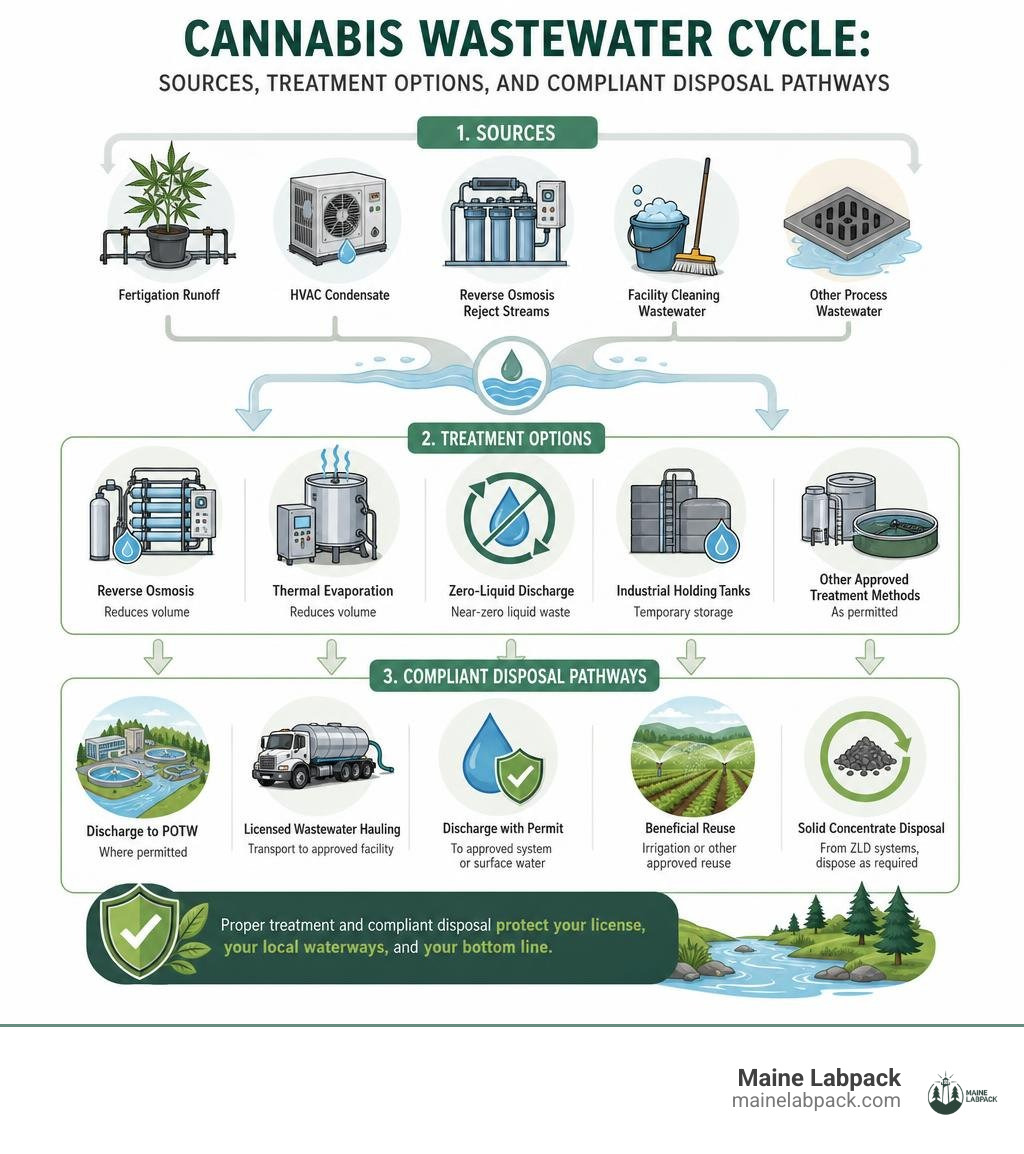
The main compliant disposal options include:
- Discharge to a Publicly Owned Treatment Works (POTW) where permitted by the local sewer authority
- Licensed wastewater hauling for facilities without approved sewer access
- On-site treatment such as reverse osmosis or evaporation to reduce hauled volume
- Zero-liquid discharge systems that leave only a concentrated residual or solid waste stream
- Industrial holding tanks for temporary storage before hauling or treatment
Cannabis cultivation wastewater can contain nutrients, salts, cleaning chemicals, disinfectants, and other residues that make it unsuitable for ordinary septic systems or unapproved drains. Most jurisdictions treat it as non-domestic industrial wastewater, which means disposal usually requires local approval, documentation, and sometimes pre-treatment.
For cannabis facilities in Maine and across New England, getting disposal right protects your license, your local waterways, and your bottom line.
Primary Wastewater Streams That Require Disposal Planning
Understanding the source of each wastewater stream helps determine whether it can be discharged, stored, treated, or hauled as an industrial waste.
Fertigation Runoff
Fertigation runoff contains concentrated nitrogen, phosphorus, potassium, dissolved salts, and other nutrient residues. Even though hydroponic wastewater is mostly water, its elevated Total Dissolved Solids (TDS) can trigger sewer authority limits or require pre-treatment before discharge.
HVAC Condensate
HVAC and dehumidification systems generate condensate from indoor grow rooms. This stream may be cleaner than fertigation runoff, but it can still pick up metals from coils or biological contaminants from the facility environment. It should be verified before reuse or discharge.
Reverse Osmosis Reject
Reverse osmosis (RO) systems create a clean permeate stream and a concentrated reject stream. RO reject can have several times the TDS of incoming water, making it a common driver of industrial wastewater disposal costs.
Facility Cleaning Water
Cleaning floors, benches, pots, and irrigation lines can generate wastewater containing soaps, sanitizers, and disinfectants. These chemicals can disrupt municipal treatment systems, so facilities should segregate, document, and manage cleaning water carefully.
For a deeper look at handling diverse facility waste streams, see this Practical Cannabis Waste Management Guide.
Regulatory Frameworks Governing Cannabis Wastewater Disposal
Because cannabis wastewater may contain nutrients, salts, solvents, disinfectants, or chemical residues, environmental agencies often classify it as non-domestic or industrial wastewater. It cannot be treated like ordinary bathroom or kitchen wastewater.
At the federal level, direct discharge of industrial wastewater into surface waters of the United States requires a National Pollutant Discharge Elimination System (NPDES) permit under the Clean Water Act. State environmental agencies and local sewer authorities may add additional discharge, storage, hauling, and reporting requirements.
To learn more about grow room waste handling, read this Guide to Disposing of Grow Room Waste. For administrative context on non-domestic classifications, these Cannabis Facility Wastewater FAQs explain how environmental conservation departments define agricultural and industrial discharges.
State-Specific Permitting And Compliance
In New England, cannabis wastewater compliance usually depends on both state rules and local sewer authority approval:
- Maine: The Maine Department of Environmental Protection (DEP) regulates cannabis waste streams closely. Under Maine’s Cannabis-Sector Environmental Guidance, cultivators must ensure that no industrial wastewater is discharged to groundwater or surface water without the proper DEP permits. Facilities should also coordinate with local utilities for sewer approvals and any associated hazardous chemical management. For local guidance, consult this Maine Cannabis Waste Management Guide.
- Massachusetts: MassDEP prohibits discharging cannabis wastewater into standard on-site septic systems. Cultivators generally need approved municipal sewer discharge or a certified industrial holding tank permitted under 314 CMR 18.00 for off-site disposal.
Wastewater Treatment And Disposal Options
Cultivators have several disposal pathways, each with different compliance obligations and cost implications.
Publicly Owned Treatment Works (POTW)
Discharging to a municipal sewer system is often the lowest-cost option, but it requires approval from the local sewer authority. The POTW may set limits for pH, temperature, TDS, nutrients, and chemical constituents. If the wastewater exceeds those limits, the facility must pre-treat it before discharge.
Direct Discharge
Direct discharge to a stream, river, wetland, or land application area is highly regulated and usually requires an NPDES permit or state equivalent. For many indoor cultivators, the monitoring, sampling, and reporting burden makes direct discharge impractical.
Industrial Holding Tanks
Facilities without approved sewer access may need certified industrial holding tanks. These tanks must be properly engineered, monitored, and pumped by a licensed wastewater hauler.
| Disposal Method | Primary Benefit | Main Drawback | Best Suited For |
|---|---|---|---|
| POTW Discharge | Low operating cost | Requires sewer access and approval | Urban or suburban facilities |
| Wastewater Hauling | Avoids on-site discharge | High ongoing cost | Rural facilities without sewer |
| On-Site Treatment | Reduces hauled volume | Higher upfront cost | Medium-to-large facilities |
| Holding Tanks | Simple storage option | Requires frequent hauling | Smaller unsewered facilities |
On-Site Volume Reduction Technologies
On-site treatment can reduce the volume of liquid waste that must be hauled or discharged:
- Reverse Osmosis (RO): Recovers a portion of wastewater as reusable water and leaves a smaller concentrated reject stream.
- Thermal Evaporation: Uses heat to concentrate liquid waste into a much smaller slurry or residual.
- Zero-Liquid Discharge (ZLD): Combines filtration, RO, and evaporation to recycle water and leave a concentrated residual or solid waste stream.
Cost Implications And Trade-Offs Of Disposal Methods
Every wastewater strategy balances upfront equipment cost against ongoing disposal expense.
Wastewater Hauling
Hauling untreated wastewater can be expensive because the facility pays to pump, transport, and dispose of large liquid volumes. For facilities without sewer access, hauling may still be the simplest compliant option — especially when paired with holding tanks and clear disposal documentation.
POTW Sewer Discharge
If a facility has approved POTW access, sewer discharge is usually far less expensive than hauling. However, facilities may need sampling, permits, pH adjustment, solids separation, or other pre-treatment before the sewer authority will allow discharge.
On-Site Treatment CAPEX vs. OPEX
Reverse osmosis, evaporation, and ZLD systems require capital investment, but they can reduce hauled volume substantially. The best option depends on wastewater chemistry, local discharge limits, available space, electricity costs, and how often the facility currently pays for hauling.
Financial Impact Of Volume Reduction
For a facility generating 1,000 gallons of wastewater per day, hauling the full volume can quickly become a major operating expense. Volume reduction lowers the number of gallons that need off-site disposal, which can turn daily hauling into occasional concentrate management.
A practical compliance plan should compare:
- Current wastewater volume and chemistry
- Sewer authority limits and permit costs
- Holding tank and hauling frequency
- Treatment equipment cost and maintenance
- Disposal requirements for the concentrated residual
Environmental Impacts And Best Practices
Improper wastewater disposal can threaten a cannabis license and contaminate local waterways, soils, and groundwater.
Nutrient-rich runoff can introduce excess nitrogen, phosphorus, salts, sediment, and chemical residues into streams or groundwater. Cleaning chemicals and disinfectants can also interfere with biological treatment systems if discharged without approval.
To prevent these issues, cultivators should manage liquids alongside solid cannabis waste using secure destruction, rendering, and documentation procedures. Learn more about compliant cannabis waste rendering for related plant material and associated waste streams.
Environmental Risks Of Improper Cannabis Wastewater Disposal
Wastewater dumped into unapproved septic systems or onto the ground can leach through soil and contaminate groundwater. This is especially serious in rural areas that rely on private wells.
Research also shows that some cannabis-related organic compounds can persist in waste treatment residuals. One study on cannabinoids in sewage sludge and biosolids found that lipophilic compounds such as THC and its metabolites can accumulate in solid particulate fractions. This reinforces the need to keep raw cannabis waste streams out of ordinary disposal pathways unless the receiving system has approved them.
Best Management Practices For Compliance
Facilities can reduce disposal risk by building wastewater controls into daily operations:
- Characterize each waste stream before discharge, storage, hauling, or treatment.
- Segregate incompatible liquids, including cleaning chemicals, nutrient runoff, and any extraction-related residues.
- Use permitted holding tanks or approved sewer connections instead of unapproved drains or septic systems.
- Keep hauling manifests, sampling results, and permit records organized for inspections.
- Work with a qualified waste partner to determine whether any wastewater must be handled as hazardous waste.
Frequently Asked Questions About Cannabis Wastewater
Can cannabis wastewater be discharged into a standard septic system?
No. Standard residential septic systems are designed for domestic wastewater. Cannabis wastewater may contain salts, fertilizers, disinfectants, and other constituents that can damage the system or contaminate groundwater. Commercial facilities need proper environmental review and approval before using any on-site disposal system.
What is the difference between hazardous and non-hazardous cannabis wastewater?
Most cultivation wastewater is non-hazardous industrial waste. However, wastewater from extraction, manufacturing, solvent handling, heavy metals, or highly acidic or basic cleaning solutions may require a formal hazardous waste determination. Hazardous wastewater must be managed by properly licensed professionals and cannot be treated like ordinary sewer or septic wastewater.
How does volume reduction save money for cultivators?
Volume reduction technologies reduce the gallons that must be hauled or discharged. Instead of paying to remove large volumes of dilute wastewater, a facility may only need to manage a smaller concentrated residual.
Ready For Safer, Simpler Cannabis Wastewater Disposal?
Cannabis wastewater disposal requires more than a convenient drain or tank. Between state rules, sewer authority approvals, hazardous waste determinations, hauling costs, and environmental risks, cultivators need a practical plan for every liquid waste stream.
Maine Labpack helps cannabis facilities across Maine and New England manage hazardous and industrial waste safely and sustainably. From waste characterization and documentation to compliant disposal coordination, Maine Labpack acts as a local, one-stop compliance partner.
Protect your license, control disposal costs, and keep New England’s waters clean. Contact Maine Labpack today for professional cannabis waste management services.