
Medical waste disposal is regulated by which agency, which is one of the most common compliance questions healthcare facilities ask — and the answer surprises many people.
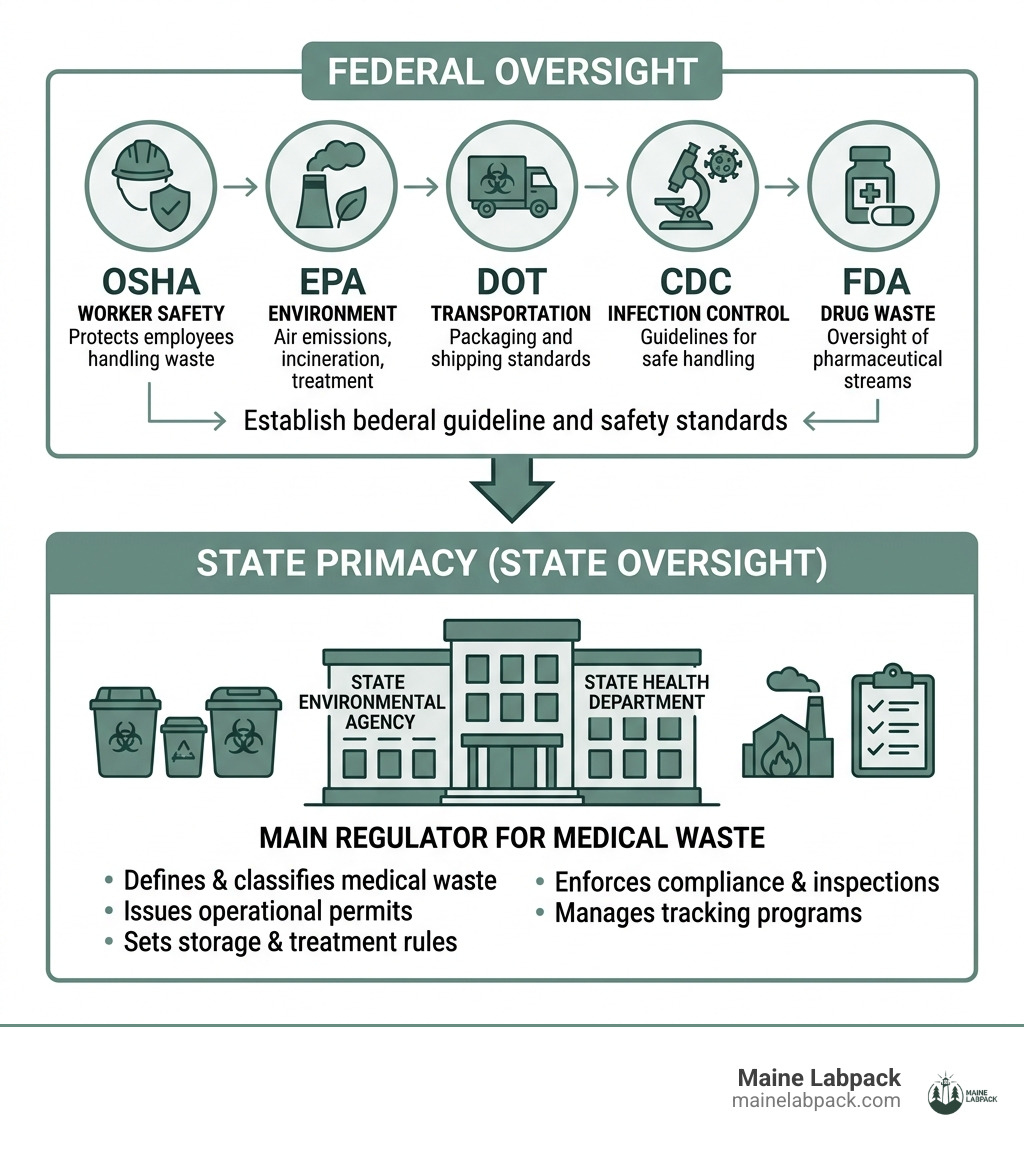
There is no single federal agency in charge. Responsibility is shared and layered:
| Level | Agency | Primary Role |
|---|---|---|
| State | State EPA or Department of Health | Primary regulator for most medical waste |
| Federal – Worker Safety | OSHA | Protects workers handling medical waste |
| Federal – Environment | EPA | Air emissions, chemical treatments, incinerators |
| Federal – Transport | DOT | Packaging and transport of biohazardous materials |
| Federal – Infection Control | CDC | Guidelines for safe waste handling |
| Federal – Drug Waste | FDA | Oversight of pharmaceutical waste streams |
The short answer: your state environmental or health agency sets the rules for how your facility must handle, store, treat, and dispose of regulated medical waste (RMW).
This wasn’t always the case. Before 1991, the EPA ran a short-term federal tracking program under the Medical Waste Tracking Act of 1988. When that program expired, states took over — and they’ve been in charge ever since.
That means a hospital in Maine faces different requirements than one in California or North Carolina. For facilities managing accumulated medical or hazardous waste, this patchwork of overlapping federal and state rules creates real compliance risk.
This guide breaks down exactly who regulates what — and what your facility needs to know to stay compliant.
Medical Waste Disposal Is Regulated By Which Agency?
When asking medical waste disposal is regulated by which agency, the most accurate answer is your state’s environmental protection or health department. This concept is known as “state primacy.” While the federal government provides a skeleton of safety and environmental standards, the muscle and skin of the regulations—the specific “how-tos”—belong to the states.
Historically, the federal government tried its hand at direct oversight. In the late 1980s, medical waste began washing up on beaches along the East Coast. This public outcry led to the Medical Waste Tracking Act (MWTA) of 1988. This was a two-year demonstration program that ran from June 1989 to June 1991 in four states—New York, New Jersey, Connecticut, and Rhode Island—and Puerto Rico.
The EPA used this period to study the problem and concluded that the risk of disease from medical waste is highest at the point of generation and tapers off significantly as it moves through the waste stream. Consequently, the EPA allowed the MWTA to expire. Since 1991, the EPA has not had the authority to regulate medical waste in the same way it regulates hazardous chemical waste under the Resource Conservation and Recovery Act (RCRA). Instead, RCRA views most medical waste as non-hazardous solid waste, leaving the heavy lifting of regulation to individual state programs.
Because states are in the driver’s seat, decoding RMW a guide to the classes of regulated medical waste is essential because one state might define “infectious” differently than its neighbor.
Federal Agencies Involved In Medical Waste Management
Even though states lead the way, several federal “guest stars” have specific cameos in the waste management process.
The Department of Transportation (DOT) is a major player once the waste leaves your facility. Because medical waste is considered a “Division 6.2 Infectious Substance,” the DOT regulates how it is packaged, labeled, and manifested for transport. If you are shipping waste across state lines—say, from a clinic in Portland, Maine, to a treatment facility in another New England state—DOT rules are the law of the land.
The Centers for Disease Control and Prevention (CDC) provides the scientific backbone for waste management through infection control guidelines. While the CDC isn’t an enforcement agency (they won’t come to your door with handcuffs), their evidence-based recommendations are often adopted into state law.
The Food and Drug Administration (FDA) oversees the “front end” of medical waste by regulating the devices that generate it—such as sharps and specialized disposal containers—and the pharmaceuticals that eventually become waste.
How OSHA Regulates Medical Waste Disposal
If you employ people who touch, carry, or treat medical waste, the Occupational Safety and Health Administration (OSHA) is your primary federal contact. OSHA’s Bloodborne Pathogens Standard is designed to protect workers from exposure to infectious materials.
OSHA requirements include:
- Exposure Control Plans: Written plans to minimize worker risk.
- Containment: Using leak-proof, puncture-resistant containers for sharps.
- Labeling: The famous fluorescent orange or orange-red biohazard symbol must be present on containers.
- Training: Workers must be trained annually on safe handling.
Understanding the 6 types of regulated medical waste helps facilities apply OSHA standards correctly. For instance, sharps disposal best practices medical waste management are specifically mandated by OSHA to prevent needlestick injuries, which were historically a major source of infection for healthcare and waste workers.
Why The EPA Regulates Medical Waste Disposal
While the EPA doesn’t track every bag of red-bag waste anymore, it still maintains a watchful eye through the Clean Air Act. Before 1997, more than 90% of infectious medical waste was incinerated on-site at hospitals. The EPA’s 1997 Hospital Medical Infectious Waste Incinerator (HMIWI) emission standards changed everything. These rules were so strict regarding mercury, dioxin, and particulate matter that most on-site incinerators were shut down in favor of cleaner technologies.
The EPA also regulates chemical treatments under the Federal Insecticide, Fungicide, and Rodenticide Act (FIFRA). If a company sells a chemical to “kill” pathogens in medical waste, that product must be registered with the EPA. This is particularly relevant for pharmaceutical waste and general medical waste treatment systems that rely on chemical disinfection rather than heat.
State Level Oversight And Regional Variations
Because states are the primary authority, the “Regulatory Maze” becomes quite literal when you cross state lines. Most states divide duties between their Department of Environmental Protection (DEP) and Department of Health (DOH). Generally, the Health Department handles on-site management (how you handle waste in the patient room), while the DEP handles the “cradle-to-grave” transport and disposal aspects.
Some states have incredibly robust acts, such as the California Medical Waste Management Act, which includes strict definitions for “trace chemotherapy” waste. Others, like North Carolina, have specific rules requiring medical waste to be sterilized before it can even enter a municipal landfill.
In New England, consistency is key for compliance. For facilities in Manchester, New Hampshire, or Worcester, Massachusetts, knowing the specific state limits on storage time is the difference between a clean audit and a heavy fine.
Maine Biohazardous Waste Guidelines
In our home state, the Maine DEP Chapter 900 rules govern biomedical waste. Maine defines biomedical waste as a subset of solid waste that presents a threat to human health due to its infectious nature.
Key requirements in Maine include:
- Registration: Generators must register with the DEP depending on the volume of waste produced.
- Packaging: Waste must be contained in red bags that meet specific tear-resistance and impact-strength standards.
- Storage: Waste must be stored in a secure, labeled area that protects it from the elements and pests.
Following Maine biohazardous waste guidelines recommendations is vital for staying within the law. Facilities should also consult a pocket guide cost medical waste disposal Maine to understand how volume and frequency of pickup impact their operational budget.
| Regulation Feature | Maine (DEP Chapter 900) | California (MWMA) | North Carolina |
|---|---|---|---|
| Primary Agency | Dept. of Environmental Protection | Dept. of Public Health | Dept. of Environmental Quality |
| Storage Time Limit | Varies by volume/temp | Up to 90 days (SQG) | No specific limit if not a nuisance |
| Treatment Required | Yes, before landfilling | Yes, via approved method | Yes, for most RMW |
| Sharps Handling | Puncture-resistant containers | Rigid, leak-resistant | Rigid, leak-proof |
Treatment Methods And Compliance Requirements
Once medical waste is collected, it must be treated to render it non-infectious before it can be disposed of as regular trash. Gone are the days when almost everything was burned. Today, approximately 90% of regulated medical waste is suitable for alternative treatments.
Common treatment methods include:
- Steam Sterilization (Autoclaving): The most common method. Waste is subjected to high-pressure steam (usually 250°F) for a set period (up to 90 minutes) to kill microorganisms.
- Microwaving: Waste is shredded, moistened, and heated with microwave energy to disinfect it.
- Chemical Disinfection: Used often for liquid waste or specialized equipment.
- Electropyrolysis: A high-heat process that breaks down waste in the absence of oxygen.
- Incineration: Now reserved mostly for pathological waste safe and compliant disposal and certain pharmaceutical wastes that cannot be treated by heat alone.
Regardless of the method, guidelines for storing medical waste must be followed until the moment of treatment to ensure no pathogens escape into the environment.
Frequently Asked Questions About Medical Waste Regulation
Why did federal regulation of medical waste change after 1991?
The shift occurred because the Medical Waste Tracking Act was designed as a temporary “demonstration program.” After the two-year period ended in 1991, the EPA concluded that medical waste did not require the same level of federal “cradle-to-grave” oversight as hazardous chemicals. The EPA found that while the waste was “gross” and caused public alarm when it washed up on beaches, the actual public health risk was relatively low compared to the occupational risk for healthcare workers. Consequently, the federal government stepped back, allowing states to develop programs tailored to their specific needs.
What are the consequences of improper medical waste disposal?
The stakes are high. Non-compliance can lead to:
- Hefty Fines: OSHA and state DEPs can levy fines reaching tens of thousands of dollars per day per violation.
- Legal Liability: Under RCRA “cradle-to-grave” principles, the generator is responsible for the waste until it is fully destroyed. If a transporter dumps your waste illegally, you are still liable.
- Physical Injury: Improperly disposed sharps from healthcare facilities cause thousands of needlestick injuries annually. Learning safe disposal of sharp in hospitals how a waste management company can help is a critical safety step.
- Reputational Damage: No facility wants to be the subject of a news story about biohazardous waste found in a local park.
How do regulations vary for pathological and pharmaceutical waste?
These two categories are the “special cases” of the medical waste world. Pathological waste (human tissues, organs, body parts) almost always requires incineration for aesthetic and ethical reasons, even if it could technically be autoclaved.
Pharmaceutical waste is even more complex. In 2019, the EPA enacted “Subpart P,” which specifically regulates how healthcare facilities handle hazardous waste pharmaceuticals. This rule prohibits the “sewering” (flushing) of hazardous waste drugs and creates a more streamlined management system. Furthermore, controlled DEA waste must be managed according to Drug Enforcement Administration rules, which require specific “rendering non-retrievable” methods to prevent drug diversion.
Get Help Staying Compliant With Medical Waste Rules
Navigating medical waste regulation is a complex task that requires a deep understanding of state-specific laws and federal safety standards. Whether you are operating in Portland, Maine, or Springfield, Massachusetts, the burden of compliance falls squarely on the generator.
Maine Labpack serves as your expert partner in this journey. As a one-stop shop for healthcare waste disposal, we bring professional, on-time, and sustainable solutions directly to your site. From Bangor, Maine, to Burlington, Vermont, we help New England facilities manage their hazardous materials responsibly, ensuring you stay out of the “Regulatory Maze” and focused on what matters most: patient care and safety.
Ready to simplify your compliance? Contact Maine Labpack today for a tailored waste management plan that meets the highest standards of safety and sustainability.