
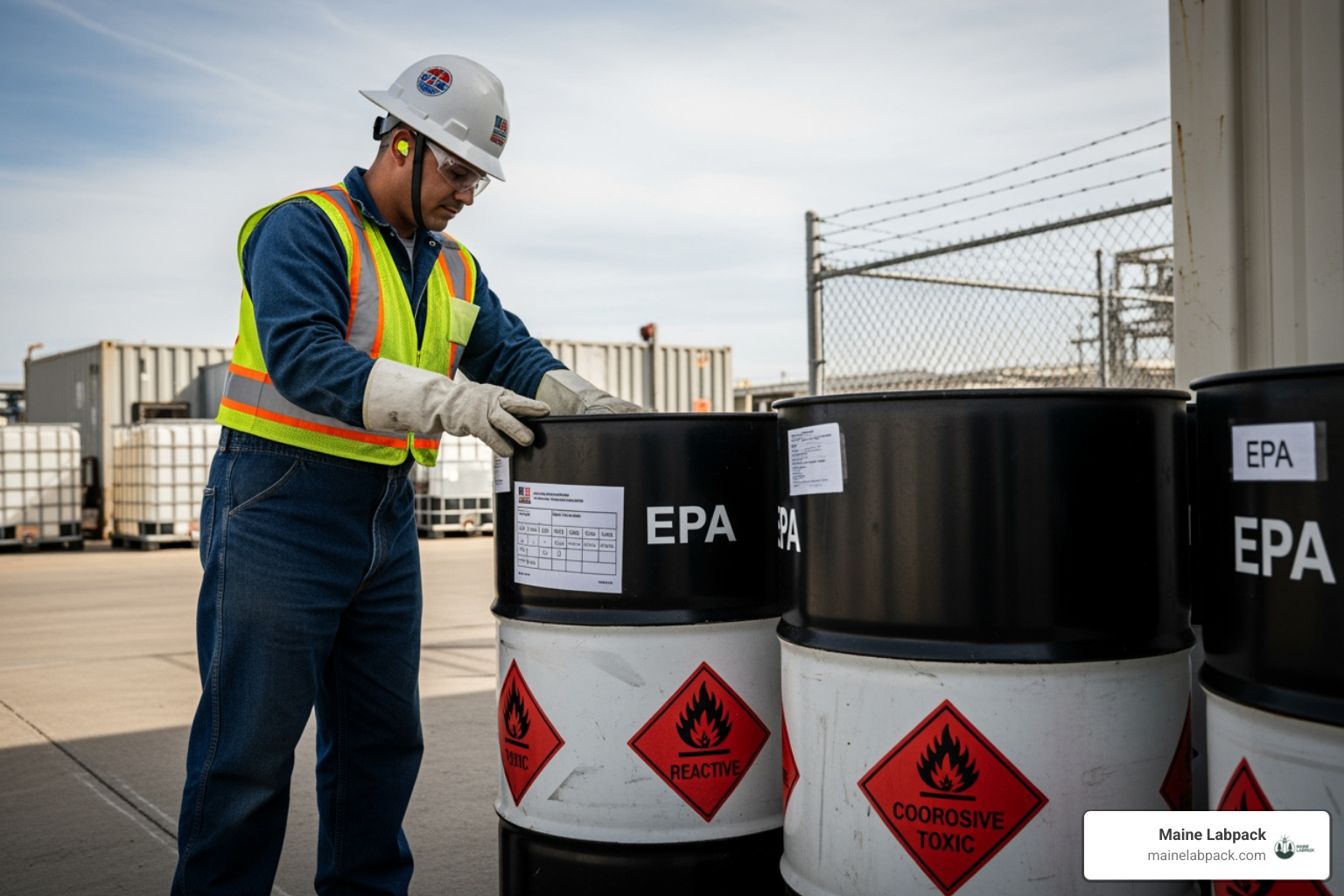
Why Understanding EPA Waste Regulations Matters for Your Facility
EPA waste regulations govern how businesses must handle, store, transport, and dispose of hazardous materials to protect human health and the environment. These rules are primarily enforced through the Resource Conservation and Recovery Act (RCRA), which establishes a “cradle-to-grave” system requiring businesses to track waste from the moment it’s generated until final disposal.
Quick Overview: Core EPA Waste Regulation Requirements
| Regulation Component | What It Covers |
|---|---|
| RCRA Framework | Federal law passed in 1976 establishing waste management standards |
| 40 CFR Parts 260-273 | Specific regulations for hazardous waste identification and management |
| Generator Categories | Classification by monthly waste volume (VSQG, SQG, LQG) with different requirements |
| Cradle-to-Grave Tracking | Responsibility from generation through storage, transport, treatment, and disposal |
| Characteristic Criteria | Four ways waste qualifies as hazardous: ignitability, corrosivity, reactivity, toxicity |
| Listed Wastes | EPA-designated waste codes (F, K, P, U lists) automatically classified as hazardous |
Managing hazardous waste in the United States requires strict compliance with both federal and state regulations. For facilities that generate chemical waste, the stakes are high. Non-compliance can result in significant fines, operational shutdowns, and environmental liability that persists long after waste leaves your property.
The EPA established these regulations to create a comprehensive system that prevents improper disposal and protects communities from contamination. Whether your facility generates a small amount of hazardous waste monthly or manages large volumes regularly, understanding your obligations under RCRA is essential.
This guide breaks down the complex regulatory landscape into clear, actionable information. You’ll learn how to identify hazardous waste, determine your generator category, understand manifesting requirements, and navigate specialized rules for materials like universal waste and used oil.
The Framework of RCRA and EPA Waste Regulations
To understand how waste is managed in the U.S., one must first look at the Resource Conservation and Recovery Act (RCRA) Overview. Passed by Congress in 1976, RCRA is the primary federal law that authorizes the EPA to regulate hazardous waste.
The law is divided into several “Subtitles.” For most businesses, the two most important are Subtitle C and Subtitle D. Subtitle C focuses on hazardous waste, creating the rigorous tracking system we use today. Subtitle D focuses on non-hazardous solid waste, such as municipal trash and industrial waste that doesn’t meet hazardous criteria. While Subtitle D is often managed at the state and local level, the EPA sets the minimum national standards for how landfills must be designed and operated.
How EPA Waste Regulations Enforce Federal Law
It is helpful to think of RCRA as the skeleton and EPA regulations as the muscle. RCRA is the law passed by Congress that sets broad goals, while EPA regulations are the specific, detailed rules used to achieve those goals. These regulations are codified in Title 40 of the Code of Federal Regulations (CFR), specifically parts 239 through 282.
When the EPA wants to change a rule, they go through a process called “rulemaking.” This allows them to update standards based on new scientific data or industrial changes without needing a new act of Congress. For a facility manager, this means the Basics of Hazardous Waste Determination can shift over time as new rules are finalized. Staying compliant means keeping an eye on both the standing law and the evolving EPA enforcement rules.
Understanding Cradle-to-Grave Responsibility
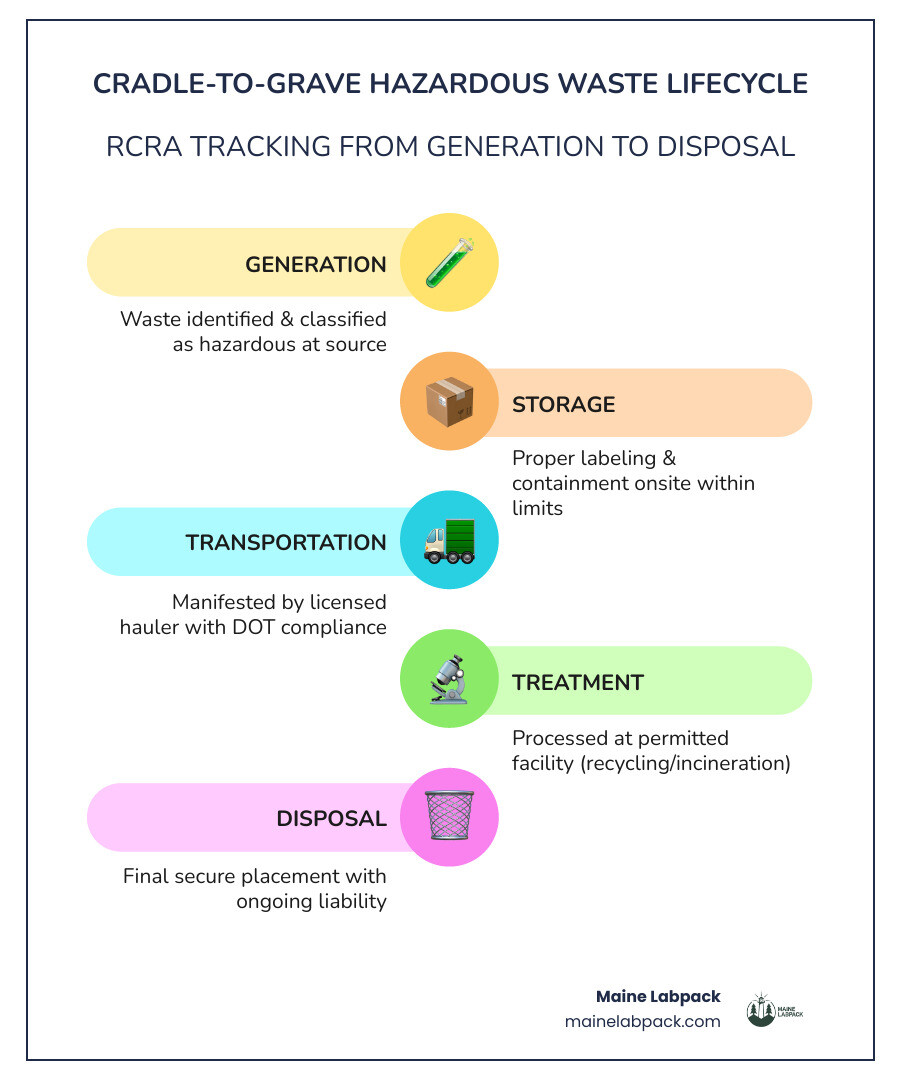
The term “cradle-to-grave” is the cornerstone of EPA waste regulations. It means that a generator is responsible for its waste from the moment it is created (the cradle) until its ultimate disposal or destruction (the grave).
This responsibility does not end when the waste leaves your facility on a truck. If a transporter spills your waste or a disposal facility leaks ten years from now, the original generator can still be held liable. This lifecycle includes:
- Generation: Accurately identifying the waste.
- Storage: Keeping it in compliant, labeled containers.
- Transportation: Using licensed haulers and the manifest system.
- Treatment/Disposal: Ensuring the waste reaches a permitted facility.
Understanding Toxic vs. Hazardous Waste: What’s the Difference? is vital here, as “toxic” is often a subset of the broader “hazardous” category that triggers these lifelong responsibilities.
Identifying Hazardous Waste and Characteristic Criteria
Before a business can comply with EPA waste regulations, it must determine if its waste is “hazardous.” Under the law, a material must first be a “solid waste” (which, confusingly, can be a liquid or a gas) before it can be a hazardous waste. Once a material is discarded, the generator must check if it is a “listed” waste or if it exhibits specific hazardous characteristics.
The definition of how How Toxic Waste is Defined: DOT, RCRA, OSHA varies slightly between agencies, but for the EPA, it all comes down to the 40 CFR Part 261 standards.
The Four Characteristics of Hazardous Waste
If a waste is not specifically “listed” by name in the regulations, it might still be hazardous if it meets one of the four characteristics.
| Characteristic | Description | Regulatory Threshold Examples |
|---|---|---|
| Ignitability | Wastes that can easily catch fire. | Liquids with a flashpoint < 140°F (60°C). |
| Corrosivity | Wastes that are highly acidic or alkaline. | Aqueous liquids with a pH ≤ 2 or ≥ 12.5. |
| Reactivity | Wastes that are unstable or react violently. | Materials that explode or generate toxic gases when mixed with water. |
| Toxicity | Wastes that are harmful when ingested or absorbed. | Determined by the Toxicity Characteristic Leaching Procedure (TCLP). |
Toxicity is often the hardest to determine without laboratory testing. The TCLP test simulates how chemicals might leach out of a landfill and into the groundwater. If the extract contains contaminants (like lead, mercury, or arsenic) above specific levels, the waste is hazardous.
Listed Wastes and Delisting Petitions
The EPA has also created four lists of hazardous wastes (the F, K, P, and U lists).
- F-list: Wastes from common manufacturing and industrial processes (e.g., spent solvents).
- K-list: Wastes from specific industries (e.g., petroleum refining or pesticide manufacturing).
- P and U lists: Discarded commercial chemical products in their unused form (e.g., certain pharmaceuticals).
Sometimes, a specific facility’s waste might technically meet a listing description but doesn’t actually pose a threat. In these cases, a facility can submit a “delisting petition.” This is a formal request to exclude a particular waste stream from the regulations. For example, the Aluminum Company of America once received an exclusion for over 16,000 cubic yards of wastewater treatment sludge (F019 and F006) after proving through rigorous verification testing and data submittal that the waste did not meet the hazardous criteria. These exclusions are often conditional and require ongoing testing to remain valid.
Compliance Standards for Generators and Transporters
Once you’ve identified your waste, you must follow the standards for your “generator category.” The EPA regulates you based on how much waste you produce in a single calendar month, not the size of your building or the number of employees you have.
Properly identifying the Anatomy of a Hazardous Waste Label is a critical first step in on-site compliance.
Generator Categories and Monthly Limits
There are three main categories of hazardous waste generators:
- Very Small Quantity Generators (VSQG): Generate less than 100 kg (approx. 220 lbs) of hazardous waste per month. They have the fewest regulations but must still identify all hazardous waste and ensure it reaches a proper destination.
- Small Quantity Generators (SQG): Generate between 100 kg and 1,000 kg (approx. 220 to 2,200 lbs) per month. They can store waste on-site for up to 180 days (or 270 days if shipping over 200 miles) and must have basic emergency procedures.
- Large Quantity Generators (LQG): Generate 1,000 kg or more per month. They have the most stringent requirements, including formal contingency plans, employee training, and biennial reporting.
Understanding How Generator Status Impacts Hazardous Waste Collection is vital for staying within the legal limits of your category.
Manifesting and Labeling Requirements
When it is time to move waste off-site, the “Uniform Hazardous Waste Manifest” becomes the most important document in your facility. This shipping paper travels with the waste from the generator to the transporter, and finally to the disposal facility. Each party signs the manifest, and a copy is returned to the generator to “close the loop,” proving the waste arrived safely.
Labels are equally important. According to Hazardous Waste Labels: A 101 Guide to Compliance, every container must be clearly marked with the words “Hazardous Waste,” the composition of the waste, and the date accumulation began. Transporters must also comply with Department of Transportation (DOT) and Pipeline and Hazardous Materials Safety Administration (PHMSA) rules, which include specific placarding for trucks and secondary containment to prevent leaks during transit.
Specialized Rules for Universal Waste and Used Oil
The EPA realized that some very common hazardous wastes are generated by almost everyone—not just heavy industry. To encourage recycling and reduce the regulatory burden, they created the Universal Waste Program. The Standards for Universal Waste Management allow for streamlined collection and transportation of:
- Batteries: Including lead-acid, lithium, and nickel-cadmium. (See the Universal Waste Guide: Batteries for details).
- Pesticides: Specifically those that are recalled or gathered as part of a waste collection program.
- Mercury-Containing Equipment: Such as thermostats and switches.
- Lamps: Fluorescent bulbs and other high-intensity discharge lamps.
- Aerosol Cans: A relatively recent addition to the federal list.
Universal waste does not count toward your monthly hazardous waste totals, and you can generally store it for up to one year on-site. Used oil also has its own set of “management standards” (40 CFR Part 279) designed to encourage recycling rather than disposal. As long as the oil is recycled and not mixed with hazardous waste, it follows simpler rules.
Frequently Asked Questions about Waste Compliance
Navigating EPA waste regulations often leads to common questions about enforcement and specific waste types. Understanding 5 Common RCRA Compliance Violations can help you avoid the most frequent mistakes made by facility managers.
What is the difference between Subtitle C and Subtitle D?
Subtitle C is for hazardous waste and involves strict “cradle-to-grave” tracking. Subtitle D covers non-hazardous solid waste, such as office trash or construction debris, and is primarily regulated by state and local governments.
How do I handle electronics?
Electronics like computers and monitors often contain lead or mercury. In many states, these can be managed under the Universal Waste rules when sent for recycling. Check out the Universal Waste Guide: Electronics for more information.
Is household hazardous waste regulated?
Generally, waste generated by individuals at home is exempt from RCRA hazardous waste regulations. However, once the same material (such as a bottle of solvent) is used in a business setting, it becomes fully regulated.
What are the penalties for non-compliance?
The EPA and state agencies take compliance seriously. Penalties are designed to be higher than the cost of following the law to discourage “cutting corners.”
- Civil Penalties: Fines can reach tens of thousands of dollars per day, per violation.
- Criminal Penalties: For “knowing violations,” individuals can face prison time and massive personal fines.
- Operational Impact: Non-compliance can result in permit revocation, potentially shutting down a facility entirely.
Preparation is key. Surviving a DEP Audit requires having organized records, up-to-date training logs, and properly labeled storage areas ready for inspection at any time.
How do state agencies enforce RCRA?
While RCRA is a federal law, the EPA often “authorizes” states to run their own hazardous waste programs. For a state to be authorized, its rules must be at least as stringent as the federal rules. In many cases, states like Maine, New Hampshire, and Massachusetts have rules that are more stringent than the EPA’s.
For example, Maine Hazardous Waste Storage Requirements might include shorter accumulation times or more frequent inspections than those required by federal law. Always check with your state agency (such as the Maine DEP or New Hampshire DES) to ensure you are meeting the highest standards. You can use the EPA’s State Authorization Tracking System (StATS) to see the current status of your state’s program.
Stay Compliant, Reduce Risk, and Keep Waste Moving Safely
Navigating EPA waste regulations can feel like a full-time job. From identifying complex chemical characteristics to managing the paperwork of the manifest system, the requirements are exhaustive. However, these rules exist for a vital reason: to ensure that the hazardous materials our society relies on don’t end up in our soil or drinking water.
Maine Labpack serves as a dedicated partner for businesses across New England—including Portland, Bangor, Manchester, and Boston—providing a one-stop shop for hazardous materials management. By coming directly to your site, they ensure that your chemical disposal is professional, on-time, and fully compliant with both state and federal laws.
Whether you are a Small Quantity Generator in Burlington or a Large Quantity Generator in Springfield, maintaining a sustainable and safe facility starts with expert knowledge. Don’t leave your compliance to chance; ensure your “cradle-to-grave” responsibility is handled by professionals who understand the nuances of the law.
For those looking to secure their facility’s future, Professional Hazardous Waste Disposal through a chemical lab pack service is the most reliable way to maintain compliance and protect the environment.