
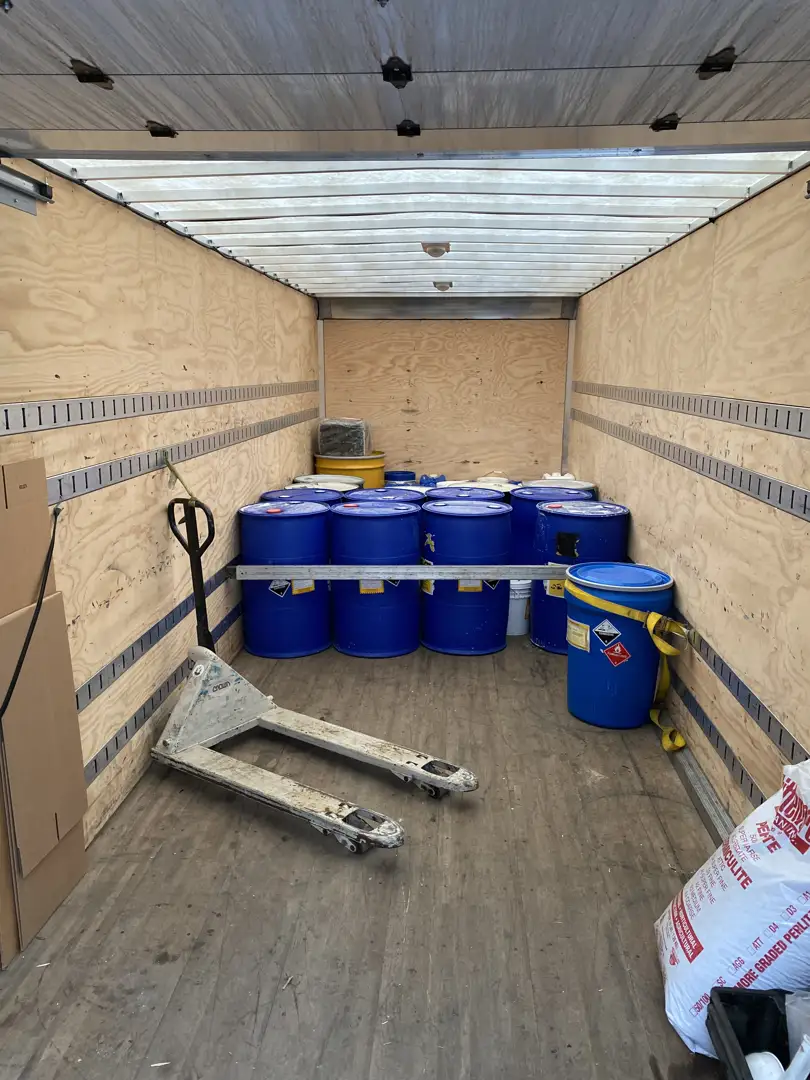
Hazardous waste manifests are legally required tracking documents that follow hazardous waste shipments from the point of generation all the way to final disposal — a system regulators call “cradle-to-grave” accountability.
If you’re managing hazardous chemicals at your facility, here’s what you need to know at a glance:
- What it is: A standardized form (EPA Form 8700-22) required by both the EPA and the U.S. Department of Transportation
- Who needs one: Generators, transporters, and treatment, storage, and disposal facilities (TSDFs) — for both interstate and intrastate shipments
- Why it’s required: Federal law under RCRA (Resource Conservation and Recovery Act) mandates tracking hazardous waste to protect human health and the environment
- How it works today: The EPA launched a national electronic system (e-Manifest) on June 30, 2018, replacing most paper-based processes
- How long to keep records: At least three years, with new credential requirements for generators as of January 22, 2025
If your facility generates, ships, or receives hazardous waste, you are legally responsible for this paperwork — and errors can lead to significant fines and compliance violations.
This guide walks you through exactly how the manifest system works, who is responsible for what, and how to stay compliant.
Understanding The Uniform Hazardous Waste Manifest System
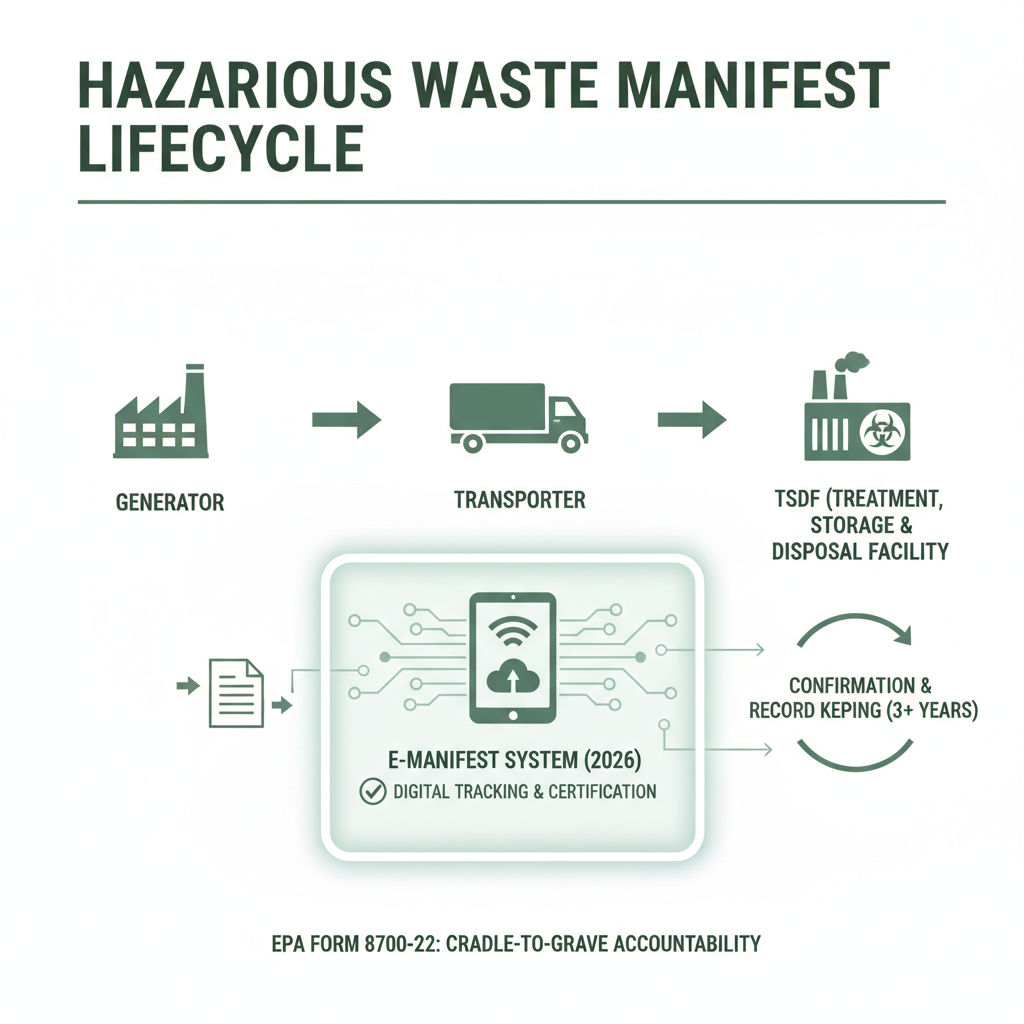
The cornerstone of hazardous waste tracking is the Uniform Hazardous Waste Manifest, officially known as EPA Form 8700-22. This document isn’t just a suggestion; it is a joint requirement by the EPA and the U.S. Department of Transportation (DOT) for any off-site transport of hazardous materials.
The system creates a chain of custody. When a generator offers waste for transport, they must accurately describe the waste, including its proper shipping name, hazard class, ID number, and packing group. This information ensures that everyone handling the waste—from the driver to the chemist at the disposal site—knows exactly what they are dealing with.
Each party has a specific role:
- Generators: You are responsible for the initial preparation of the manifest and ensuring the waste is correctly classified. Before you can even fill out a form, you must perform a Basics of Hazardous Waste Determination to know what you are shipping.
- Transporters: They must sign the manifest to acknowledge receipt of the waste and carry the document (or an electronic equivalent) during transport.
- TSDFs (Treatment, Storage, and Disposal Facilities): The receiving facility must sign the manifest to confirm receipt, note any discrepancies, and eventually return a confirmed copy to the generator or upload the data to the EPA.
For those needing the nitty-gritty details on the form itself, the EPA provides Uniform Hazardous Waste Manifest: Instructions, Sample Form and Continuation Sheet | US EPA to ensure every box is checked correctly.
Who Must Use The Manifest System?
The requirement to use hazardous waste manifests depends largely on your generator status and the type of waste you are moving.
- Large Quantity Generators (LQGs) and Small Quantity Generators (SQGs): These facilities must use the uniform manifest for all hazardous waste shipments.
- Very Small Quantity Generators (VSQGs): While federal rules are more relaxed for VSQGs, many states in New England (like Maine and New Hampshire) have stricter requirements that may still necessitate a manifest.
- State-Regulated Waste: Even if a waste isn’t technically “hazardous” under federal RCRA rules, it might be state-regulated. In these cases, a manifest is often still required to ensure proper tracking to a licensed facility.
Understanding your status is critical because it dictates your reporting and recordkeeping burdens. You can learn more about how these categories differ in our guide on Understanding EPA Waste Rules: What You Need to Know.
The Transition From Paper To Electronic Tracking
For decades, the manifest system relied on multi-copy carbon paper. However, on June 30, 2018, the EPA launched The Hazardous Waste Electronic Manifest (e-Manifest) System. This shift was designed to modernize tracking, reduce the “paperwork burden” (estimated at 60 minutes per paper manifest for generators), and provide real-time data to regulators.
Initially, the system moved from a 6-copy paper form to a 5-copy form. As of January 22, 2025, the transition continues with a new 4-copy form update. While paper manifests are still “allowed,” the EPA is making it increasingly clear that the future is digital. The e-Manifest system is now the central hub where all final manifest copies reside.
Navigating The E-Manifest System And User Fees
To use the electronic system, facilities must register through the EPA’s RCRAInfo portal. Registration allows you to sign manifests electronically and, perhaps more importantly, access the final copies of your manifests once the TSDF has processed them.
As of January 22, 2025, LQGs and SQGs are required to maintain credentials to access these final copies. If you don’t have an account, you can’t verify that your waste actually reached its destination—a major compliance red flag.
The system isn’t free, but the fees are structured to encourage you to go digital. Only the receiving facilities (TSDFs) pay the fees directly to the EPA, though these costs are typically passed along to generators.
The Impact Of The Third Final Rule
The EPA’s “Third Final Rule” has brought significant changes to the e-Manifest landscape starting in early 2025. One of the biggest updates involves fee restructuring. To push more users away from paper, the fee for “Scanned Image Uploads” is significantly higher than the fee for “Fully Electronic Manifests.”
The rule also expands tracking for international shipments (exports) and tightens the requirements for how quickly data must be uploaded. These changes mean that How Generator Status Impacts Hazardous Waste Collection is more relevant than ever, as higher-volume generators face more complex digital reporting requirements.
How To Properly Complete Hazardous Waste Manifests
Filling out a manifest is a high-stakes exercise in data entry. One wrong code can lead to a rejected shipment or a fine.
Key areas to focus on include:
- Item 3 (Emergency Response Phone): This must be a 24/7 monitored number where someone knowledgeable about the shipment and spill response can be reached.
- Item 15 (Generator’s Certification): This is where you sign, attesting that the waste is properly classified, packaged, and labeled. You are also certifying a “waste minimization” statement, meaning you’re doing your best to reduce the amount of hazardous waste you produce.
- Item 19 (Management Method Codes): These codes describe how the waste will be treated (e.g., H040 for incineration). These are typically entered by the TSDF, but generators should review them for accuracy.
Proper documentation starts before the truck arrives. Ensuring you have the right Anatomy of a Hazardous Waste Label and following Everything You Need to Know About Hazardous Waste Labeling ensures that the manifest data matches the physical containers.
Training Requirements For Signatories
Who can sign a manifest? Not just anyone. The person signing must have first-hand knowledge of the shipment. Under DOT regulations (49 CFR 172 Subpart H), any employee involved in preparing hazardous materials for transport must undergo training every three years.
This training covers:
- General Awareness: Understanding the risks of hazardous materials.
- Function-Specific Training: How to actually fill out the forms and pack the waste.
- Safety and Security: How to handle emergencies and protect the shipment.
Failure to train staff can lead to personal liability for the signer if a significant incident occurs. Compliance is a team effort, and you can stay ahead by following a Hazardous Waste Labels: A 101 Guide to Compliance strategy.
Obtaining Forms From Approved Printers
You can’t just print a manifest from your office inkjet and call it a day. Paper manifests must be purchased from EPA-approved registered printers. These printers are assigned a unique three-letter suffix for the Manifest Tracking Number (MTN) to ensure no two manifests in the country are the same.
You can find a list of these providers at the Form 8700-22 Uniform Hazardous Waste Manifest registry.
Compliance Requirements: Retention, Discrepancies, And State Rules
Once the waste leaves your facility, the clock starts ticking on your compliance obligations.
- Retention: You must keep copies of signed hazardous waste manifests for at least three years. While the e-Manifest system stores these digitally, many facilities choose to keep physical or local digital backups for extra security.
- The 35/45 Day Rule: If you are an LQG and don’t receive a signed copy back from the TSDF within 35 days, you must contact them to find out where your waste is. If you still don’t have it by day 45, you must file an “Exception Report” with the EPA or your state agency. (For SQGs, the window is 60 days).
Staying organized is the only way to pass an inspection. Reviewing Maine Hazardous Waste Storage Requirements and preparing for the possibility of a DEP Audit can save your facility from major headaches.
Handling Discrepancies And Rejections
Sometimes, what arrives at the TSDF isn’t what was written on the manifest. This is called a “manifest discrepancy.”
Common discrepancies include:
- Quantity Mismatches: Shipping 10 drums but only 8 arriving.
- Waste Type: Shipping “Waste Flammable Liquid” but the lab finds it’s actually a corrosive.
- Full or Partial Rejections: The facility cannot accept the waste and must send it back or to an alternate facility.
If a discrepancy isn’t resolved within 20 days, the TSDF must file a report. These errors are among the 5 Common RCRA Compliance Violations that regulators look for during audits.
State-Specific Manifest Variations
While the manifest is a “uniform” federal form, states often add their own flavor. For example, Maine has specific requirements for state-only waste codes that must be included in Item 13.
In New England, the rules can vary slightly as you cross state lines from New Hampshire to Massachusetts or Vermont. Always consult local guidance, such as the Maine.gov Uniform Hazardous Waste Manifest resource, to ensure you aren’t missing any state-specific requirements.
Frequently Asked Questions About Hazardous Waste Manifests
Who is authorized to sign hazardous waste manifests?
An authorized signer is typically a trained employee of the generator who has first-hand knowledge of the waste. However, a “designated agent”—such as a professional waste management contractor—can sign “on behalf of” the generator if they are properly trained and authorized in writing. Regardless of who signs, the generator remains legally responsible for the waste’s “cradle-to-grave” journey.
What are common errors found on hazardous waste manifests?
Even experts make mistakes. Some of the most frequent errors include:
- Incorrect EPA ID Numbers: Using an old ID or a temporary one that has expired.
- Handwritten MTNs: Manifest Tracking Numbers must be pre-printed by an approved printer.
- Wrong Units of Measure: Using “gallons” when the form requires “pounds” or “kilograms.”
- Missing Signatures: Forgetting to have the transporter sign upon pickup.
How are international and rail shipments documented?
International shipments require additional documentation, including an “Export Consent” from the EPA and a specification of the port of entry or exit on the manifest. Rail shipments have a unique “exception”: intermediate rail carriers do not have to sign the manifest, provided the paper trail is maintained through freight bills and the initial and final carriers sign appropriately.
Stay Compliant With Hazardous Waste Manifests
Navigating hazardous waste manifests can feel like a full-time job. Between the transition to the e-Manifest system, the shifting fee structures, and the strict training requirements, there is zero room for error.
At Maine Labpack, we specialize in taking the complexity out of hazardous waste management. Serving all of New England—from Portland and Bangor to Manchester, Boston, and Burlington—we provide professional, on-time, and sustainable disposal solutions. We don’t just pick up your waste; we act as your partner in compliance, ensuring your manifests are perfect and your facility is protected.
Ready to simplify your waste tracking? Explore our Professional Hazardous Waste Disposal Services and let our experts handle the paperwork so you can focus on your business.