
How do you dispose of fluorescent tubes safely? Here’s the short answer:
- Do not put them in your regular trash or curbside recycling bin.
- Keep tubes intact and wrap them carefully in newspaper or bubble wrap.
- Drop them off at a local household hazardous waste (HHW) facility, a participating hardware store, or a community HHW collection event.
- Businesses must use a licensed hazardous waste hauler or a registered universal waste recycler.
That’s the core of it. But the why behind these steps matters — especially if you manage a facility with accumulated tubes.
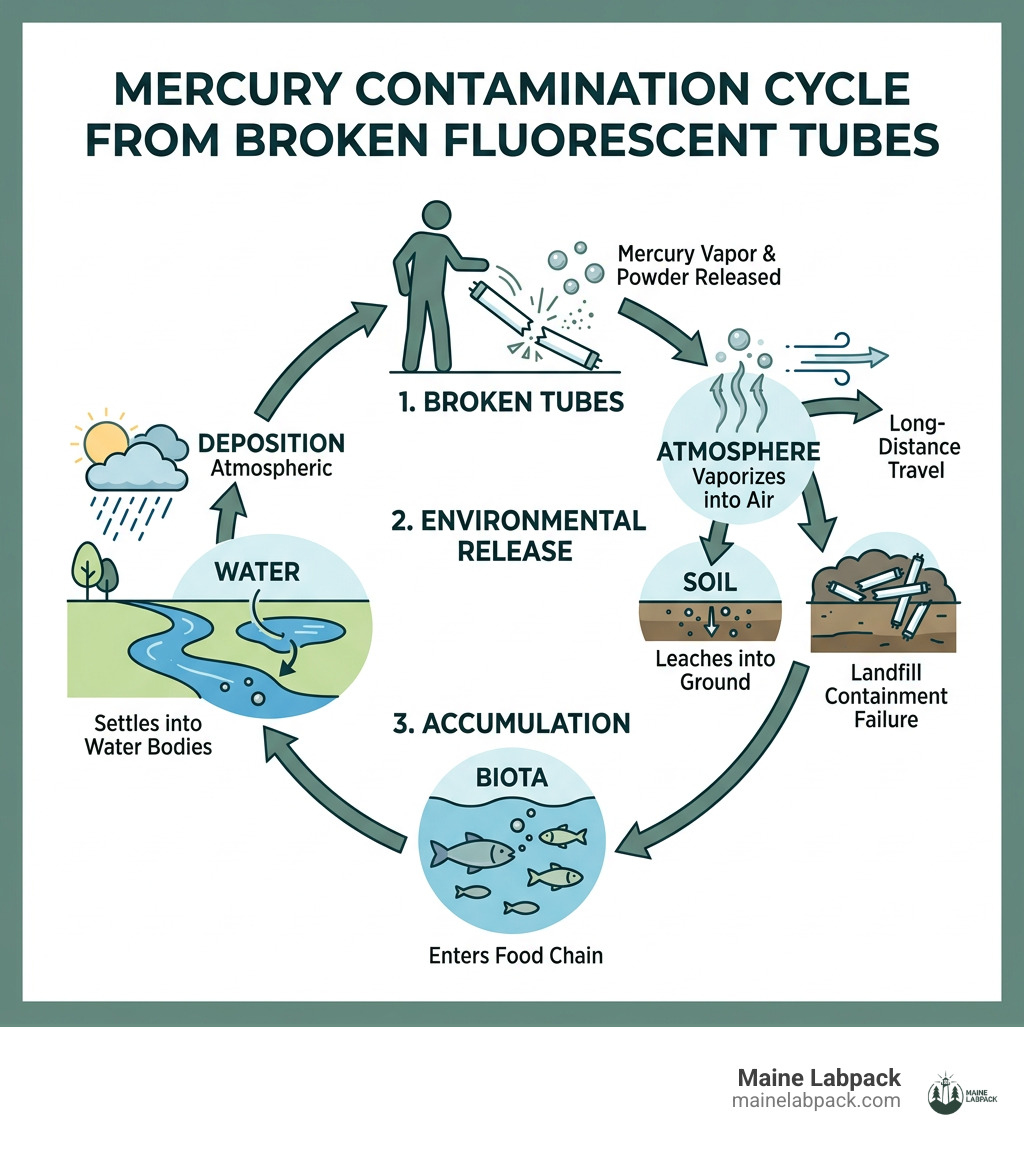
Fluorescent tubes contain mercury, a toxic metal that doesn’t break down in the environment. When tubes end up in landfills, that mercury can leach into soil and water, or vaporize into the air during incineration. It’s not a small problem — seven U.S. states have banned mercury-containing lamps from landfills entirely.
For facilities managers and businesses, improper disposal isn’t just an environmental risk. It’s a compliance risk that can result in fines and operational disruption.
This guide walks you through everything you need to know — from safe handling to finding a recycling point near you.
Why You Cannot Throw Fluorescent Tubes in the Trash
It is tempting to think of a light bulb as just another piece of glass, but fluorescent tubes are a different beast entirely. The primary reason for the strict rules surrounding them is mercury toxicity. Every fluorescent tube contains a small amount of mercury vapor and mercury-coated powder (phosphor). While the amount in a single tube is small, the cumulative effect of millions of tubes being tossed into the trash is devastating.
When a tube breaks in a dumpster or a landfill, the mercury is released. Mercury is a potent neurotoxin that can cause significant health issues, particularly in pregnant women, infants, and young children. It doesn’t just stay in the landfill, either. Through a process called atmospheric dissipation, mercury vapor can travel long distances before settling into water bodies, where it converts into methylmercury and enters the food chain.
Beyond the environmental impact, there are legal and financial penalties for improper disposal. Businesses that toss old tubes into a standard construction dumpster are risking heavy fines from state environmental agencies and the EPA. In New England, where environmental regulations are strictly enforced from Portland to Boston, staying compliant is simply good business.
How Do You Dispose of Fluorescent Tubes Safely?

If you are a homeowner or a small business owner in New England, you have several paths to ensure your old lighting doesn’t end up contaminating the local environment. The goal is always to keep the tubes intact. A broken tube is a hazardous waste cleanup project; an intact tube is a straightforward recycling task.
For residents in areas like Manchester, New Hampshire, or Worcester, Massachusetts, the most common solution is a Household Hazardous Waste (HHW) collection day. Many municipalities host these events once or twice a year, allowing residents to drop off items like paint, batteries, and fluorescent tubes for free or a nominal fee.
For businesses, the process is more formal. Because businesses often generate larger volumes of waste, they typically cannot drop off hundreds of tubes at a local hardware store. Instead, they should partner with a professional service. You can learn more about the specifics of this process through Universal Waste Recycling Light Bulbs, which outlines how these materials are collected and processed to help keep your facility compliant with state laws.
Identifying Mercury-Containing Bulbs
Not every light bulb requires special treatment, but the list of those that do is longer than you might think. Before you recycle, it helps to know which bulb types typically contain mercury.
Common types include:
- Linear Fluorescent Tubes: The standard 4-foot and 8-foot lamps found in shops and offices.
- U-Tube and Circline Bulbs: Curved or circular fluorescent lamps often used in decorative fixtures.
- Bug Zappers and Tanning Bulbs: These specialized lamps contain high levels of mercury and UV-phosphors.
- Black Lights and Germicidal Bulbs: Used for sanitation and specialized lighting; these are highly hazardous if broken.
- Cold-Cathode and Neon Lights: These contain pressurized gases and mercury to produce light.
- High-Intensity Discharge (HID) Lamps: Including metal halide and high-pressure sodium lamps used in streetlights or warehouses.
To keep things simple, if it isn’t a traditional incandescent bulb or a modern LED, you should assume it contains mercury. For a deeper dive into bulb identification, refer to the Universal Waste Guide Lamps and Bulbs.
Step-by-Step Guide on How to Dispose of Fluorescent Tubes
Ready to clear out that corner of the basement or the utility closet? Follow these steps to reduce the risk of breakage and keep cleanup simple.
- Safe Removal: Before touching the fixture, turn off the power at the switch or the fuse box. Use a sturdy ladder if the bulbs are overhead. Carefully twist or slide the tube out of its sockets.
- Inspect for Damage: If the tube is cracked or leaking white powder, skip to the “What to Do if a Fluorescent Tube Breaks” section below. If it’s intact, proceed.
- Packaging: The best way to transport tubes is in their original cardboard sleeves or boxes. If you don’t have those, wrap the tubes in several layers of newspaper or bubble wrap. Use packing tape to secure the ends so they don’t slide out.
- Secure Transport: Place the wrapped tubes in a spot in your vehicle where they won’t roll around or be crushed by other items. A cardboard box or even a PVC pipe can provide extra protection.
- Drop Off: Take them to your chosen recycling point. For a detailed look at the EPA’s recommendations for different bulb types, see the guide on Recycling and Disposal of CFLs and Other Bulbs that Contain Mercury.
Finding a Local Recycling Point
Finding a place to take your tubes doesn’t have to be a scavenger hunt. In New England, you have several reliable options:
- Retail Take-Back: Large retailers like Home Depot and Lowe’s often have recycling kiosks near the entrance or customer service desk. Many of these locations only accept Compact Fluorescent Lamps (CFLs) and may not take the long 4-foot or 8-foot linear tubes due to breakage risks during shipping. Always call your local store in Bangor or Concord before heading over.
- Municipal Transfer Stations: Many towns in Maine and New Hampshire have designated areas at their transfer stations for “Universal Waste.”
- Professional Hazardous Waste Services: For businesses or residents with a large volume of bulbs, hiring a professional to come to your site is the safest and most efficient option. This is especially true for property managers in Boston or Springfield who may have hundreds of tubes to swap out at once.
For more information on managing mercury-containing items, check out the Universal Waste Management Guide Mercury.
Regulations and Professional Disposal for Businesses
For a business, the question of how do you dispose of fluorescent tubes is governed by the EPA’s Universal Waste Rule. This rule was created to make it easier for businesses to collect and recycle hazardous waste without the full burden of “Hazardous Waste” manifests and regulations.
However, “easier” doesn’t mean “anything goes.” Businesses are categorized by how much waste they generate:
- Very Small Quantity Generators (VSQGs): Generate less than 220 lbs of hazardous waste per month.
- Small Quantity Generators (SQG): Generate between 220 and 2,200 lbs per month.
- Large Quantity Generators (LQG): Generate more than 2,200 lbs per month.
| Feature | Household Disposal | Business Disposal (Universal Waste) |
|---|---|---|
| Legal Requirement | Encouraged/Required by state law | Mandatory under federal/state law |
| Transport | Self-transport to HHW events | Licensed haulers or self-transport with logs |
| Storage Limits | None (but keep it safe!) | Must dispose of within 1 year |
| Documentation | Usually none | Invoices/Logs must be kept for 3 years |
| Cost | Often free or low-cost | Service fees apply for professional pickup |
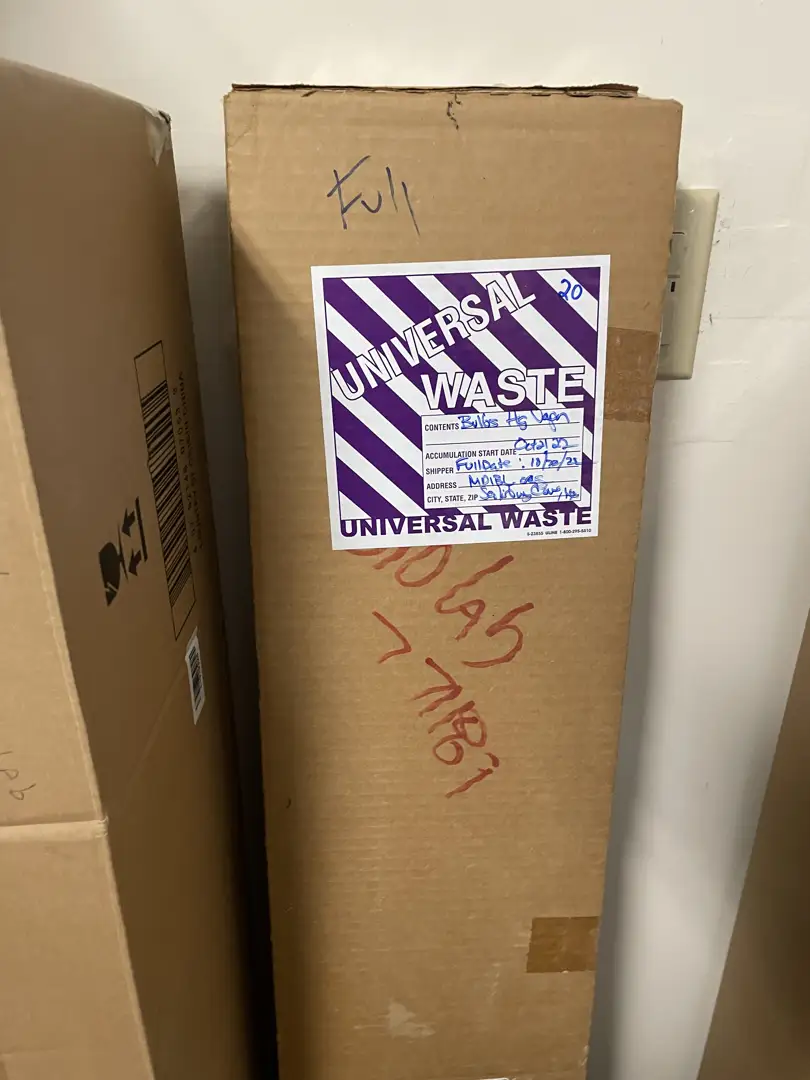
In EPA Region 1 (which includes all of New England), businesses must ensure their tubes are stored in structurally sound containers that are kept closed and labeled with the words “Universal Waste—Lamps,” “Waste Lamps,” or “Used Lamps.” For a complete breakdown of these requirements, see the Universal Waste Guide Lamps Light Bulbs.
What to Do if a Fluorescent Tube Breaks
Accidents happen. If a tube shatters, don’t panic, but don’t reach for the vacuum cleaner either. Vacuuming a broken fluorescent bulb will spread mercury vapor throughout the room and contaminate the vacuum itself.
Instead, follow these steps:
- Evacuate and Ventilate: Have people and pets leave the room. Open a window or door to the outside and leave the area for at least 15 minutes. If you have a central HVAC system, turn it off to prevent the vapor from circulating.
- Gear Up: Wear disposable gloves and, if possible, a dust mask.
- Scoop, Don’t Sweep: Use stiff paper or cardboard to scoop up the large glass fragments and powder. Do not use a broom.
- Tape the Rest: Use sticky tape (duct tape or packing tape works great) to pick up any remaining small glass shards and fine powder.
- Wipe Down: Use a damp paper towel or wet wipe to clean the area.
- Seal It Up: Place all fragments, tape, and wipes into a glass jar with a metal lid or a heavy-duty plastic bag that can be sealed air-tight.
- Label and Dispose: Label the container as “Broken Lamp” and take it to your local HHW facility.
The Benefits of Switching to LED Technology
If you are tired of worrying about mercury and fragile glass tubes, there is a better way. LED technology has advanced to the point where you can now purchase “plug-and-play” LED tubes that fit directly into your existing fluorescent fixtures.
The benefits of switching are massive:
- Zero Mercury: LED tubes contain no mercury, making them much safer for your home or office.
- Longevity: While a fluorescent tube might last 15,000 hours, an LED tube can last up to 50,000 hours. That is years of avoided maintenance.
- Energy Efficiency: LEDs save about 30% more energy than even the best fluorescent tubes, which translates directly to lower utility bills in high-cost areas like Rhode Island and Massachusetts.
- Durability: LEDs are made of plastic, not thin glass, so they won’t shatter if dropped.
Why LEDs are the Best Way to Dispose of Fluorescent Tubes Long-Term
The best way to solve the problem of how do you dispose of fluorescent tubes is to stop using them. By retrofitting your facility with LEDs, you eliminate the need for hazardous waste management for your lighting in the future. It is a one-time investment that pays off in reduced disposal costs, lower energy bills, and a smaller environmental footprint.
As you phase out your old tubes, the transition itself must be handled responsibly. For a guide on making the switch, check out How to Dispose of Fluorescent Light Bulbs.
Frequently Asked Questions About Fluorescent Disposal
Can I put fluorescent tubes in my curbside recycling bin?
Absolutely not. Curbside recycling programs are designed for “clean” recyclables like paper, plastic, and aluminum. Fluorescent tubes are considered Household Hazardous Waste (HHW). If they break in the recycling truck, they contaminate the entire load and put workers at risk of mercury exposure.
Do hardware stores like Home Depot or Lowe’s accept all tube sizes?
It depends on the location. Most retail kiosks are designed for small CFL bulbs. Many stores do not have the space or the specialized shipping containers required to safely take back 4-foot or 8-foot linear tubes. It is always best to call the store in Lewiston or South Portland before you drive over with a trunk full of tubes.
What happens to the mercury during the recycling process?
When you send your tubes to a professional recycler, they aren’t just crushed. The tubes are processed in a machine that captures the mercury vapor. The aluminum end caps are removed for scrap metal recycling, and the glass is cleaned and downcycled into materials like concrete or tile. The mercury-containing phosphor powder is sent to a retort facility where the mercury is refined and reused in new products.
Ready to Dispose of Fluorescent Tubes the Safe Way?
Properly managing your old lighting is a small but vital part of being a responsible resident or business owner in New England. Whether you are a homeowner in Coastal Maine or a facility manager in Boston, knowing how to dispose of fluorescent tubes helps keep communities safer and the environment cleaner.
If you are looking for a professional, sustainable partner to handle your hazardous materials, Maine Labpack is here to help. Serving all of Maine, New Hampshire, Massachusetts, Vermont, and Rhode Island, we are a one-stop shop for chemical and hazardous waste disposal. We come directly to your site, ensuring your waste is managed on time and in full compliance with all regulations.
Ready to schedule a pickup or get guidance on your universal waste program? Explore our universal waste recycling services and request a quote today.