
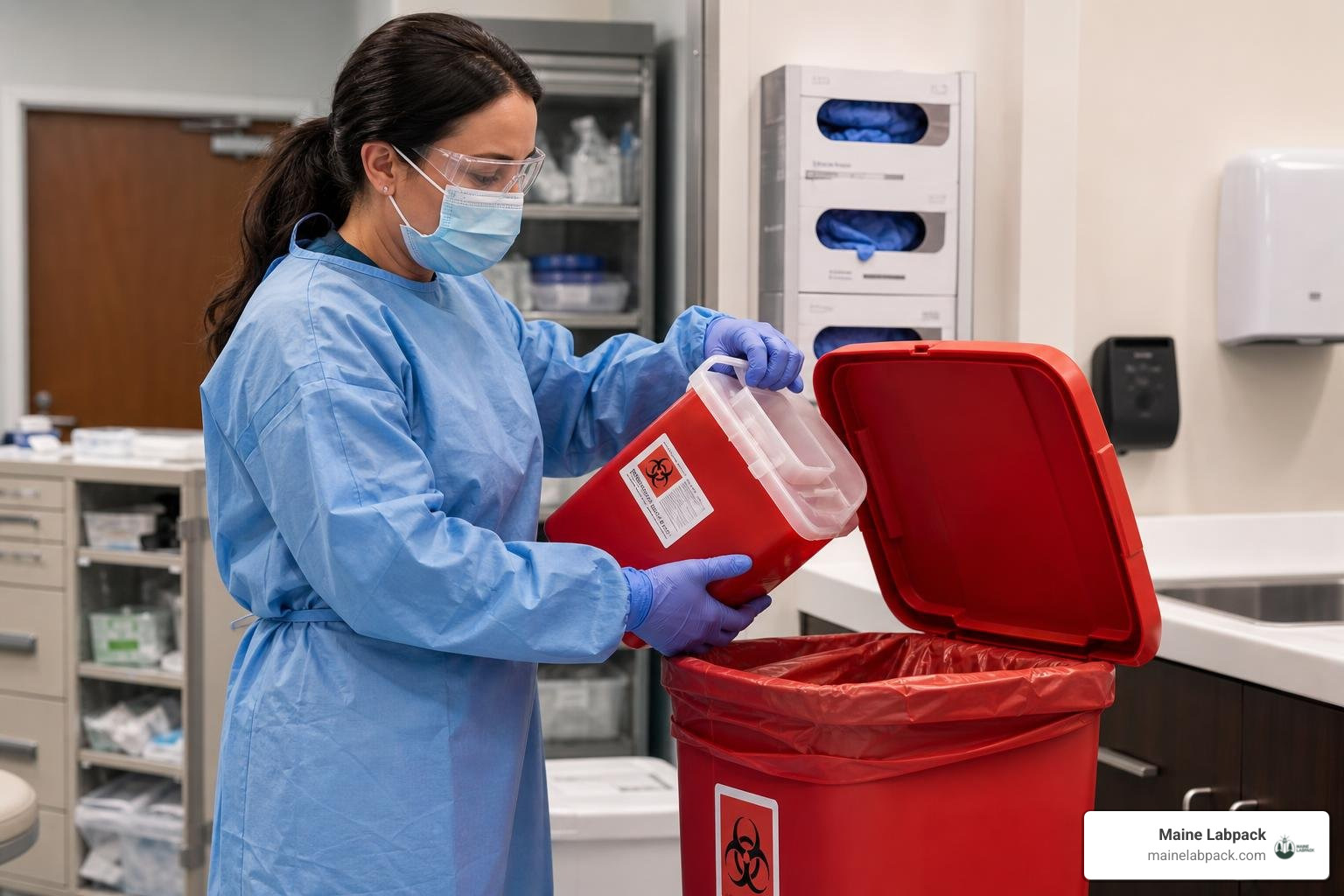
Emptying sharps containers correctly is one of the most critical — and most regulated — tasks in any healthcare or medical facility.
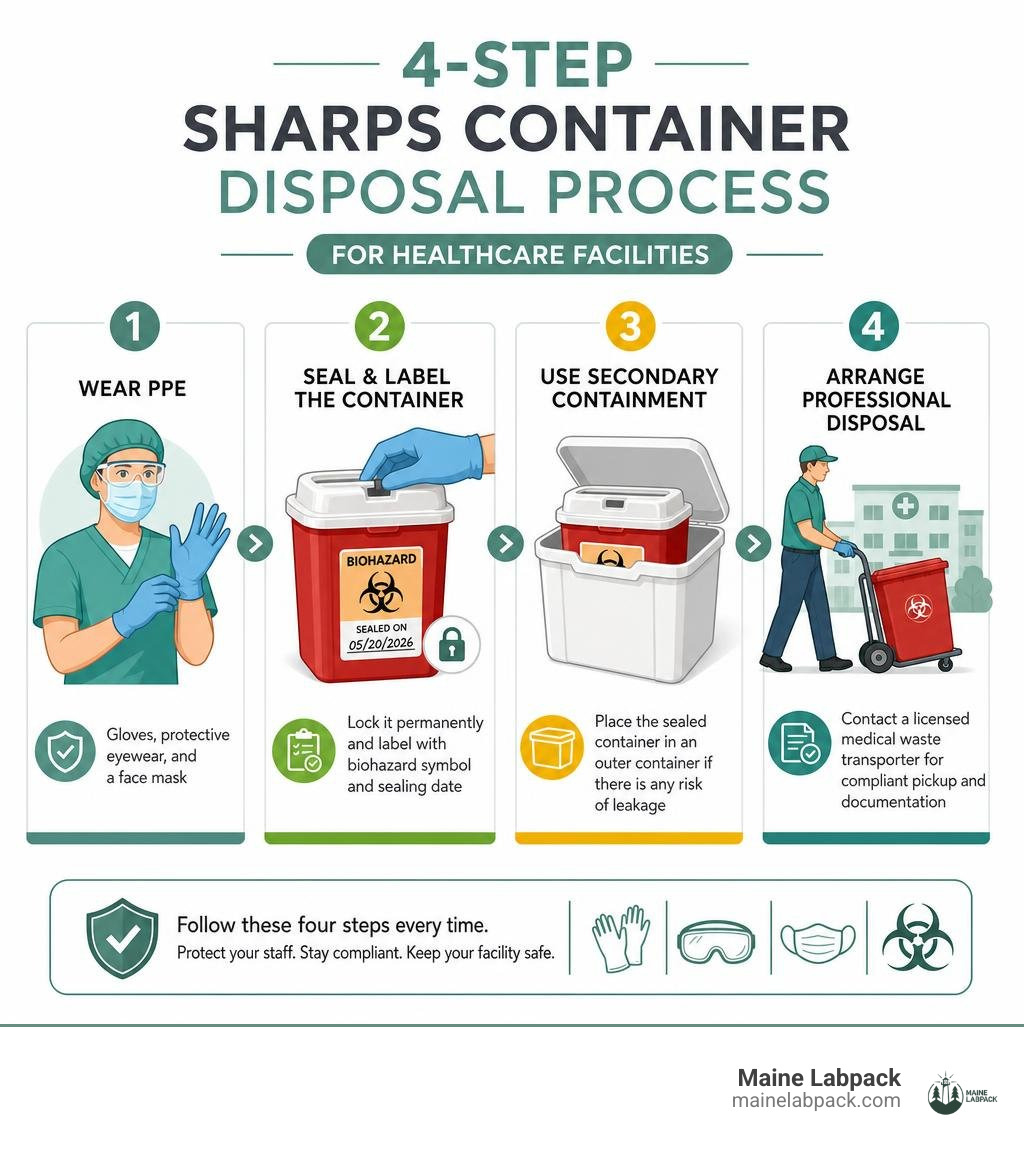
Here’s a quick overview of the 4-step process:
- Wear PPE — gloves, protective eyewear, and a face mask before handling any full container
- Seal and label the container — lock it permanently and mark it with a biohazard label and sealing date
- Use secondary containment if needed — place the sealed container in an outer container if there is any risk of leakage
- Arrange professional disposal — contact a licensed medical waste transporter for compliant pickup and documentation
These steps aren’t optional. They’re backed by OSHA, the FDA, and state-level regulations — and skipping any one of them puts your staff and your facility at serious risk.
The numbers tell a stark story. According to the CDC, approximately 385,000 needlestick and sharps-related injuries occur among hospital-based healthcare workers in the United States every year. Many of those incidents are directly linked to overfilled containers, improper sealing, or unsafe handling during disposal.
For facilities managing accumulated sharps waste, the stakes go beyond worker safety. Non-compliance can trigger regulatory fines, operational disruptions, and lasting liability.
Getting this right isn’t complicated — but it does require a clear process.
For more background, review Maine Labpack’s guidance on sharps waste management and safe sharps disposal methods.
Understanding Sharps Waste and Facility Risks
Clinical and laboratory facilities generate various types of medical waste daily, but none present as immediate a physical threat as contaminated sharps. When a sharp instrument is used on a patient or in a laboratory procedure, it becomes a vector for infectious agents. Managing these items requires strict adherence to established protocols to protect staff, patients, and waste management personnel.
Following CDC sharps injury prevention guidance is essential for minimizing occupational exposure. When facilities neglect proper disposal protocols, they open the door to severe consequences, including the transmission of bloodborne pathogens such as Human Immunodeficiency Virus (HIV), Hepatitis B Virus (HBV), and Hepatitis C Virus (HCV).
What Are Contaminated Sharps?
Under the OSHA Bloodborne Pathogens standard, contaminated sharps are defined as any objects capable of penetrating the skin that have come into contact with blood or other potentially infectious materials (OPIM). This definition encompasses a wide range of clinical tools, including:
- Hypodermic Needles and Syringes: Used for injections, blood draws, and fluid aspiration.
- Scalpels, Lancets, and Blades: Essential for surgical procedures, capillary blood sampling, and laboratory dissections.
- Dental Wires and Orthodontic Instruments: Sharp metal components capable of puncturing heavy utility gloves.
- Broken Glass and Capillary Tubes: Contaminated laboratory glassware that can easily slice through standard protective barriers.
According to OSHA’s guidance on handling contaminated sharps safely, even safety-engineered devices with built-in injury protection mechanisms must be treated as contaminated sharps. These safety mechanisms can fail, meaning the device must still be deposited directly into an approved sharps container immediately after use.
The Dangers of Delaying Emptying Sharps Containers
Allowing sharps containers to overfill is one of the most common safety violations in healthcare facilities. When a container is packed past its safe limit, needles and blades begin to protrude from the opening. This creates a high-risk zone where healthcare workers are highly vulnerable to accidental needlesticks when attempting to discard subsequent items.
The consequences of these injuries are both physical and financial. Beyond the immediate risk of life-altering infections, a single needlestick injury triggers an expensive, time-consuming protocol involving post-exposure prophylaxis (PEP), laboratory testing, counseling, and lost work hours. Proactive management and routine monitoring are the most effective ways to reduce operational risk and support sharps disposal best practices.
Best Practices for Emptying Sharps Containers
Maintaining a safe medical facility requires integrating sharps management into daily operational workflows. Rather than treating waste disposal as an afterthought, clinical managers must establish clear, standardized facility safety protocols that dictate exactly how, when, and by whom containers are serviced.
Partnering with a dedicated medical waste specialist can make safe hospital sharps disposal easier to manage across departments and shifts.
The Three-Quarters Fill Level Rule
The golden rule of sharps safety is that no container should ever be filled to capacity. The FDA and OSHA mandate that sharps containers must be sealed and replaced when they are approximately three-quarters (75%) full.
Most FDA-cleared containers feature a highly visible fill line indicator printed on the exterior. Staff must conduct routine visual inspections of all wall-mounted, tabletop, and floor-standing units to ensure they do not exceed this threshold. If a container lacks a clear visual line, or if the contents are approaching the top of the bin, it must be locked and removed immediately to prevent protrusion and accidental punctures. For complete regulatory context, consult the FDA’s guidance on cleared sharps disposal containers.
Regulatory Timelines for Emptying Sharps Containers
While the three-quarters rule is the primary trigger for container replacement, time limits also play a major role in compliance. Even if a container has not reached its 75% fill capacity, state-specific medical waste regulations often dictate a maximum duration that a container can remain in an active clinical area.
In many New England jurisdictions, medical waste storage laws require active containers to be sealed and rotated out within designated timeframes — sometimes up to 18 months from the date of first use, or much sooner depending on the volume and type of facility. Compliance tracking systems, including logging the date a container was first placed into service, are essential for passing state health department inspections.
How to Dispose of Sharps in 4 Easy Steps
To ensure absolute safety and regulatory compliance during the process of emptying sharps containers, facilities should adopt a standardized, step-by-step protocol. Before examining these steps, it is helpful to understand the structural differences between single-use and reusable sharps containers:
| Feature | Single-Use Sharps Containers | Reusable Sharps Containers |
|---|---|---|
| Material Construction | Heavy-duty rigid plastic | Ultra-durable, puncture-resistant plastic |
| Processing Method | Incinerated or autoclaved with the container | Emptied and disinfected mechanically by a licensed provider |
| Environmental Impact | Higher volume of plastic waste | Eco-friendly; containers are reused multiple times |
| Overfill Protection | Printed visual fill lines | Often equipped with mechanical overfill guards |
Whether your facility utilizes single-use or reusable systems, the following four-step procedure must be executed precisely. For more detail on compliant service options, review Maine Labpack’s guide to professional sharps waste disposal.
Step 1: Prepare and Wear Personal Protective Equipment
Before approaching an active sharps container for removal, the designated staff member must don appropriate Personal Protective Equipment (PPE). Standard clinical attire is insufficient when handling concentrated sharps waste. The required safety gear includes:
- Heavy-Duty Utility Gloves: Standard nitrile exam gloves offer virtually no protection against a direct puncture from a needle or scalpel. Heavy-duty, puncture-resistant utility gloves must be worn.
- Protective Eyewear: Goggles or safety glasses protect against accidental fluid splashes if a container is jarred.
- Face Masks and Gowns: Fluid-resistant masks and protective gowns provide an additional barrier against bloodborne pathogens.
Step 2: Securely Seal and Label the Container
Once fully protected, the technician must activate the container’s permanent locking mechanism. FDA-cleared sharps containers are engineered with two-stage lids: a temporary closure for daily use and a permanent lock for final disposal.
The technician must slide, press, or snap the lid into its permanent locking position until an audible click is heard, ensuring it cannot be reopened. After locking, a biohazard label must be clearly visible on the exterior. The technician must write the sealing date, the facility name, and any required container identification details directly on the label to establish a clear tracking record.
Step 3: Place in Secondary Containment if Necessary
If the primary sharps container shows any signs of external contamination, physical damage, cracking, or leakage, it cannot be transported as-is. Under Department of Transportation (DOT) and state environmental protection guidelines, compromised containers must be placed into an approved secondary containment system.
This involves placing the sealed primary container inside a larger, leakproof, and puncture-resistant outer packaging bin that is clearly marked with the international biohazard symbol. This step prevents leaks or spills during transit through hallways and loading docks.
Step 4: Arrange for Professional Disposal
Under no circumstances should a sealed sharps container be discarded with regular solid waste or recycling. Once locked and prepared, the container must be transferred to a secure utility room or holding area to await pickup.
The facility manager must coordinate with a licensed medical waste transporter to handle the collection, transport, and final treatment of the waste. The transporter will provide a medical waste manifest. This document serves as legally binding proof of the chain of custody, verifying that the sharps were transported and destroyed in accordance with all federal and state environmental laws.
Regulatory Guidelines and Compliance Standards
Operating a clinical facility in New England means navigating a multi-layered regulatory environment. Sharps disposal is governed by several federal agencies alongside state-specific departments of environmental protection and public health. Staying compliant requires a thorough understanding of state sharps disposal regulations and how they apply to your facility.
OSHA Bloodborne Pathogens Standard Requirements
OSHA’s Bloodborne Pathogens standard (29 CFR 1910.1030) is the cornerstone of workplace safety regarding sharps. Under this standard, employers are legally required to:
- Maintain an Exposure Control Plan (ECP): A written document, updated annually, detailing how the facility eliminates or minimizes exposure to bloodborne pathogens.
- Evaluate and Implement Safer Medical Devices: Employers must actively solicit input from non-managerial clinical staff to identify and adopt needleless systems or sharps with engineered injury protections.
- Provide Comprehensive Training: All employees with occupational exposure risk must receive initial and annual training on safe handling, container monitoring, and post-exposure protocols.
- Keep Detailed Records: Facilities must maintain a sharps injury log and retain employee training records for a minimum of three years.
FDA and State-Level Disposal Regulations
While OSHA focuses on worker safety, the FDA regulates the manufacturing and clearance of sharps disposal containers. Facilities must prioritize the use of FDA-cleared containers, which undergo rigorous testing for puncture resistance, durability, and leak prevention.
At the state level, environmental agencies oversee the transport, treatment, and disposal of medical waste. In Maine, Massachusetts, New Hampshire, Vermont, and Rhode Island, regulations dictate strict rules for waste segregation, maximum storage times, transport vehicle licensing, and manifest tracking. Non-compliance with state-level environmental protection rules can result in severe financial penalties and operational shutdown orders.
Alternative Containers During Supply Shortages
In the event of severe supply chain disruptions, facilities may experience shortages of standard FDA-cleared sharps containers. During these periods, healthcare managers must implement emergency conservation strategies without compromising safety or violating federal law.
CDC guidance on sharps container shortages outlines how to handle these situations. Under strict OSHA guidelines, if FDA-cleared containers are entirely unavailable, facilities may temporarily utilize alternative containers that meet the following criteria:
- Heavy-Duty Plastic Construction: The container must be rigid and puncture-resistant (such as empty, heavy-duty plastic laundry detergent or bleach bottles).
- Leakproof Design: It must be leakproof on the sides and bottom to prevent fluid escape.
- Secure, Tight-Fitting Lid: The lid must seal tightly and prevent hand entry.
- Clear Biohazard Labeling: The alternative container must be clearly labeled as containing biohazardous sharps waste and marked to indicate that it is not an FDA-cleared vessel.
Once the supply chain normalizes, facilities must immediately transition back to using standard FDA-cleared containers.
Frequently Asked Questions About Sharps Disposal
Can reusable sharps containers be emptied manually?
No. OSHA regulations strictly prohibit facility staff from manually opening, emptying, or cleaning reusable sharps containers. Manual emptying carries an extremely high risk of needlestick injuries and exposure to infectious pathogens. Reusable containers must be handled exclusively by licensed medical waste companies that utilize specialized, fully automated mechanical processing systems to empty, wash, and sanitize the bins.
What should never be placed in a sharps container?
Sharps containers are designed solely for items capable of puncturing the skin. To conserve space and comply with waste segregation laws, the following items must never be placed in a sharps container:
- Uncontaminated PPE (gloves, gowns, masks) — discard in regular trash or red biohazard bags.
- Pharmaceutical waste (unused medications) — requires specialized pharmaceutical waste disposal.
- Chemotherapy waste — must be segregated into designated yellow chemotherapy waste containers.
- Regular solid waste or recyclable plastics.
How long can a sharps container remain in use before disposal?
While a container must be sealed immediately once it reaches the three-quarters fill line, it cannot sit indefinitely even if it remains mostly empty. Depending on state regulations across New England, active containers must be rotated out within designated timeframes (often between 30 days and 18 months, depending on the facility type and local public health rules) to prevent odor, bacteria buildup, and compliance violations.
Ready for Safer, Simpler Sharps Disposal?
Properly managing and emptying sharps containers is a fundamental pillar of clinical safety and regulatory compliance. From understanding the strict definition of contaminated sharps to executing a flawless 4-step disposal process, healthcare managers must ensure their teams are fully trained and equipped.
For medical facilities, laboratories, and clinical sites across New England, Maine Labpack provides a reliable, comprehensive solution. Operating out of Maine and serving regions including Portland, South Portland, Bangor, Lewiston, New Hampshire (Manchester, Concord), Massachusetts (Boston, Worcester, Springfield), Vermont (Burlington, Montpelier), and Rhode Island, Maine Labpack acts as a professional, on-time, and sustainable hazardous waste partner.
Protect your staff and keep your facility fully compliant. Learn more about our professional sharps disposal services and schedule your streamlined waste management solution today.