

What You Need to Know About Laboratory Relocation Services
Laboratory relocation services are specialized moving solutions designed to safely transport sensitive equipment, hazardous chemicals, biological samples, and critical research materials from one facility to another while maintaining regulatory compliance and minimizing downtime.
Here is what a professional lab relocation typically covers:
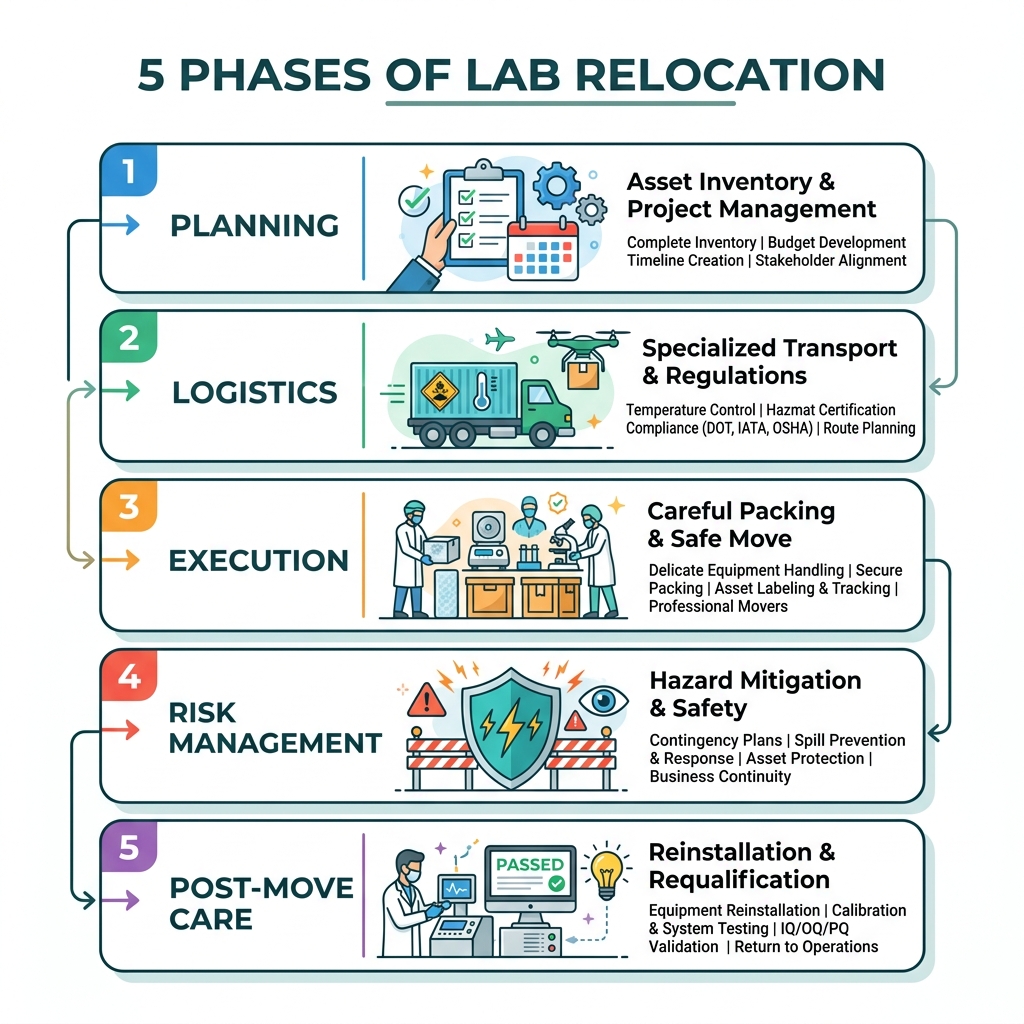
- Pre-move planning – Asset inventory, stakeholder alignment, and budget development
- Regulatory compliance – OSHA, DOT, IATA, and state-specific requirements
- Specialized transport – Temperature-controlled vehicles, cryogenic handling, and hazmat-certified logistics
- Reinstallation and requalification – IQ/OQ/PQ, calibration, and system testing
- Post-move support – Inventory integration, environmental monitoring, and return to operations
If you are planning a lab move, one thing is clear: this is not a job for a general moving company.
Laboratory moves are among the most complex logistical challenges a research facility will ever face. You are not just moving furniture and boxes. You are moving irreplaceable samples, regulated chemicals, high-value instruments, and years of accumulated research, all under strict compliance requirements.
The stakes are high. A poorly managed relocation can mean damaged equipment, failed audits, lost samples, and weeks of costly downtime. For facilities already managing hazardous materials, the risks can increase quickly. Guidance from agencies like the Occupational Safety and Health Administration and the U.S. Department of Transportation reinforces why specialized planning is essential for any laboratory transition.
The good news is that with the right partner and a structured process, a lab move can be completed safely, on schedule, and without disrupting your core work.
The Critical Role of Professional Laboratory Relocation Services
When it comes to moving a high-stakes environment like a biotech facility or a clinical research center, the typical moving model is not enough. Professional laboratory relocation services are essential because they bridge the gap between simple logistics and scientific continuity. General movers may handle office furniture well, but they rarely understand the vibration sensitivity of a mass spectrometer or the legal requirements for transporting volatile reagents across state lines in New England.
The primary goal of a professional service is to reduce downtime. In the scientific world, time is more than money; it can affect the progress of a clinical trial or the viability of a long-term study. Specialized teams are better equipped to relocate large volumes of assets across multiple labs while helping keep projects on schedule and within budget. That level of precision depends on training, documentation, and experience with regulated laboratory environments.
One of the biggest differentiators is asset safety. Professional lab movers use custom-built vehicles equipped with air-ride suspension and climate control to protect sensitive internal components. They also work toward a science-ready outcome, helping ensure that when an instrument arrives at its new home in Boston or Portland, it can be reinstalled, calibrated, and returned to service efficiently.
Before you start packing boxes, it is vital to understand the landscape. There are 5 Important Factors to Consider Before Moving Your Lab that can shape your timeline and risk profile. These include everything from infrastructure requirements at the new site to the specific needs of your most delicate instrumentation. Choosing a partner with proven laboratory experience can help reduce disruption and support a smoother start in the new space.
Navigating Challenges in Specialized Laboratory Relocation Services

Relocating a lab is a bit like performing surgery on a marathon runner while they are still running. Most facilities cannot simply shut down for a month. This creates a high-pressure environment where risk mitigation is the name of the game. Professional laboratory relocation services focus heavily on maintaining a strict chain of custody and adhering to Environmental Health and Safety (EH&S) protocols.
Contingency planning is another hallmark of a professional move. What happens if a blizzard hits while you’re moving samples between Manchester and Burlington? Specialized providers use 24/7 monitoring and have backup power sources, such as on-board generators and extra liquid nitrogen supplies, to ensure that even if the truck is delayed, the samples remain at the required temperature.
Overcoming Risks With Specialized Laboratory Relocation Services
The most significant risk in any lab move involves hazardous materials. Chemicals are not just “stuff” to be moved; they are regulated substances that require specific documentation and handling. This is where Planning a Laboratory Move: Safe Chemical Transportation becomes the foundation of your strategy.
A professional partner will provide comprehensive packing and transportation that adheres to OSHA standards and DOT special permits. This often involves a Chemical Lab Pack service, where chemists identify, categorize, and safely package chemicals for transport or disposal. This process ensures that incompatible chemicals are never stored together, preventing accidental reactions during transit.
Furthermore, for labs moving across state lines—such as from a facility in Springfield to a new site in Providence—compliance with IATA training for air shipments or DOT regulations for road transport is mandatory. Professional services handle the “paperwork headache,” ensuring that every manifest is accurate and every container is properly labeled.
Ensuring Cold Chain Integrity for Biological Samples
For many New England research hubs, the most valuable assets aren’t the machines, but the biological samples stored in freezers. Maintaining cold chain integrity is a non-negotiable requirement. Specialized logistics teams use custom trucks that can maintain environments ranging from ambient temperatures down to -190°C.
There are five things you need to know regarding lab relocation and sample safety, specifically the need for redundancy. This means using 24/7 alarmed temperature monitoring that is compliant with 21 CFR Part 11. If a freezer’s temperature fluctuates by even a few degrees, the system alerts the team immediately. Cryogenic transport and a constant supply of liquid nitrogen are essential for long-haul moves where vapor-phase or liquid-phase storage must be maintained to protect the “lifeblood” of the lab’s research.
A Step-by-Step Guide to the Relocation Process
A successful relocation does not happen on move day; it starts months earlier during the planning phase. The centerpiece of this process is the asset matrix. This is a comprehensive document that lists every piece of equipment, its power requirements, dimensions, sensitivity levels, and destination in the new facility.
Stakeholder alignment is equally critical. A dedicated project manager acts as the conductor for an orchestra of vendors, including Original Equipment Manufacturers (OEMs), IT specialists, and facility managers. They help ensure that electrical outlets are in the right place, utility connections are ready, and the loading dock is clear when the specialized trucks arrive.
One of the first decisions you will face is whether to choose a single-phase or multi-phase move.
| Feature | Single-Phase Move | Multi-Phase Move |
|---|---|---|
| Downtime | Higher (complete shutdown) | Lower (rolling transition) |
| Complexity | Lower logistics management | Higher logistics management |
| Cost | Generally more economical | Higher due to multiple trips |
| Research Continuity | Interrupted | Maintained |
| Best For | Smaller labs or new startups | Large pharma, clinical labs |
Effective communication and budget management are the glue that holds these phases together. A well-planned move can also create long-term efficiencies by giving teams a chance to reassess storage, decommission outdated equipment, and improve workflow in the new space.
Key Factors in Selecting Laboratory Relocation Services
When vetting laboratory relocation services, look beyond the price tag. You should evaluate consulting capabilities, project management strength, and experience with specialized environments. For instance, Cannabis Testing Lab Moves & Relocation require a strong understanding of state-specific rules that differ from standard clinical or academic lab moves.
Key selection criteria should include:
- Geographic coverage: Do they have a strong presence in New England? Moving through the narrow streets of Boston or the rural routes of Northern Maine requires local knowledge.
- Insurance requirements: Ensure the provider has appropriate liability coverage for scientific instruments and potential research loss.
- Experience levels: How many years have they been handling mission-critical labs? Look for a partner with substantial specialized experience.
- Vendor sourcing: Can they coordinate with your OEMs to help preserve warranties and support proper reinstallation?
Execution and Post-Move Requalification
The move is not over when the last box is unloaded. In fact, for many scientists, the next phase is the most important: getting equipment back online. This is where What You Need to Know About Lab Decommissioning and subsequent recommissioning come into play.
Professional services coordinate with OEM technicians to reinstall high-end systems. This includes:
- IQ/OQ/PQ: Installation Qualification, Operational Qualification, and Performance Qualification are essential for regulatory compliance, especially for FDA-regulated labs.
- Calibration: Ensuring that every scale, pipette, and sensor is accurate after the vibrations of transport.
- System testing: Running blanks, standards, or other verification checks to confirm that instrumentation is producing reliable data.
The goal of these post-move services is a fast return to science, minimizing the gap between the old facility closing and the new one producing results.
Frequently Asked Questions About Lab Relocation
How Much Does a Laboratory Relocation Cost?
While every move is unique, several factors influence the final budget. It is helpful to think of it as a customized service rather than a flat fee.
- Asset Volume: The number of instruments and freezers is the primary driver.
- Distance: Moving across town in Worcester is different than moving from Bangor to Concord.
- Specialized Handling: Do you have hazardous chemicals that require a lab pack? Do you have biological samples requiring -190°C transport?
- Insurance Premiums: High-value equipment requires specialized coverage.
Cost-Saving Tips:
- Decommission early: Don’t pay to move equipment you no longer use.
- Consolidate samples: Use the move as an opportunity to clean out freezers.
- Plan off-peak: If possible, avoid moving during peak seasonal times in New England.
- Accurate Inventory: A detailed asset matrix prevents “surprise” costs on move day.
How Do Services Differ for Biotech Versus Clinical Labs?
Different lab types have different “pain points.”
- Biotech Labs: Often focus on R&D, requiring the move of unique, one-of-a-kind prototypes and large volumes of diverse chemicals.
- Clinical Labs: Prioritize patient data and sample integrity. They often require 24/7 operation, making multi-phase moves essential.
- Academic Research: May involve moving entire vivariums (animal research facilities) or radioactive materials, which require very specific permits.
- Pharma Standards: These labs must adhere to the strictest GMP (Good Manufacturing Practice) and GLP (Good Laboratory Practice) standards, requiring exhaustive documentation during the move.
What Are the Biggest Risks of Using General Movers?
The “cheaper” option often ends up being the most expensive. General movers lack the training to handle biohazards or sensitive electronics.
- Equipment Damage: Standard moving blankets don’t protect a laser system’s internal alignment.
- Regulatory Fines: Transporting hazardous chemicals without the proper DOT permits can result in substantial state and federal fines.
- Lost Research: If a general mover unplugged a freezer to “make room,” decades of research could be destroyed in hours.
- Improper Packing: Using standard cardboard boxes for corrosive chemicals is a recipe for a hazardous spill.
Ready To Relocate Your Lab? Maine Labpack Is Here to Help
Successfully navigating a lab move requires more than just muscle; it requires a partner who speaks the language of science and understands the complexities of New England’s regulatory environment. Maine Labpack stands as a premier choice for facilities in Maine, New Hampshire, Massachusetts, Vermont, and Rhode Island that need a professional, on-time, and sustainable approach to managing their most challenging assets.
As a hazardous waste management expert, Maine Labpack acts as a one-stop shop, coming directly to your site to handle chemical lab packing and the disposal of unwanted materials. This ensures that your new facility starts with a clean slate, free of expired reagents or legacy waste. Whether you are a startup in a Portland incubator or a major research institution in Boston, professional laboratory relocation services ensure that your transition is “science-ready” from day one.
From ensuring OSHA compliance to providing more info about cannabis waste management, the right partnership allows you to focus on your breakthroughs while the experts handle the heavy lifting. Ready to plan your next lab move with confidence? Reach out to Maine Labpack today!