

The Truth About Mercury in Fluorescent Tubes
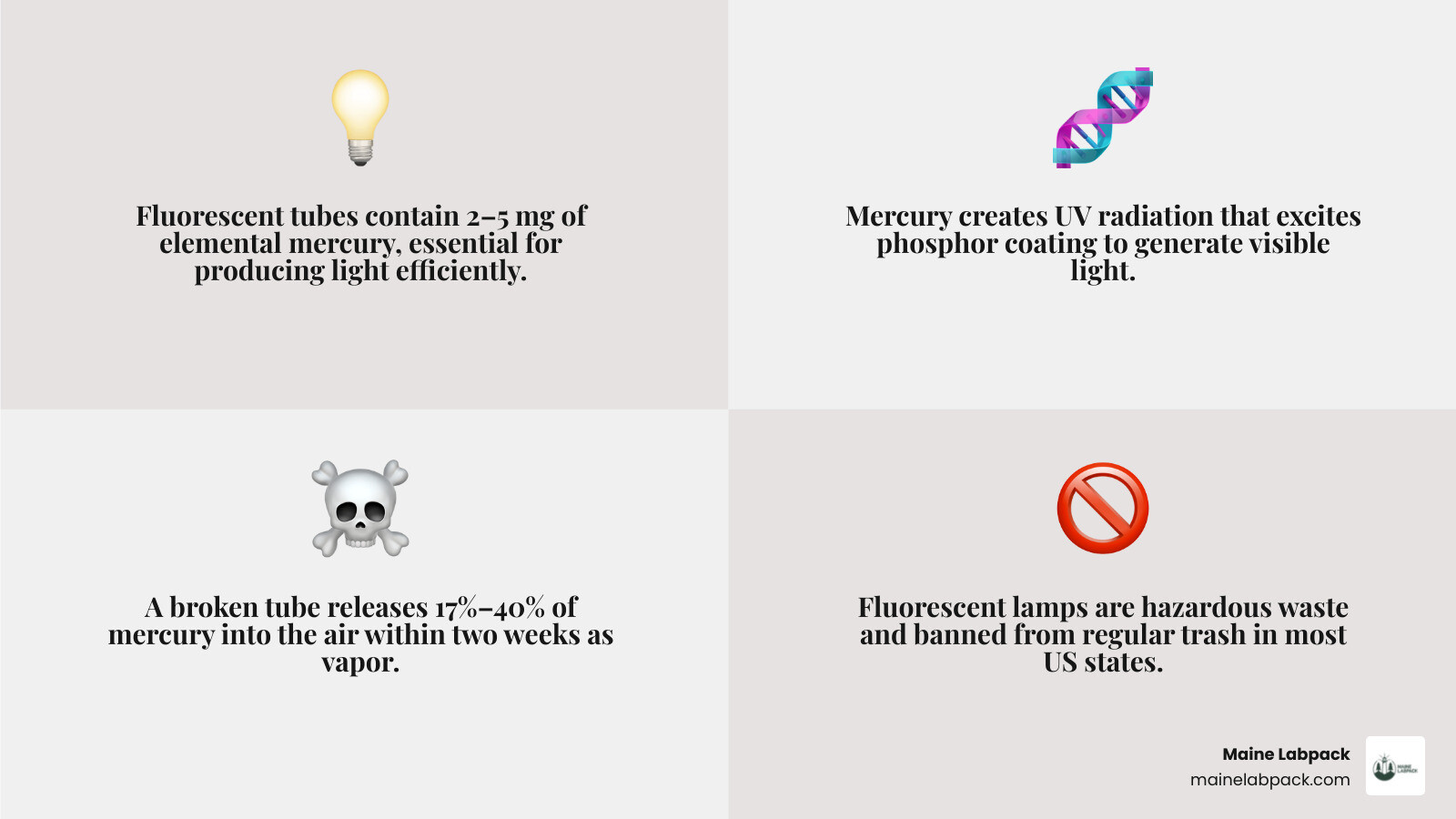
Do fluorescent tubes contain mercury? Yes. All fluorescent lighting, including linear tubes and compact fluorescent lamps (CFLs), contains elemental mercury.
Here’s what facility managers need to know:
| Type | Mercury Content |
|---|---|
| Common 4-ft tube (T8/T12) | ~2–5 mg |
| CFL under 25 watts | Up to 5 mg (NEMA cap) |
| CFL 25–40 watts | Up to 6 mg (NEMA cap) |
| Older or larger lamps | Up to 46 mg |
Key takeaways:
- Mercury is required for fluorescent lamps to produce light efficiently.
- Broken tubes can release mercury vapor and contaminated phosphor dust.
- Fluorescent lamps are hazardous or universal waste in many U.S. states.
- Improper disposal can create compliance risks and fines.
For facilities managing large numbers of fluorescent tubes, safe handling is both a safety and compliance issue. Contact Maine Labpack to keep your facility aligned with universal waste regulations.
Do Fluorescent Tubes Contain Mercury Today?
Yes. Modern fluorescent lamps still rely on elemental mercury to produce light efficiently. Manufacturers have reduced mercury levels over time, but fluorescent designs have not eliminated mercury without losing major light-producing efficiency.
Older T12 tubes could contain up to 46 milligrams of mercury. Today, many four-foot T8 tubes contain about 3 to 5 milligrams. That is far less than older lamps, but it is still enough to require careful management.
Because mercury remains present, fluorescent tubes are regulated under universal waste rules. Maine Labpack’s Universal Waste Guide for Lamps and Light Bulbs explains how businesses should store, label, transport, and recycle spent lamps across New England.
Why Mercury Is Essential For Fluorescent Lighting
Mercury plays a central role in how fluorescent tubes work. Inside the glass tube, a small amount of mercury exists as both liquid and vapor.
When the light turns on, electricity passes through the electrodes and excites mercury atoms. Those atoms emit ultraviolet (UV) radiation. A phosphor coating inside the glass absorbs that UV radiation and converts it into visible light.
| Bulb Type | Typical Mercury Content | Luminous Efficacy |
|---|---|---|
| Incandescent | 0 mg | 16 lm/W |
| Modern T8 Fluorescent | 3–5 mg | 80–100 lm/W |
| Modern CFL | 1–5 mg | 50–70 lm/W |
| High-Intensity Discharge (HID) | 20–250 mg | 60–120 lm/W |
This process makes fluorescent lighting efficient, but it also means every spent or broken tube must be handled as mercury-containing waste. Mercury-free fluorescent designs have been tested, but LEDs are now the more practical mercury-free alternative.
Health Risks and Proper Cleanup Procedures
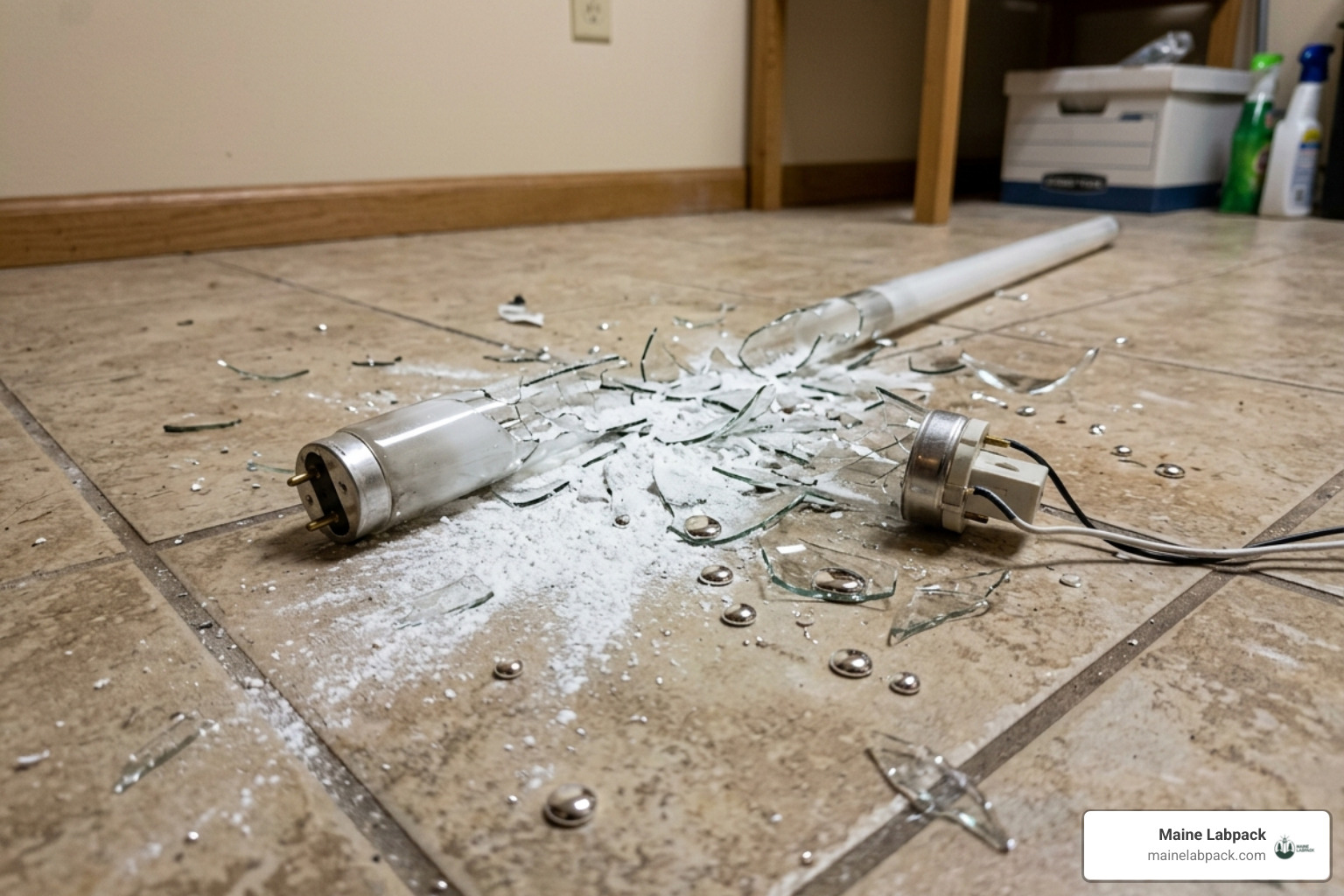
The main concern is not an intact bulb in the ceiling. The risk increases when a tube breaks and releases mercury vapor or contaminated phosphor powder.
Health Risks And Safety
Mercury is a neurotoxin that can affect the central nervous system and kidneys. A single modern bulb contains a small amount, but vapor exposure is highest right after a break, especially near the floor where children or pets may be closer to the release.
Short-term exposure can cause headaches, respiratory irritation, or dizziness. Chronic exposure is a bigger concern for workers in facilities where bulbs are frequently broken or mishandled. Maine Labpack’s Universal Waste Management Guide for Mercury outlines why controlled handling and exposure prevention matter.
Recommended Procedures For Cleaning Up A Broken Fluorescent Tube
Do not use a vacuum cleaner. It can spread mercury vapor and contaminated dust through the room. Instead:
- Ventilate: Open windows and doors, turn off central HVAC, and leave the area for at least 15 minutes.
- Gear Up: Wear gloves and safety glasses.
- Scoop, Don’t Sweep: Use stiff paper or cardboard to collect glass and powder.
- Tape The Rest: Use duct tape or packing tape for small fragments and dust.
- Wipe Down: Clean the area with a damp paper towel.
- Seal It: Place all cleanup waste in a glass jar or heavy-duty plastic bag.
In Maine and New Hampshire, state restrictions on mercury-containing fluorescent bulbs affect how these materials must be handled. Broken bulb waste should be labeled and managed as hazardous waste.
Environmental Impact and Disposal Regulations
Improperly discarded fluorescent tubes can break in landfills, allowing mercury to leach into groundwater or evaporate into the air. Mercury can also convert into methylmercury, which bioaccumulates in fish and moves through the food chain.
That is why fluorescent lamp recycling is more than a best practice. In many New England states, mercury-containing lamps are banned from regular trash and must be recycled through approved channels.
For businesses in Portland, Bangor, Lewiston, and across New England, Maine Labpack’s guide on how to dispose of fluorescent light bulbs explains the proper disposal process. Recycling separates the glass, aluminum end caps, and mercury-bearing phosphor powder so those materials can be managed safely.
Mercury-Free Alternatives
The simplest way to reduce mercury risk is to switch to LED lighting. LEDs are mercury-free and offer practical advantages:
- Energy Savings: LEDs use less electricity than fluorescent tubes.
- Longevity: Many LEDs last 50,000 hours or more.
- Durability: LEDs are less fragile than glass tubes.
- Lower Risk: No mercury vapor is released if an LED breaks.
During a lighting transition, spent fluorescent tubes still need proper recycling. Maine Labpack’s universal waste recycling services for light bulbs can help businesses manage that change safely.
Keep Your Facility Compliant With Safe Fluorescent Tube Disposal
Fluorescent tubes helped reduce energy use for decades, but their mercury content requires specialized handling, storage, and disposal.
Maine Labpack helps businesses throughout New England manage fluorescent lamps and other hazardous waste responsibly. From Portland and Bangor to Lewiston and Northern Maine, the team provides on-site waste management that keeps facilities safer and more compliant. Contact Maine Labpack today to schedule a pickup.
Frequently Asked Questions
How much mercury is in a standard four-foot tube?
A modern four-foot T8 tube typically contains 2 to 5 milligrams of elemental mercury. Even spent bulbs still contain mercury, so they must be recycled rather than thrown away.
Can I throw fluorescent bulbs in the regular trash?
No. In many New England states, businesses cannot dispose of mercury-containing bulbs in regular trash. Because they are universal waste, they should be collected and sent to a permitted recycling facility.
What are the symptoms of mercury exposure from a broken bulb?
The risk of acute poisoning from one broken bulb is low, but possible symptoms include headache, dizziness, or respiratory irritation. Following proper ventilation and cleanup steps helps reduce immediate exposure. For mercury-containing devices beyond lamps, Maine Labpack’s universal waste recycling services for mercury devices provide safe recycling support.