
Hazardous waste disposal is the regulated process of safely managing materials that pose risks to human health and the environment. Whether you’re a facility manager dealing with accumulated chemicals or a homeowner with old paint cans, understanding proper disposal methods helps protect your community and keep you compliant with federal and state regulations.
Quick Guide to Hazardous Waste Disposal:
- For Businesses: Determine your generator status (Very Small, Small, or Large Quantity Generator) based on monthly waste volume—this dictates storage limits and compliance requirements
- For Households: Use free local collection centers or special events; never pour hazardous materials down drains or throw them in regular trash
- Common Items: Motor oil, batteries, paints, cleaning chemicals, pesticides, electronics, and fluorescent bulbs all require special handling
- Professional Services: Licensed hazardous waste disposal companies handle pickup, characterization, transportation, and final disposal with full regulatory compliance
Since the mid-20th century, improper hazardous waste management has threatened groundwater supplies, contaminated soil, and endangered public health. The EPA’s Resource Conservation and Recovery Act (RCRA) established a “cradle-to-grave” tracking system to protect communities from these risks.
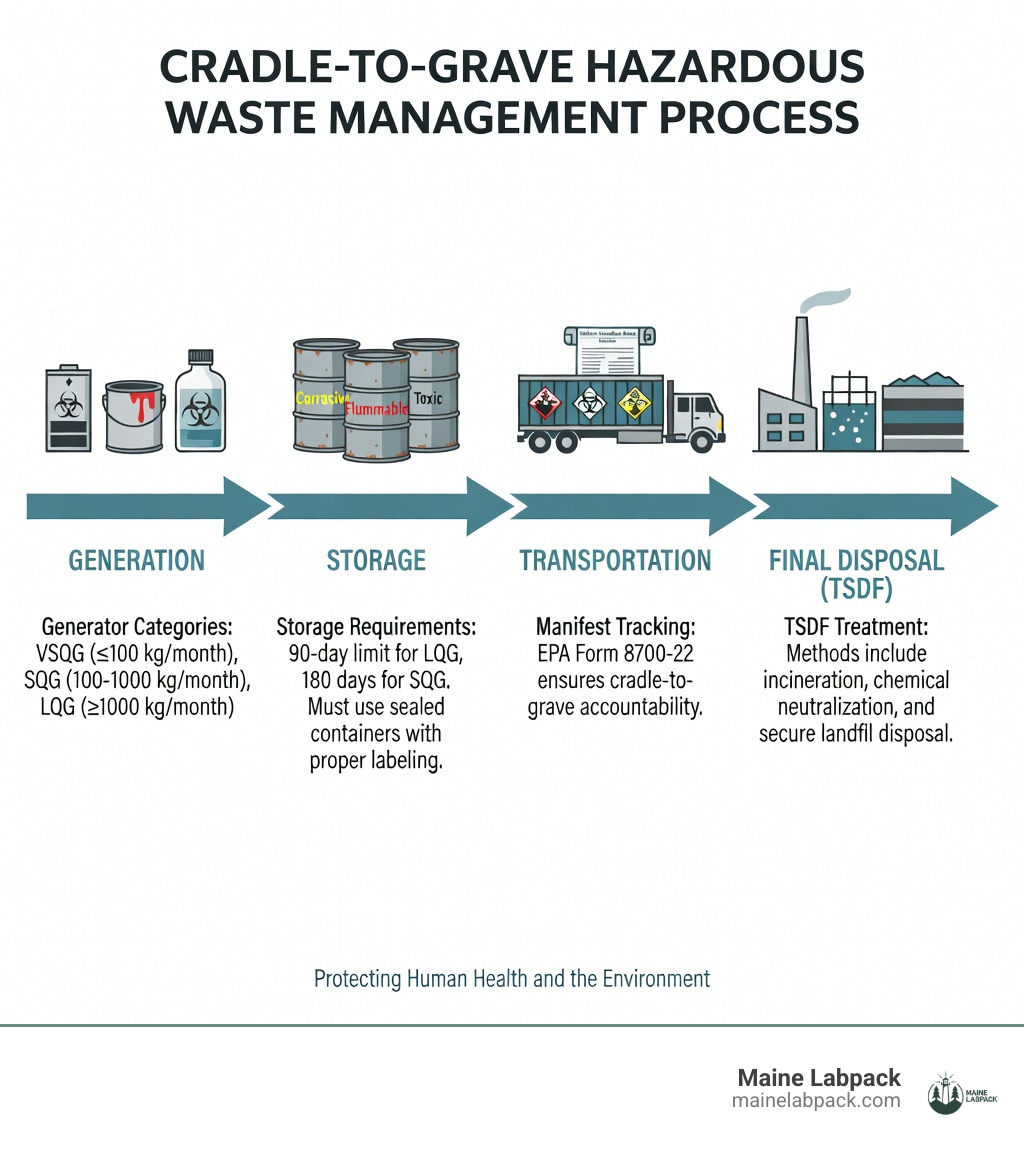
The stakes are high for businesses. Facilities that generate hazardous waste face strict limits on accumulation time, labeling requirements, and disposal documentation rules. A Large Quantity Generator producing 1,000 kilograms or more per month must ship waste within 90 days, maintain detailed manifests, and work only with permitted treatment, storage, and disposal facilities (TSDFs). Smaller generators have different thresholds but still face serious penalties for non-compliance.
For households, the challenge is simpler but equally important. Products labeled as toxic, flammable, corrosive, or reactive—from old batteries to leftover paint—need proper disposal through designated programs. As one California county program notes, while individual household waste may seem minor, “waste from millions of homes in the county leads to significant environmental concerns.”
Defining Hazardous Waste Under RCRA Regulations
To understand how to get rid of the “scary stuff,” we first have to know what it is. Under the eCFR: 40 CFR Part 260 framework, hazardous waste is a subcategory of “solid waste.” Interestingly, “solid waste” doesn’t actually have to be solid—it can be liquid, semi-solid, or even contained gas.
According to the EPA’s guidelines, a material is considered hazardous if it poses a threat to human health or the environment. The process of hazardous waste determination involves checking whether the waste is “listed” or exhibits specific “characteristics.”
Listed Wastes
The EPA has pre-defined certain wastes as hazardous because they consistently pose a threat. These are broken into four lists:
- F-list: Wastes from common industrial and manufacturing processes (non-specific sources).
- K-list: Wastes from specific industries, such as petroleum refining or pesticide manufacturing.
- P-list and U-list: Discarded commercial chemical products. The P-list is particularly grumpy—it contains acute hazardous waste, which is highly toxic even in small amounts.
Characteristic Wastes
If a waste isn’t on a list, it might still be hazardous if it shows one of these four “personality traits”:
- Ignitability: It catches fire easily (think gasoline or certain solvents).
- Corrosivity: It can eat through metal or skin (strong acids or bases).
- Reactivity: It’s unstable and might explode or release toxic gases when mixed with water or heated.
- Toxicity: It contains harmful chemicals that can leach into groundwater (like lead or mercury).
Managing Household Hazardous Waste Disposal
For many of us, hazardous waste disposal starts in the garage or under the kitchen sink. Household Hazardous Waste (HHW) includes leftover products that contain corrosive, toxic, ignitable, or reactive ingredients.
Common household items that require special care include:
- Paints and Solvents: Old latex or oil-based paints and thinners.
- Automotive Fluids: Used motor oil, antifreeze, and brake fluid.
- Electronics (E-Waste): Old TVs, tablets, cell phones, and computers.
- Garden Chemicals: Pesticides, herbicides, and fertilizers.
- Batteries and Bulbs: Lithium-ion batteries and fluorescent tubes.
Properly managing these items through universal waste recycling ensures that heavy metals and toxins don’t end up in our local New England ecosystem.

Local Collection Programs and Residency Requirements
In New England, residents have several options for safe disposal. Many municipalities in Maine, from Portland to Bangor, offer specific HHW collection days. For example, the Maine DEP provides resources to help homeowners find local drop-off sites.
In many regions, these programs are free for residents, though you usually need to provide proof of residency (such as a driver’s license or utility bill). Some areas, like Oceanside or Southern Nevada (for those reading from afar), have strict limits, such as a 5-gallon-per-day limit on motor oil or antifreeze. In New England, cities like South Portland and Lewiston often coordinate seasonal “clean-up” events where residents can bring everything from old car batteries to mercury thermometers.
If you are unable to transport your waste, some communities offer door-to-door pickup for seniors or residents with disabilities, though these often require an appointment system.
Environmental Risks of Improper Disposal
Why can’t you just toss that old bottle of weed killer in the bin? When hazardous waste is disposed of improperly—like being poured down a storm drain or tossed in the trash—it doesn’t just “disappear.”
- Groundwater Contamination: Chemicals can seep through the soil and enter the aquifers that provide our drinking water.
- Soil Pollution: Toxic residues can kill beneficial soil organisms and make land unsafe for gardening or play.
- Ecosystem Damage: Chemicals that reach our rivers and the Maine coastline can devastate fish populations and birds of prey.
Investing time in a proper collection program is an investment in your community’s health.
Business Compliance: Generator Categories and Storage Rules
If you run a business, the rules get a bit more technical. Your regulatory burden depends on how much waste you produce each month. The EPA and state agencies like the Maine DEP categorize businesses into three groups.
| Generator Category | Monthly Non-Acute Waste Limit | Monthly Acute Waste Limit |
|---|---|---|
| Very Small Quantity Generator (VSQG) | ≤ 100 kg (approx. 220 lbs) | ≤ 1 kg |
| Small Quantity Generator (SQG) | > 100 kg but < 1,000 kg | ≤ 1 kg |
| Large Quantity Generator (LQG) | ≥ 1,000 kg (approx. 2,200 lbs) | > 1 kg |
Generator status is critical because it determines how long you can keep waste on-site and what kind of paperwork you need to file. For example, an LQG generally cannot store waste for more than 90 days without a permit, while a VSQG has much more flexibility.
Best Practices for Business Hazardous Waste Disposal
To stay out of hot water with regulators, businesses must follow strict storage requirements. Here are the golden rules:
- Secondary Containment: Always store liquid hazardous waste so that, if the primary container leaks, a secondary tub or pallet will catch the spill.
- Proper Labeling: Every container must have a compliant hazardous waste label that clearly identifies the contents and the hazards (e.g., “Flammable”).
- Container Integrity: Keep containers closed unless you are adding or removing waste. No “open-top” buckets allowed!
- Avoid Common Mistakes: Some of the most common handling mistakes include failing to perform weekly inspections or mixing incompatible chemicals (which can lead to some very exciting, and very illegal, chemical reactions).
Regulatory Oversight and State Alignment
While the EPA sets the federal “floor” for regulations, states often have their own programs that are even more stringent. In our neck of the woods, the Maine Department of Environmental Protection (DEP) manages hazardous waste rules. These state programs are authorized by the EPA to enforce RCRA rules.
Regular facility inspections are a reality for many businesses. To avoid RCRA compliance violations, it is vital to keep your manifests organized and your staff trained. Here in New England, companies often turn to professional management firms to ensure they stay on the right side of the law.
Transportation, Universal Waste, and Facility Closure
Once your hazardous waste is ready to leave your site, the “cradle-to-grave” tracking system moves into the transportation phase.
The Manifest System
Every shipment of hazardous waste (except for some VSQG waste) must be accompanied by a Uniform Hazardous Waste Manifest. This document tracks the waste from the moment it leaves your door until it reaches a permitted Treatment, Storage, and Disposal Facility (TSDF). It’s like a passport for your trash.
Universal Waste Rules
To encourage recycling, the EPA created “Universal Waste” rules for common items. This category includes:
- Batteries: Lead-acid, lithium, and nickel-cadmium.
- Pesticides: Recalled or unused stocks.
- Mercury-containing lamps: Fluorescent bulbs and HID lamps.
- Aerosol cans: If they are still pressurized or contain hazardous product.
Managing these through universal waste recycling involves fewer regulatory hoops than traditional hazardous waste, provided you recycle them properly.
Facility Closure and TSDFs
Final disposal happens at highly regulated TSDFs. These facilities use advanced technologies like high-temperature incineration (which can destroy 99.9999% of hazardous constituents) or secure landfills. When a business stops using a hazardous waste storage area, they must follow specific “closure” steps to ensure no contamination is left behind.
Professional Solutions for Hazardous Waste Disposal
Managing chemicals can be overwhelming. This is where professional services come in. Whether you are a school lab in Worcester, a hospital in Boston, or a manufacturing plant in Portland, specialized services can simplify the process.
Lab Pack Services
Lab pack services are designed for facilities with many small containers of different chemicals. A professional team comes to your site, identifies the chemicals, categorizes them by compatibility, and packs them into larger drums with absorbent material. This is much safer than trying to pour them all into one big vat (please don’t do that!).
Specialized Waste Streams
Different industries have different needs:
- Healthcare Waste: Proper healthcare waste disposal includes managing pharmaceutical waste, sharps, and pathological waste.
- Cannabis Waste: As the industry grows in New England, cannabis waste management now involves disposing of solvent testing waste and microbiology waste.
- Radioactive Waste: Certain medical or industrial processes generate radioactive waste that requires specialized shielding and transport.
Specialized Chemical and Laboratory Waste Handling
One of the biggest headaches for facility managers is “unknown” chemicals—bottles with missing labels that have been sitting in the back of a cabinet for decades. Professional disposal companies specialize in “waste characterization,” using field testing to determine what the substance is so it can be handled safely.
When choosing a lab pack service company, look for providers that offer on-site collection and prioritize sustainable disposal methods, such as recycling or fuel blending, over simple landfilling.
Frequently Asked Questions about Hazardous Waste
What is the difference between listed and characteristic waste?
Listed waste is specifically named by the EPA in the RCRA regulations (like F-listed solvents). Characteristic waste is not specifically named but is hazardous because it is ignitable, corrosive, reactive, or toxic.
How long can a business store hazardous waste on-site?
It depends on your generator status. Large Quantity Generators (LQG) usually have 90 days. Small Quantity Generators (SQG) usually have 180 days (or 270 days if the waste is being shipped more than 200 miles). Very Small Quantity Generators (VSQG) generally do not have a time limit, provided they stay under total weight limits.
Where can I find free household hazardous waste drop-off locations?
Check your local city or town website. In Maine, the DEP website is a great starting point. Most New England cities host at least one or two HHW collection events per year.
Ready to Handle Hazardous Waste the Right Way?
Proper hazardous waste disposal isn’t just a legal requirement; it’s a vital part of being a good neighbor. From the smallest household battery to the largest industrial drum, every piece of waste managed correctly is a win for our local environment.
Maine Labpack serves as a dedicated partner for businesses across New England—from Manchester and Concord to Burlington and Boston. They specialize in professional, on-time, and sustainable chemical management, acting as a one-stop shop that comes directly to your site to handle the heavy lifting of compliance and disposal.
Ready to clear out those old chemicals and ensure your facility is RCRA-compliant? Request a Quote today and let the experts handle the “scary stuff” safely.