

Hazardous waste disposal in Maine requires safe handling by residents and businesses — here are the most important options at a glance:
Quick Answer: Where to Dispose of Hazardous Waste in Maine
| Type | Who It’s For | Where to Go |
|---|---|---|
| Household hazardous waste | Residents | Environmental Depot (Lewiston), Riverside Recycling (Portland), town collection events |
| Paint disposal | Residents | PaintCare.org drop-off locations statewide |
| Electronics and batteries | Residents and businesses | Retail take-back programs, municipal collection sites |
| Business/commercial hazardous waste | Businesses | Licensed hazardous waste disposal companies (EPA ID required) |
| Obsolete pesticides | Residents | Annual Maine Board of Pesticide Control collection events (pre-registration required) |
Think about your garage for a moment. Old paint cans. A half-empty jug of weed killer. Automotive fluids. Cleaning products you stopped using years ago.
Most Maine homes have a corner like that. And the problem is real: the average household generates more than 20 pounds of household hazardous waste per year, with up to 100 pounds quietly accumulating over time.
These materials can’t go in the regular trash. They can’t be poured down the drain. And leaving them to pile up creates safety and community risks — for your home, your community, and Maine’s water supply.
This guide covers what counts as hazardous waste, where to drop it off, how to handle it safely, and what Maine businesses must do to stay compliant.
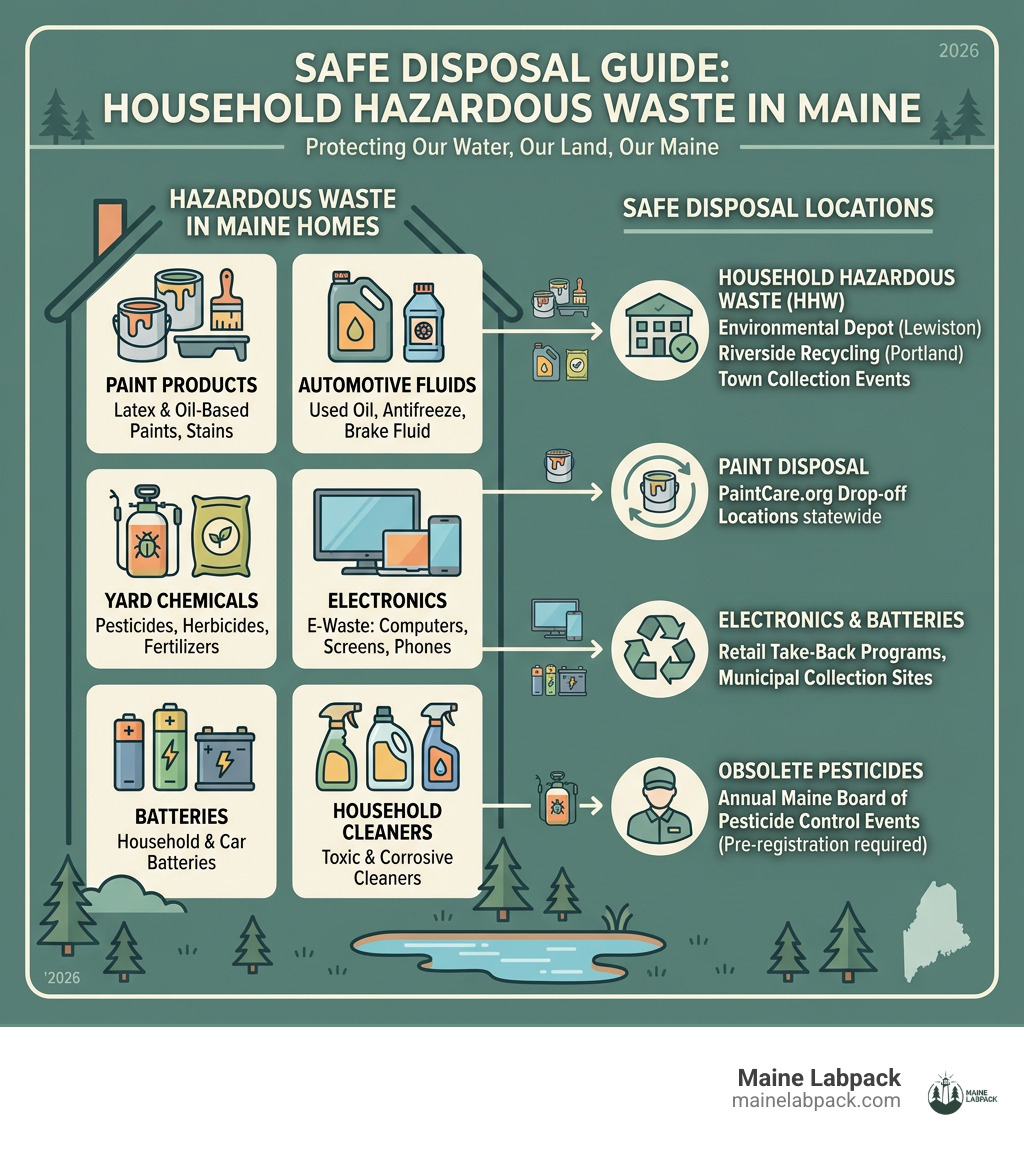
Household hazardous waste (HHW) refers to leftover products that contain ingredients that are toxic, corrosive, flammable, or reactive. In a typical Maine home, this includes everything from oven cleaners and drain openers to pool chemicals and lighter fluid. While these items are helpful when in use, they become a significant liability once they are ready for disposal.
Protecting Maine’s environment, particularly our groundwater and coastal ecosystems, is the primary reason for strict disposal laws. Because many Maine residents rely on private wells for drinking water, improper disposal poses a direct threat to public health. When hazardous materials are poured into septic systems or storm drains, they don’t just “disappear.” They seep into the soil, contaminate aquifers, and eventually reach our lakes and rivers.
It is strictly illegal in Maine to dispose of HHW in regular curbside trash. If these materials reach a landfill or incinerator that is not equipped to handle them, they can cause fires, chemical reactions, or the release of heavy metals such as mercury and lead into the air and water. Understanding the Toxic vs. Hazardous Waste: What’s the Difference? is the first step in recognizing why these items require specialized management.
Business Compliance and Hazardous Waste Disposal in Maine
For Maine businesses, the rules are more complex than they are for residents. Business waste is governed by the Maine Department of Environmental Protection (DEP) and the EPA under the Resource Conservation and Recovery Act (RCRA).
The first step for any business is to determine its generator status. How Generator Status Impacts Hazardous Waste Collection is based on the volume of waste produced per month:
- VSQG (Very Small Quantity Generator): Produces less than 220 lbs of hazardous waste per month.
- SQG (Small Quantity Generator): Produces between 220 and 2,200 lbs per month.
- LQG (Large Quantity Generator): Produces more than 2,200 lbs per month.
Businesses (except some VSQGs) must obtain an EPA ID number. This can be done by filing a Paper Notification of Regulated Waste Activity or using the electronic myRCRAid system.
Storage and Accumulation
Maine has specific Maine Hazardous Waste Storage Requirements regarding container types, secondary containment, and labeling. Most Maine facilities qualify for a 270-day accumulation extension (rather than the standard 180 days) because the state has very few treatment facilities, necessitating long-distance transport to out-of-state disposal sites.
Properly identifying your waste is critical. Everything You Need to Know About Hazardous Waste Labeling ensures that transporters and emergency responders know exactly what they are dealing with. Furthermore, all shipments must be tracked using the Uniform Hazardous Waste Manifest, which is now largely handled through the EPA’s e-Manifest system.
Industry-Specific Waste Streams and Emergency Reporting
Maine’s unique economy creates specific waste challenges.
- Pulp and Paper Mills: These facilities often deal with spent pulping liquors and boiler chemicals.
- Seafood Processing: Ammonia from refrigeration systems and heavy-duty cleaning agents are common.
- Agriculture and Cannabis: From potato farms in Aroostook County to the growing industry in Southern Maine, a Guide to Cannabis Waste Management in Maine is essential for staying compliant with pesticide and solvent disposal.
- Healthcare: Medical facilities must follow Maine Biohazardous Waste Guidelines & Recommendations to manage infectious materials safely.
If a spill occurs, it must be reported immediately to the Maine DEP Emergency Line at 1-800-482-0777. Keeping meticulous records is the best way to ensure you are Surviving a DEP Audit without facing significant civil penalties, which can reach up to $25,000 per violation per day.
Frequently Asked Questions About Hazardous Waste Disposal in Maine
How do I dispose of old pesticides and herbicides in Maine?
The Maine Board of Pesticide Control, in partnership with the DEP, hosts an annual Obsolete Pesticide collection every October. These events take place in Presque Isle, Bangor, Augusta, and Portland. You must pre-register by late September to participate; drop-ins are generally not accepted. If you miss the event, contact the Board of Pesticide Control for guidance on safe interim storage.
What is the difference between hazardous waste and universal waste?
Universal waste is a sub-category of hazardous waste that is very common and widely generated. This includes items like Universal Waste Guide: Electronics (CRTs, monitors), certain batteries, and lamps. These items contain heavy metals like mercury or lead but are often discarded by the public without realizing the danger. A Guide to Mercury Waste Recycling & Disposal is particularly important in Maine, as mercury-added products (like old thermostats or PCB ballasts) are strictly regulated to prevent them from entering the environment.
How can I find local disposal options for specific items?
For items not covered in this guide, Maine residents have several digital tools at their disposal:
- ecomaine Recyclopedia: A searchable database for hundreds of household items.
- Earth911: A national database that allows you to search by zip code for specific materials.
- Municipal Websites: Many Maine towns have specific “Transfer Station” pages that list hours and fees.
- Town Office: When in doubt, call your local town office. They can provide the most up-to-date information on upcoming local collection days.
Ready to Dispose of Hazardous Waste the Right Way?
Managing hazardous waste disposal in Maine is a shared responsibility. Whether you are a homeowner clearing out a basement in Bangor or a facility manager at a paper mill in Skowhegan, following these regulations protects the “Way Life Should Be.” Improper disposal isn’t just a legal risk — it’s a threat to the clean water and natural beauty that make Maine unique.
Maine Labpack provides professional, sustainable hazardous waste management solutions across New England. From South Portland to Aroostook County, they offer a one-stop-shop approach, coming directly to your site to handle chemical packing, lab packs, and complex waste streams with total DEP compliance.
Ready to handle your hazardous waste the right way? Get in touch with Maine Labpack to schedule a pickup and ensure your materials are managed safely, on time, and in full compliance with state and federal regulations.